

Hormonal Acne Treatment: Causes, Types, and What Actually Works

Table of Contents
Written & Medically Reviewed by
- Medical Doctor, Chulalongkorn University — Second Class Honors
- Dermatology (International Program), Chulabhorn International College of Medicine, Thammasat University
- 3 Years Experience in Aesthetic Medicine
Hormonal acne is not ordinary breakouts arriving late. It sits deeper, follows your cycle, and shrugs off the products that clear teenage spots.
This guide explains what actually drives it, which in-clinic treatments have evidence behind them, and — just as importantly — which ones we deliberately leave out.
Key Takeaways
Hormonal acne is androgen-driven, so it settles along the jawline and chin and resists over-the-counter products. In-clinic programmes at Edition Clinic start from 3,999 THB and target inflammation and scarring rather than the hormones themselves. Prescription medication from a dermatologist still carries the strongest evidence base.
What Is Hormonal Acne and How Is It Different?
Hormonal acne is acne driven by androgens that overstimulate the sebaceous glands into producing excess oil. Unlike teenage breakouts, it concentrates along the jawline, chin and lower cheeks, appears in adults well past their twenties, and produces deep painful nodules rather than surface pimples.
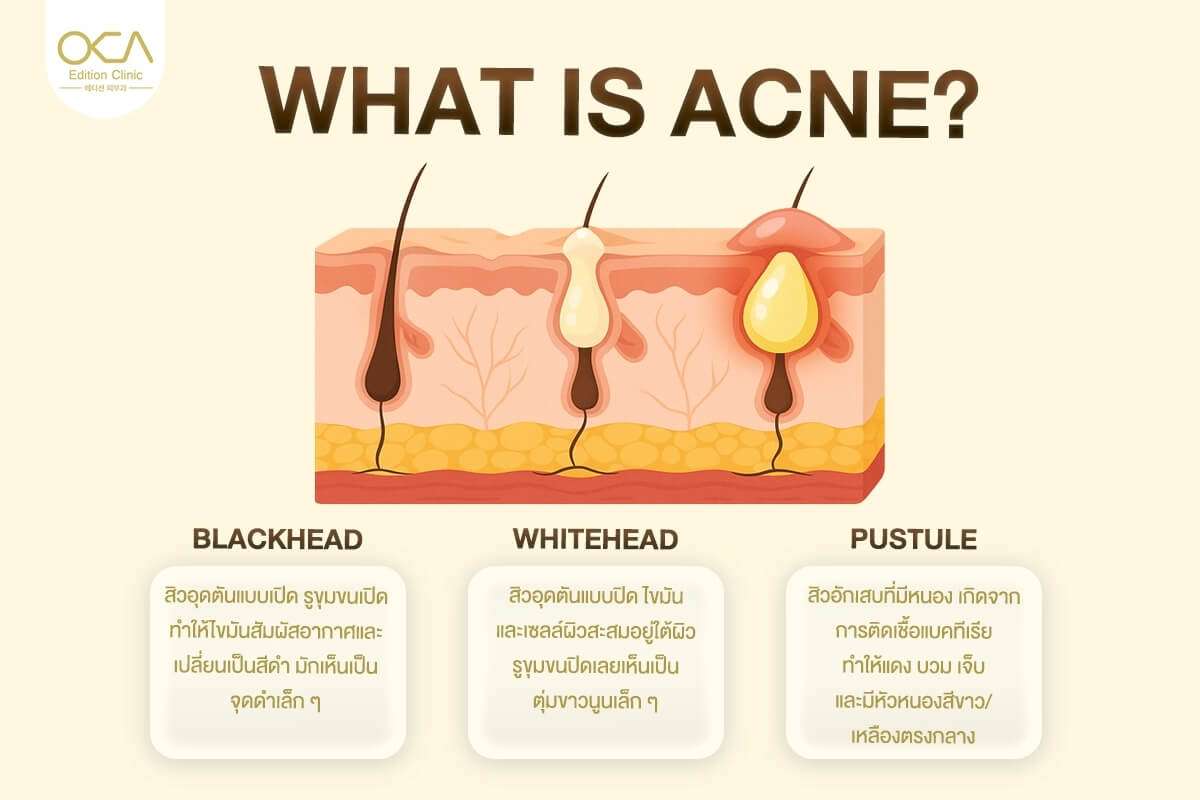
That distinction decides which treatments can work. Surface products act on the outer skin, while hormonal acne begins at the level of the oil gland itself.
How to Tell If Your Acne Is Hormonal
Five features separate hormonal acne from bacterial or fungal breakouts.
- Location: jawline, chin and lower cheeks, where oil glands carry the most androgen receptors
- Depth: painful nodules and cysts rather than whiteheads or blackheads
- Timing: flares 7–10 days before menstruation, or during stretches of high stress
- Resistance: little response to benzoyl peroxide, salicylic acid or standard shop-bought products
- Age: common in adults in their twenties to forties, not only in teenagers
Hormonal Acne vs Bacterial and Fungal Acne
Bacterial acne shows up as inflamed pustules spread across the forehead, nose and cheeks, and responds well to antibacterial treatment.
Fungal acne produces uniform itchy bumps on the chest, back and forehead. It needs antifungal treatment and will not respond to acne products.
Hormonal acne is identified by its jawline position, its cyclical timing and its depth — which is why it needs treatment that reaches the gland.
What Causes Hormonal Acne?
Hormonal acne follows a chain. Androgens stimulate the sebaceous glands, excess sebum mixes with dead skin cells and blocks the follicle, and Cutibacterium acnes multiplies inside it. The trigger is internal, which is why the inflammation keeps returning on a cycle.
Internal Triggers You Cannot Fully Control
These are the drivers that sit behind the skin rather than on it.
- Menstrual cycle: progesterone rises before menstruation and lifts oil production, which is why breakouts often arrive 7–10 days beforehand
- PCOS: raised androgen levels produce persistent and often severe hormonal acne
- Pregnancy and menopause: large hormonal shifts can start new acne or worsen existing breakouts
- Genetics: inherited gland sensitivity means the same hormone level produces more oil
- Testosterone therapy: raises sebum output in both men and women
External Factors That Make It Worse
These will not cause hormonal acne on their own, but they reliably amplify it.
- Stress: cortisol stimulates sebaceous glands directly and amplifies inflammation
- Sleep loss: disrupts hormone regulation and slows overnight skin repair
- High-glycaemic diet: sugar and refined carbohydrates raise insulin, which can increase androgen activity
- Dairy: linked to acne severity in some people, though the evidence remains inconsistent
- Climate: Bangkok's heat and humidity raise sweat and oil output year-round
Why Over-the-Counter Products Are Not Enough
Benzoyl peroxide and salicylic acid act on the skin surface, clearing bacteria and loosening dead cells. They work well for superficial acne.
No topical product can change hormone levels or switch off an overactive oil gland from outside. That gap is what in-clinic treatment fills.
Why Should You Treat Hormonal Acne Early?
The goal of in-clinic treatment is not to stop breakouts permanently. It is to stop each one leaving a scar. Because hormonal acne recurs in cycles, every untreated inflammatory episode damages collagen, and once a scar forms it is permanent.
Deep nodules and cysts carry the highest scarring risk of any acne type, and they are exactly what hormonal acne produces.
That is why timing matters more than intensity here. Reducing the inflammatory load early is worth more than a stronger treatment later.
⚠️ Why Deep Lesions Are Different
A surface pimple heals within the epidermis. A nodule or cyst destroys tissue in the dermis, and the dermis repairs with fibrous scar rather than original structure. That is why picking or squeezing a jawline lesion causes damage a whitehead never would.
What Scarring Costs You Later
Treating active acne is non-invasive and comparatively inexpensive. Treating the scars afterwards is neither.
Scar correction runs 9,000–17,900 THB per session and typically needs three to six sessions, which is set out on our acne scar treatment page.
Not Sure Whether Your Acne Is Hormonal?
A free 1:1 assessment identifies your acne type, your triggers and whether you need in-clinic treatment, medication, or both. No pressure and no hidden fees.
💬 Get a Free Consultation800+ reviews across Google & GoWabi · 6,700+ patients treated
In-Clinic Treatment or Prescription Medication: Which Do You Need?
For hormonal acne, prescription medication has the stronger evidence base and in-clinic treatment has the faster effect on visible inflammation. Edition Clinic does not prescribe medication — our programmes work on the skin itself, and we refer patients who need hormonal therapy.
According to a 2025 meta-analysis of five randomised placebo-controlled trials covering 563 women, oral spironolactone produced substantially higher odds of acne improvement than placebo.
Combined oral contraceptives carry similar weight in current dermatology guidance, and oral isotretinoin remains the standard for severe nodular and scarring acne.
All three need a dermatologist or gynaecologist, ongoing monitoring, and in some cases contraception planning. We do not offer them, and we say so before you book.
| Factor | Prescription Medication | In-Clinic Treatment |
|---|---|---|
| What it targets | Hormone signalling and follicular turnover, from the inside | Inflammation, oil output and scar risk, at the skin |
| Strength of evidence | Strongest — multiple randomised trials and meta-analyses | Moderate — device studies, mostly small and short-term |
| Who provides it | Dermatologist or gynaecologist | Planned by Dr. Mild, performed by our medical team |
| Time to visible change | Usually 8–12 weeks, sometimes with an initial flare | Redness and swelling often settle within 2–4 weeks |
| Main limitation | Systemic side effects, monitoring, unsuitable in pregnancy | Does not change hormone levels, so breakouts still recur |
| Pigmentation risk in deeper skin | Low, though some agents increase sun sensitivity | Device-dependent — we lead with 1064nm for this reason |
| Role in preventing scars | Indirect, by reducing how many lesions form | Direct, by shortening how long each lesion stays inflamed |
| Available at Edition Clinic | No — we refer you to a prescribing specialist | Yes, from 3,999 THB per programme session |
Most patients sit between the two columns: already on a topical prescription, still breaking out, and worried about the marks.
In that situation the two approaches are not rivals. Medication lowers how many lesions form, and in-clinic treatment shortens how long each one stays inflamed.
Results may vary depending on which hormonal driver is involved, and on whether an underlying condition such as PCOS has been diagnosed.
What In-Clinic Treatments Work for Hormonal Acne?
Our hormonal acne programmes are built on two devices that appear in every session: LDM dual-frequency ultrasound for inflammation, and a 1064nm Nd:YAG laser for oil glands and bacteria. The devices carry the evidence; the ampoules layered on top are optional.
That ordering is deliberate. The platform carries the clinical evidence, and the add-ons adjust the programme to your skin.
1064nm Nd:YAG Laser — The Evidence Anchor ⭐
The 1064nm Nd:YAG wavelength is FDA-cleared for mild-to-moderate inflammatory acne. It reaches deep enough to heat sebaceous glands while passing largely through surface pigment.
That second property is why it leads our protocol. For Fitzpatrick III–V skin, which describes most patients in Bangkok, the wavelength with the lowest pigmentation risk matters more than the strongest one.
Best for active inflammatory breakouts, oily skin and deeper skin tones. A standalone whole-face session is 2,500 THB, and the same laser is built into every programme.
LDM Dual-Frequency Ultrasound — Calming the Cycle
LDM applies rapidly alternating ultrasound frequencies to the epidermis and dermis without heat. The aim is to dampen inflammatory signalling rather than destroy tissue.
According to a 2025 retrospective study in the Journal of Cosmetic Dermatology, 22 patients with mild-to-severe acne treated with triple-frequency LDM improved by a mean 73.69% on acne grading by the final session.
Improvement continued after treatment stopped, reaching 90.14% at follow-up, with no significant side effects reported.
That study was retrospective, unblinded, and part-funded by the device manufacturer whose chief executive is a listed author. The direction is credible, but treat the size of the effect with caution.
Gold PTT, Ampoules, and What We Leave Out
On top of the laser and ultrasound platform sit two optional additions and two deliberate omissions. The additions adjust a programme to your skin type. The omissions exist because the evidence does not match hormonal acne, not because we lack the equipment.
Gold PTT — Gold Microparticles With the Same Laser

Gold PTT applies gold microparticles to the skin, drives them into the follicle with ultrasound, then activates them with the same 1064nm laser to concentrate heat at the oil gland.
Published human data for this specific combination is thin — small case series rather than controlled trials. We present it as an enhancement to the laser, not as a separate proven treatment.
Best for oily, persistently inflamed skin that has not settled with laser sessions alone. The programme is 6,999 THB, typically three sessions at two-week intervals.
Rejucell — Topical Ampoules Delivered by LDM
Rejucell is a topical ampoule applied to the skin and driven in during the LDM step. The PN version uses polynucleotide; the R version combines hyaluronic acid, amino acids, vitamins and minerals.
It is a cosmetic ampoule rather than an injectable, so we describe it as barrier and comfort support rather than acne treatment. Programmes run 3,999–5,999 THB.
What We Do Not Use for Hormonal Acne
Two treatments we own are deliberately absent from this list, and the reasons matter more than the omissions.
Skin botox does reduce sebum in published studies, but those studies used mild-to-moderate acne on the cheeks — not the deep jawline lesions that define hormonal acne.
Microneedling improves texture, but needling across actively inflamed nodules risks spreading inflammation. It belongs in the scar phase instead.
Both remain available at our clinic for the indications they actually fit. You can see the full device list on our laser and equipment page.
Dr. Mild: "I tell every hormonal acne patient the same thing at the first visit. We are not going to stop your hormones. What we can do is keep each flare from turning into a scar, and that is the goal we should be measuring."
How Does Treatment Work at Edition Clinic?
Every acne session follows the same four-step structure and takes about 60 minutes. Diagnosis and planning are handled by Dr. Natcha Prachayakul, and the session itself is performed by a physician, a registered nurse or a senior therapist, always under medical supervision.
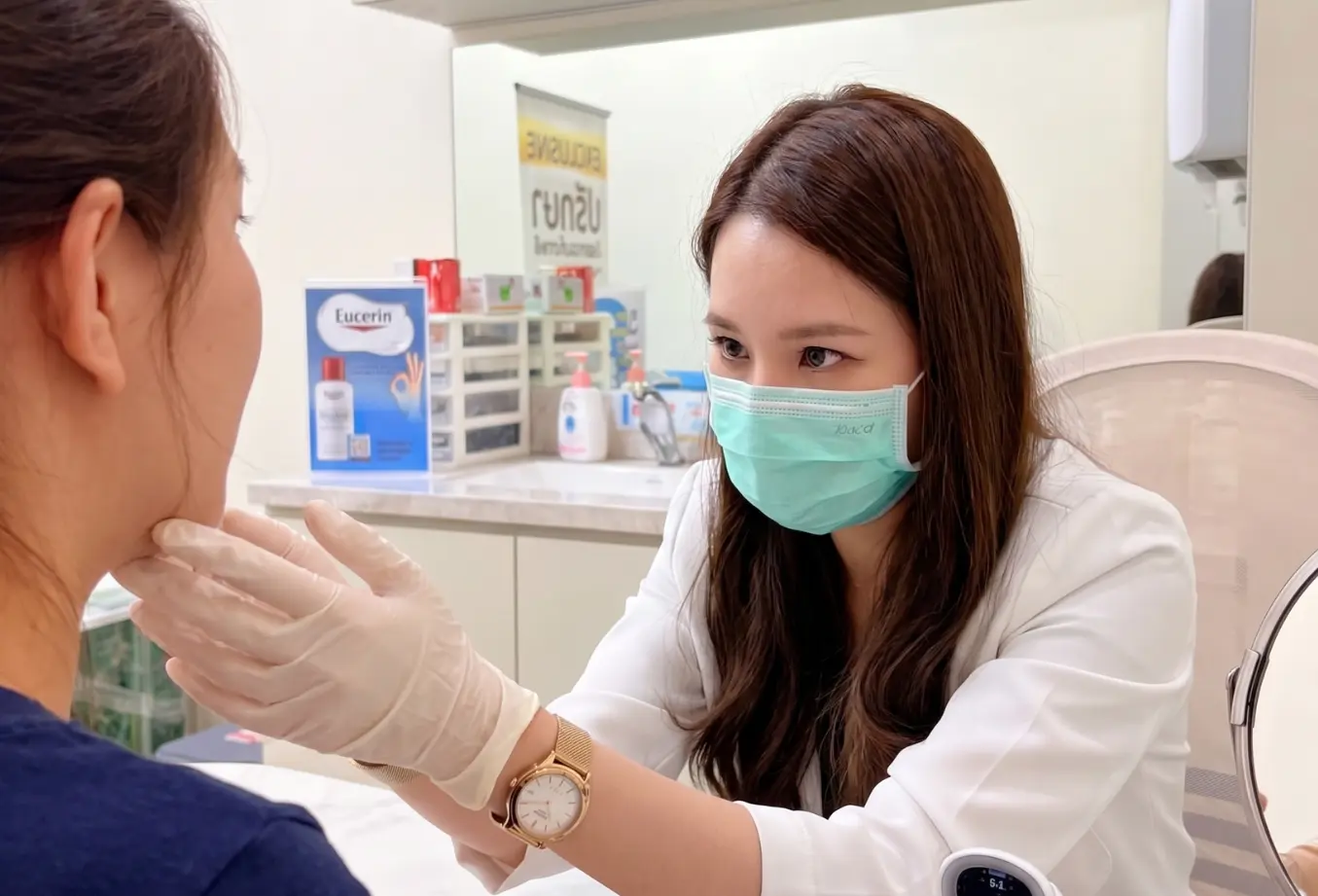
Step 1 — Assessment and Planning (10 minutes)
We record your acne type, oil levels, barrier condition and where you are in your cycle. Hormonal skin changes between visits, so the plan is re-checked each time.
Step 2 — Cleansing and Preparation (10 minutes)
Deep cleansing removes surface oil so the laser and ultrasound couple properly with the skin. Numbing cream is used only when the selected settings call for it.
Step 3 — Laser and Device Work (about 30 minutes)
The 1064nm laser pass comes first, followed by any programme-specific step such as gold microparticle application. Settings are adjusted live rather than fixed to a fixed protocol.
Step 4 — LDM Calming and Aftercare
The session closes with LDM to reduce redness and shorten recovery. You leave with written aftercare and a provisional date for the next visit.
What a Full Course Looks Like
Most hormonal acne patients move through three phases rather than a fixed number of visits.
- Calming phase (1–2 sessions): bring down active inflammation and stop new deep lesions forming
- Stabilising phase (2–4 sessions): fewer breakouts per cycle and a visibly stronger barrier
- Maintenance phase (every 4–8 weeks): hold results through hormonal fluctuation
- Review point: if breakouts persist through a full course, we refer you for hormonal assessment rather than adding sessions
- Scar phase (optional): begins only once active acne is controlled
💡 How We Plan Treatment
We recommend the smallest plan likely to work, tell you when a different treatment or a different clinician would suit you better, and confirm each step with you before starting. All treatments are carried out by licensed medical professionals.
What Results Can You Expect?
Improvement is progressive rather than immediate. Most patients see calmer inflammation within two to four weeks, fewer new lesions by week six, and a clear reduction in breakout frequency at three months, with maintenance every four to eight weeks after that.
Here is what a typical timeline looks like in practice.
- Weeks 1–2: less redness and tenderness in existing lesions; the skin feels calmer before it looks clearer
- Weeks 4–6: fewer new lesions per cycle and noticeably less oil through the day
- Month 3: breakouts are smaller and shorter-lived, and post-acne marks begin to fade
- Month 6: a stable pattern, maintained with sessions rather than rebuilt from scratch
- Ongoing: flares still happen around your cycle, but they resolve faster and mark less
Results during the stabilising phase often fluctuate with your cycle. That is expected and does not mean the programme is failing.
Results may vary with acne severity, skin type, medication use and how consistently sessions are attended.
Dr. Mild: "The mistake I see most often is a patient asking for scar treatment while the acne is still active. If we resurface skin that is still inflamed, we are working against ourselves. Stabilise first, then repair."
Want an Honest Read on Your Skin?
Our team will tell you straight whether in-clinic treatment is the right next step, or whether you would get more from seeing a prescribing dermatologist first. No upselling and no unnecessary add-ons.
💬 Message Us on WhatsAppAll treatments performed by licensed medical professionals
Is Hormonal Acne Treatment Safe?
Side effects across these programmes are mild and short-lived: warmth during treatment, redness for a few hours, occasionally one day of sensitivity. All sessions are performed by licensed medical professionals using single-use applicators, at settings recorded for each patient and reviewed before the next visit.
What to Expect Afterwards
Recovery is usually a matter of hours rather than days.
- Mild redness for a few hours, occasionally into the following day
- Warmth or light tingling during the laser pass, settling immediately afterwards
- Makeup can generally go back on after four to six hours
- Normal activity, work and exercise can resume the same day
- Existing lesions may look more defined for a day before improving
Aftercare That Actually Changes the Outcome
Two of these matter far more than the rest in Bangkok's climate.
- Daily SPF 30 or higher — the single biggest factor in whether marks fade or darken
- Gentle, non-comedogenic cleansing while the skin settles
- No retinol, AHA or BHA for three to five days after a session
- No picking or squeezing, which converts a healing lesion into a scar
- Keep hydrated and skip alcohol for 24 hours
Tell Us Before You Book If Any of These Apply
Some situations change the plan or delay treatment entirely.
- You are taking oral isotretinoin, or stopped within the last six months
- You are pregnant, breastfeeding or trying to conceive
- You have a history of keloid scarring
- You have an active skin infection, including cold sores
- You have had a recent peel, laser or injectable treatment elsewhere
Safety commitment: All devices are operated at documented settings, all applicators are single-use, and every treatment plan is reviewed by a licensed doctor before the first session.
How Much Does Hormonal Acne Treatment Cost in Bangkok?
Hormonal acne treatment in Bangkok at Edition Clinic runs from 3,999 THB to 6,999 THB per programme session, with a standalone 1064nm laser session at 2,500 THB. Every programme price already includes the LDM and laser steps, so nothing is billed as a separate add-on.

The entry programme pairs a Rejucell ampoule with LDM at 3,999 THB. The full oil-control programme, Gold PTT with LDM and laser, is 6,999 THB.
Between them sit the barrier-focused programmes at 5,999 THB, which suit skin already irritated by strong topicals.
Every quote is given before treatment begins, and nothing is added during a session without asking you first.
For the complete programme list and current pricing, see our acne treatment programmes page.
💡 Why Treating Now Costs Less
A stabilising course of three to five sessions sits in the 12,000–35,000 THB range. Scar correction afterwards starts at 9,000 THB per session and usually needs three to six of them, on skin that has already lost structure. The cheaper path is the earlier one.
Ready to Start Treating Your Hormonal Acne?
Programmes from 3,999 THB at our Thonglor clinic, near BTS Thong Lo. Korean-standard protocols, a clear quote up front, and a free 1:1 consultation included.
📅 Book Your Appointment800+ reviews across Google & GoWabi · 6,700+ patients treated
Already Have Acne Scars? What Comes Next
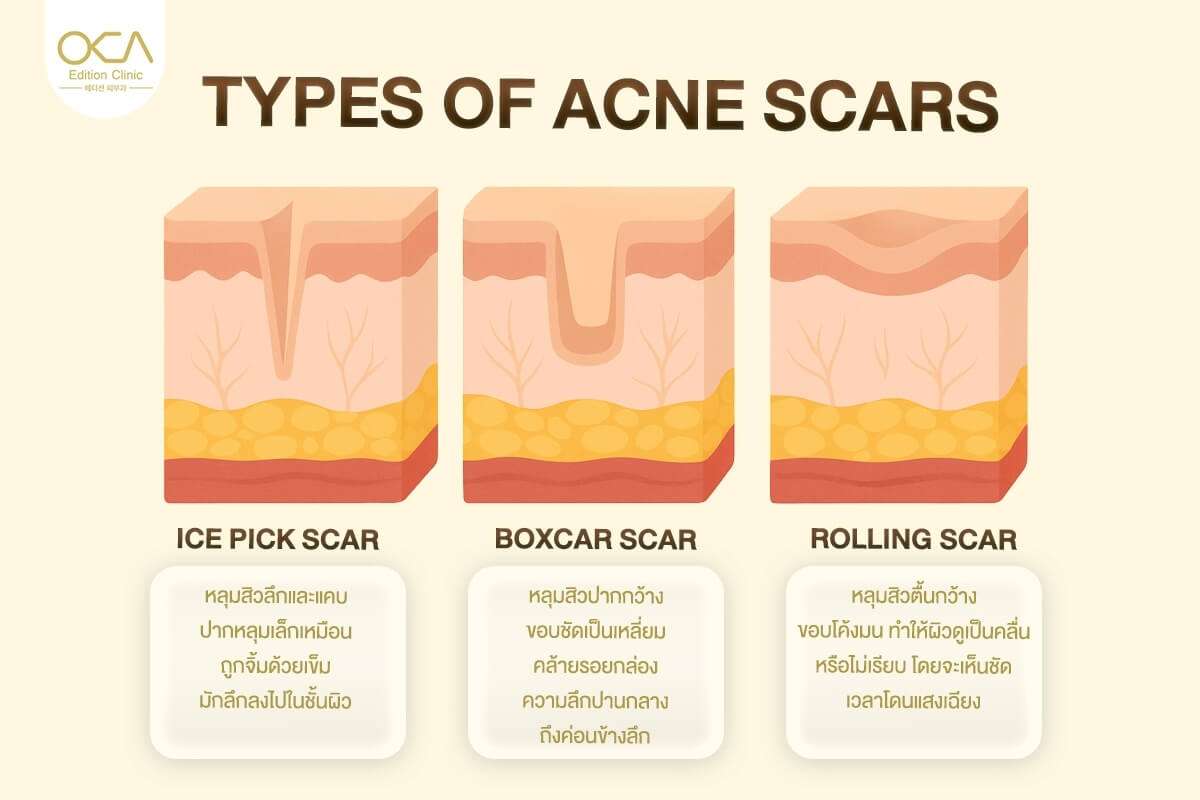
Scar treatment is a separate phase that begins once active breakouts are controlled. Edition Clinic uses RF microneedling with Potenza, Subcision for tethered scars, and polynucleotide injectables, all performed by a doctor in a dedicated session rather than inside a standard acne programme.
Why RF Microneedling Leads for Deeper Skin Tones
According to a randomised split-face trial of 30 patients, RF microneedling and fractional CO2 laser improved atrophic acne scars to a similar degree over three sessions.
Mean scar scores fell from 54.73 to 30.53 with RF microneedling and from 53.67 to 31.03 with the CO2 laser, with no significant difference between them.
The difference showed up in recovery instead. The RF side healed faster and produced fewer pigmentary events, which is the outcome that matters most in Fitzpatrick III–V skin.
A separate pilot study in Fitzpatrick IV–VI skin reported improvement in both scarring and post-inflammatory pigmentation after three sessions, though with only six completers.
Subcision for Tethered Rolling Scars
Some scars are held down by fibrous bands beneath the surface. No amount of resurfacing lifts them, because the problem is tethering rather than texture.
Subcision releases those bands with a fine instrument and is priced at 10,000 THB. It is frequently combined with RF microneedling in the same course.
Polynucleotide Injectables
Polynucleotide preparations such as Rejuran are injected to support dermal repair, and they have controlled trial evidence in moderate to severe acne scarring.
Results may vary by scar type, and ice-pick scars respond least well to any of these approaches.
A device-by-device comparison is set out in our guide to Potenza versus Morpheus8 RF microneedling, and full pricing sits on the acne scar page.
Dr. Mild: "Most of my patients here have deeper skin tones, so the question I ask is not which device is strongest. It is which one leaves the least pigmentation behind. That single question changes the order of the whole treatment plan."
Clinic-wide patient count: 6,717 unique patients treated from 7 August 2023 to 1 October 2026, excluding repeat visits. This is not a treatment-specific count.
Frequently Asked Questions About Hormonal Acne Treatment
1. Where on the face does hormonal acne usually appear?
Answer: Hormonal acne concentrates along the jawline, chin and lower cheeks, because the oil glands in those areas carry the highest density of androgen receptors. Forehead and nose breakouts are more often bacterial or product-related, which is why location is the first thing we assess.
2. Can in-clinic treatment cure hormonal acne permanently?
Answer: No. In-clinic treatment controls oil, inflammation and scarring, but it does not change the hormone levels driving the cycle. Breakouts can still occur, and maintenance sessions every four to eight weeks are what keep them smaller, shorter-lived and far less likely to scar.
Long-term hormonal control needs a prescribing specialist, which we do not provide.
3. Does laser treatment work for hormonal acne?
Answer: Yes, within limits. The 1064nm Nd:YAG wavelength is FDA-cleared for mild-to-moderate inflammatory acne and reduces both oil production and inflammation. It cannot alter hormone levels, so it manages the consequences of those hormones rather than the hormones themselves, which is why laser alone rarely ends the cycle.
4. Is 1064nm laser safe for darker skin tones?
Answer: It is the safer choice among acne lasers for Fitzpatrick III–V skin, because the longer wavelength passes largely through surface melanin instead of being absorbed by it. That lowers, though it never fully removes, the risk of post-inflammatory pigmentation after treatment.
5. How many sessions will I need?
Answer: Most hormonal acne courses run three to five sessions at two to four week intervals, followed by maintenance every four to eight weeks. Gold PTT specifically is usually three sessions two weeks apart, matching the protocol used in published case reports.
6. Can I have treatment while taking isotretinoin?
Answer: Tell us before booking. Skin on oral isotretinoin heals differently and is more reactive, so we generally postpone energy-based treatment until you have been off it for a period agreed with your prescribing doctor. Gentle calming programmes may still be appropriate.
7. Does Edition Clinic prescribe spironolactone or the pill?
Answer: No. We do not prescribe hormonal medication or oral isotretinoin. If your assessment suggests that medication would help more than in-clinic treatment, we will tell you and refer you to a dermatologist or gynaecologist rather than sell you sessions.
8. What is the difference between Gold PTT and a plain laser session?
Answer: Both use the same 1064nm laser. Gold PTT adds gold microparticles beforehand, delivered into the follicle by ultrasound, so more laser energy converts to heat at the oil gland. The published evidence for that addition is limited to small case series.
9. Is LDM the same as a normal ultrasound facial?
Answer: No. LDM alternates between two or three ultrasound frequencies within milliseconds, which is a different mechanism from continuous ultrasound used for product penetration. It works without heat, and we use it specifically to reduce inflammatory signalling rather than to warm or exfoliate the skin.
10. Will treatment help the red marks left after a breakout?
Answer: Usually yes, and faster than the marks would fade alone. Red marks are residual inflammation rather than true scars, and they respond to the calming steps in our programmes. Brown marks take longer and depend heavily on daily sun protection.
11. Can I have acne treatment during my period?
Answer: Yes. Skin can be more sensitive and more reactive in the days before and during menstruation, so settings are reduced accordingly rather than the session being cancelled. Many patients prefer to book in the week just after their cycle, purely for comfort rather than for results.
12. What is the difference between acne treatment and acne scar treatment?
Answer: Acne treatment targets active lesions and inflammation to prevent new scars forming. Scar treatment remodels collagen in damage that already exists, using RF microneedling, Subcision or injectables. Doing them in the wrong order works against you, so we stabilise first.
Ready to Take Control of Your Hormonal Acne?
In-clinic programmes from 3,999 THB, planned by a licensed doctor and built around what your skin actually needs. Book a free consultation at Edition Clinic today.