

Sculptra vs Filler: How to Know Which One You Actually Need

Table of Contents
Dr. Pallavi Mishra
Licensed Aesthetic Doctor (MBBS)
Specializing in collagen stimulators (Sculptra, Radiesse, Juvelook)
Ultraformer III & MPT certified
You've noticed volume loss in your face — maybe hollower cheeks, deeper folds, or a less defined jawline — and now you're trying to figure out whether Sculptra or a dermal filler is the right choice. After treating 6,000+ patients with various injectable platforms, we can tell you this: the answer depends entirely on what's causing the volume loss and what kind of result you're looking for.
What Is Sculptra and How Does It Work?
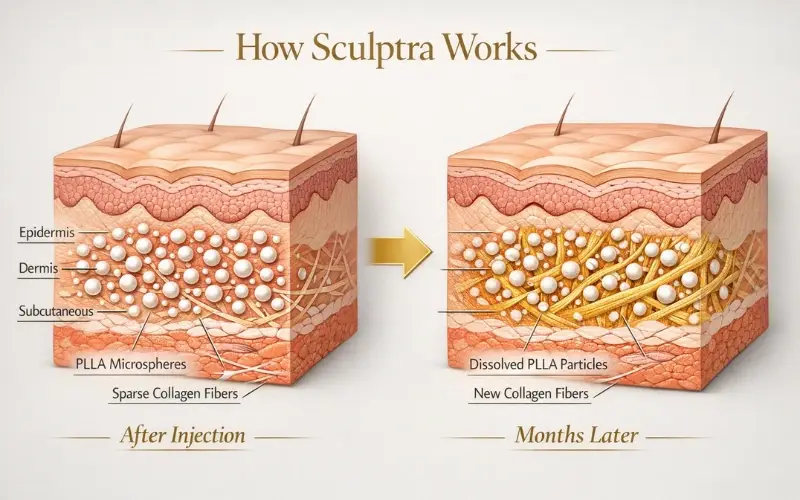
Sculptra is an injectable collagen stimulator made from poly-L-lactic acid (PLLA). Unlike traditional dermal fillers that physically fill in wrinkles or hollow areas, Sculptra works by stimulating your body's own collagen production to gradually restore lost volume over several weeks.
When Sculptra is injected into the deep dermis, the PLLA microparticles trigger a controlled tissue response. Your body's immune cells recognize these particles and activate fibroblasts — the cells responsible for producing collagen. According to research published in the journal Cells, PLLA enhances the synthesis of both type I and type III collagen by modulating macrophage activity in the skin. Over time, the PLLA particles are naturally absorbed, leaving behind a matrix of newly formed collagen that provides volume and structure.
How Is Sculptra Different from a Traditional Filler?
The easiest way to understand the difference: filler fills, Sculptra builds. A hyaluronic acid (HA) filler like Juvederm or Restylane adds gel-like substance directly into the tissue, creating immediate volume. Sculptra doesn't add any permanent filler material — instead, it triggers your skin to produce its own collagen, which gradually restores volume over 4–6 weeks.
Think of it this way: filler is like adding padding to a cushion. Sculptra is like reupholstering the cushion entirely. The result with Sculptra looks and feels more natural because the volume comes from your own tissue, not an injected substance.
Sculptra vs Filler: What Are the Key Differences?
Both Sculptra and hyaluronic acid fillers are effective solutions for facial volume loss, but they work through completely different mechanisms and are suited for different goals. Here's a side-by-side comparison of the most important factors.
| Feature | Sculptra (PLLA) | HA Filler |
|---|---|---|
| How It Works | Stimulates your own collagen | Adds gel for instant volume |
| Results Onset | Gradual (4–6 weeks) | Immediate |
| Duration | 2+ years | 6–18 months |
| Natural Look | Very natural, gradual | Depends on amount injected |
| Best For | Overall volume loss, skin laxity | Specific areas (lips, chin, nose) |
| Reversible | No | Yes (hyaluronidase) |
| Sessions Needed | 2–3 sessions | Usually 1 |
| Post-Treatment Massage | Required (5-5-5 rule) | Not required |
In short, Sculptra and filler aren't competitors — they serve different purposes. Some patients benefit most from one or the other, and many benefit from a combination of both.
What About Sculptra vs Radiesse?
Another common question is how Sculptra compares to Radiesse (calcium hydroxylapatite), since both are collagen stimulators rather than traditional fillers. Here's how they differ:
| Feature | Sculptra (PLLA) | Radiesse (CaHA) |
|---|---|---|
| Active Ingredient | Poly-L-lactic acid | Calcium hydroxylapatite |
| Immediate Volume | No (gradual only) | Yes (partial) |
| Duration | 2+ years | 12–18 months |
| Sessions Needed | 2–3 sessions | Usually 1 |
| Dilution for Skin Quality | Not applicable | Yes (hyperdilute technique) |
| Best For | Deep volume restoration, long-term | Volume + skin tightening |
Both are effective collagen stimulators with strong safety profiles. The choice depends on whether you prioritize longer-lasting results (Sculptra) or a combination of immediate volume with collagen stimulation (Radiesse).
Not Sure Which One Is Right for You?
Every face is different. Our doctor provides a free 1:1 consultation to assess your facial volume, recommend the right treatment, and give you a clear, upfront quote — no pressure, no hidden fees.
💬 Get a Free Consultation5.0 ⭐ from 800+ reviews · 6,000+ patients treated
Who Is Sculptra Best For?
Sculptra is ideal for patients experiencing gradual, widespread facial volume loss rather than a specific area that needs filling. It works best for people who want natural-looking improvement that builds over time rather than an overnight transformation.
In our experience, the patients who are happiest with Sculptra results tend to share these characteristics:
- Age 35–55 with early to moderate volume loss: The cheeks are starting to flatten, the temples are hollowing, and the jawline is losing definition — but you're not ready for (or interested in) surgery.
- Wanting results that don't look "done": Because Sculptra builds collagen gradually, the improvement happens subtly over weeks. Friends notice you look refreshed, not "filled."
- Preferring long-lasting results: If you don't want to return for filler touch-ups every 6–12 months, Sculptra's 2+ year duration is appealing.
- Comfortable with a gradual timeline: Sculptra is not the right choice if you need to look your best for an event next week. It requires patience — and the payoff is worth it.
Who Should Choose Filler Instead?
Hyaluronic acid fillers remain the better choice in several specific scenarios. If any of the following describe your situation, dermal filler may be the more appropriate starting point.
- You want results for a specific area: Lip enhancement, chin augmentation, or nose reshaping are best addressed with HA filler, not Sculptra. Sculptra should not be injected into the lips or around the eyes.
- You need immediate results: If you have an event coming up and need to look your best in days rather than weeks, filler delivers instant volume.
- You're new to injectables: Filler is reversible with hyaluronidase, making it a lower-commitment option for first-timers who want to "test" the result before committing.
- You have localized volume loss: If only your nasolabial folds are deep but the rest of your face has good volume, targeted filler placement is more efficient than Sculptra.
Can You Combine Sculptra and Filler?
Yes — and this is actually a strategy we use frequently at Edition Clinic. Sculptra addresses the overall foundation (broad volume loss, skin laxity, collagen depletion), while filler handles the details (lip definition, chin projection, precise contour correction). The two treatments can be performed in the same session or staged a few weeks apart, depending on your goals.
Want Honest Advice on Your Options?
Our medical team (16+ years experience) will give you straightforward guidance — including recommending a different treatment entirely if it would work better for your specific situation.
💬 Message Us on WhatsAppAll treatments performed by licensed medical professionals
Sculptra Results Timeline: What to Expect Week by Week
One of the most common concerns about Sculptra is the waiting period. Unlike filler, where you walk out with visible results, Sculptra requires patience. Understanding the timeline prevents unnecessary worry and sets realistic expectations.
Day 0 — Treatment Day
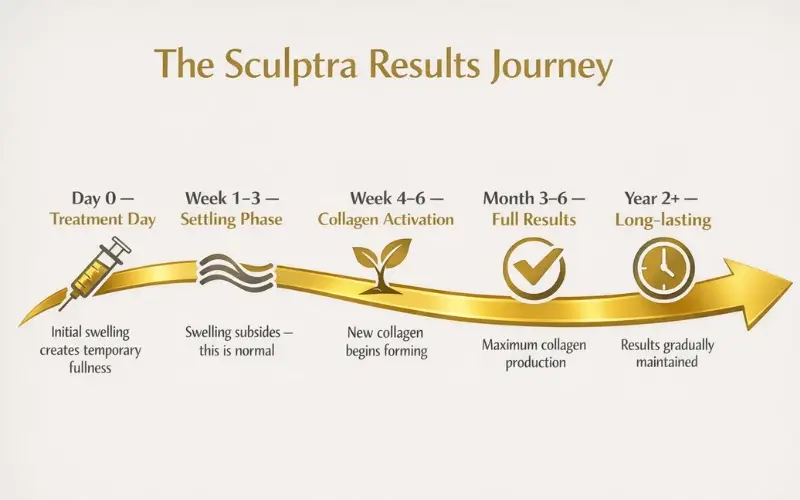
Immediately after injection, you'll notice some swelling and fullness in the treated area. This is mostly from the water used to reconstitute the Sculptra powder, not the actual result. It gives you a temporary preview of what the final volume might look like.
Week 1–3 — The Settling Phase
The initial swelling subsides as the water carrier is absorbed by your body. During this phase, many patients feel like "nothing happened" — this is completely normal and expected. The PLLA microparticles are still present in the dermis, but collagen production hasn't visibly kicked in yet.
💡 Don't Panic at Week 2
In our experience treating thousands of patients with Sculptra, the most common concern we hear is "it's been two weeks and I don't see anything." This settling phase is a normal part of how Sculptra works — the real results are building beneath the surface.
Week 4–6 — Collagen Activation
This is when the magic starts. Your fibroblasts begin producing new collagen around the PLLA particles, and you'll start noticing subtle improvements — slightly fuller cheeks, smoother skin texture, and a more refreshed overall appearance.
Month 3–6 — Full Results
Maximum collagen production occurs during this window. The improvement is now clearly visible: restored volume, improved skin quality, and a more youthful facial contour. Most patients complete their second or third session during this period to build on the results.
Year 2+ — Long-lasting
Sculptra results can last 2 years or longer. The collagen your body produced is real tissue — it doesn't dissolve like hyaluronic acid. Over time, natural aging will gradually reduce the results, and maintenance sessions can extend them further.
What Does a Sculptra Session Look Like?
A Sculptra session at Edition Clinic typically takes 30–45 minutes from start to finish. Here's what to expect during each step of the process.

Step 1 — Consultation and Assessment: Your doctor examines your facial structure, discusses your goals, and determines how many vials you'll need. At Edition Clinic, every patient receives a 1:1 consultation — we don't use a one-size-fits-all approach.
Step 2 — Preparation: The treatment area is cleaned, and a topical numbing cream is applied for comfort. The Sculptra powder is reconstituted with sterile water (prepared at least 24 hours in advance for optimal consistency).
Step 3 — Injection: Using a fine needle or cannula, the doctor injects Sculptra into the deep dermis using a grid-like pattern. With 16+ years of experience, our medical team places each injection with precision to ensure even distribution and natural results.
Step 4 — Massage: Immediately after injection, the treated area is firmly massaged to distribute the product evenly. This step is critical for preventing nodule formation.
Step 5 — Aftercare Instructions: You'll be instructed to follow the 5-5-5 rule: massage the treated area 5 times a day, for 5 minutes each time, for 5 days. This at-home massage is essential for achieving smooth, even results.
Side Effects and Safety: What You Need to Know
Sculptra has a well-established safety profile, backed by over 25 years of clinical use worldwide. It is FDA-approved and manufactured by Galderma, one of the world's leading dermatology companies. However, like all injectable treatments, there are potential side effects to be aware of.
Common Side Effects (Temporary)
- Swelling: Mild to moderate swelling at injection sites, usually resolving within 2–5 days
- Bruising: Minor bruising that fades within 5–10 days
- Redness and tenderness: At injection points, typically subsiding within 24–48 hours
- Temporary asymmetry: Swelling may be uneven initially; this resolves as swelling subsides
Rare Side Effects
- Subcutaneous nodules: Small, non-visible bumps that can form under the skin. The risk is significantly reduced by proper injection technique and diligent post-treatment massage (the 5-5-5 rule). According to a comprehensive review in Clinical, Cosmetic and Investigational Dermatology, nodule incidence has decreased significantly with modern reconstitution techniques and injection protocols.
- Granulomas: Extremely rare inflammatory reactions. Treatable with medication if they occur.
⚠️ Important Safety Information
Sculptra should not be used by individuals with a history of keloid scarring, active skin infections at the injection site, or certain autoimmune conditions. It should not be injected into the lips, periorbital area, or blood vessels. All treatments at Edition Clinic are performed by licensed medical professionals. Results may vary from patient to patient.
How Much Does Sculptra Cost in Bangkok?
Sculptra pricing is based on the number of vials used, which depends on the degree of volume loss and the treatment area. Here are the current prices at Edition Clinic Bangkok:
| Package | Price (THB) | Best For |
|---|---|---|
| 1 Vial | 20,900 | Targeted area (temples or cheeks) |
| 2 Vials | 40,000 | Full face treatment |
| 3 Vials | 58,500 | Full face + jawline/neck |
How Many Vials of Sculptra Do I Need?
The number of vials depends on several factors: your age, the degree of volume loss, and the treatment area. As a general guideline:
- Mild volume loss (early 30s–40s): 1–2 vials per session, 2 sessions total
- Moderate volume loss (40s–50s): 2 vials per session, 2–3 sessions total
- Significant volume loss (50s+): 2–3 vials per session, 3 sessions total
Your doctor will determine the exact number during your consultation. We always start conservatively — it's better to add more gradually than to overcorrect.
Is Sculptra Worth It Compared to Filler?
When comparing long-term cost, Sculptra often works out more economically. A single filler session might cost less upfront, but results last 6–18 months — meaning you'll need 2–3 filler sessions to cover the same 2-year period that one Sculptra treatment course covers. Over 2 years, the total spend is often comparable, with Sculptra providing a more natural-looking result.
Ready to Get Started?
Genuine Sculptra by Galderma · Korean-standard protocols · Starting from 20,900 THB · Free 1:1 doctor consultation included.
📅 Book Your Appointment5.0 ⭐ from 800+ reviews · 6,000+ patients treated
Frequently Asked Questions About Sculptra
1. How many sessions of Sculptra do I need?
Answer: Most patients need 2–3 sessions spaced about 4–6 weeks apart for optimal results. The exact number depends on the degree of volume loss and the treatment area. Your doctor will assess your needs during a 1:1 consultation.
2. Does Sculptra hurt?
Answer: Most patients describe mild discomfort during Sculptra injections. A topical numbing cream is applied before treatment, and the reconstituted Sculptra solution can be mixed with lidocaine for additional comfort. Any soreness typically resolves within 1–2 days.
3. Can I combine Sculptra with filler?
Answer: Yes, Sculptra and hyaluronic acid fillers can be used together as part of a comprehensive facial rejuvenation plan. Sculptra addresses overall volume loss and collagen stimulation, while filler can target specific areas like the lips or chin for immediate results. Your doctor can design a combination protocol tailored to your goals.
4. How long does Sculptra last?
Answer: Sculptra results can last 2 years or more after a complete treatment course. Because the results come from your body's own collagen production, the improvement fades gradually and naturally over time. Maintenance sessions can extend the results further.
5. What areas can Sculptra treat?
Answer: Sculptra is most commonly used to treat the cheeks, temples, jawline, and chin area. It is effective for correcting hollow cheeks, sunken temples, nasolabial folds, and overall facial volume loss. Sculptra should not be injected into the lips or around the eyes.
6. Is Sculptra safe for all skin types?
Answer: Yes, Sculptra is safe for all skin types and tones. Since it works by stimulating your body's own collagen production rather than adding a foreign substance, it is well-tolerated across diverse skin types. However, it should not be used by individuals with a history of keloid scarring or certain autoimmune conditions.
7. What is the difference between Sculptra and Radiesse?
Answer: Both Sculptra and Radiesse are collagen stimulators, but they use different active ingredients. Sculptra contains poly-L-lactic acid (PLLA), while Radiesse contains calcium hydroxylapatite (CaHA). Sculptra works more gradually over multiple sessions and typically lasts longer (2+ years), while Radiesse provides some immediate volume and lasts about 12–18 months.
8. How much does Sculptra cost in Bangkok?
Answer: At Edition Clinic Bangkok, Sculptra starts at 20,900 THB per vial. A 2-vial package is 40,000 THB, and a 3-vial package is 58,500 THB. The total cost depends on how many vials you need, which is determined during your consultation based on the degree of volume loss.
9. When will I see results from Sculptra?
Answer: Initial swelling right after treatment may create temporary fullness, but this subsides within a few days. The real results from collagen production begin appearing around 4–6 weeks after treatment and continue to improve over 3–6 months. Maximum results are typically visible at the 3–6 month mark.
10. Can Sculptra be dissolved if I don't like the results?
Answer: No, unlike hyaluronic acid fillers which can be dissolved with hyaluronidase, Sculptra cannot be reversed with an enzyme. However, because Sculptra works gradually and results build over time, overcorrection is rare when treated by an experienced practitioner. The effects will naturally diminish over 2+ years as the collagen is gradually reabsorbed.
11. What should I avoid after Sculptra treatment?
Answer: After Sculptra treatment, you should massage the treated area following the 5-5-5 rule: 5 times a day, for 5 minutes each time, for 5 days. Avoid excessive sun exposure, strenuous exercise, and alcohol for the first 24–48 hours. Do not apply makeup for at least 12 hours after treatment.
12. Is Sculptra FDA-approved?
Answer: Yes, Sculptra is FDA-approved. It was first approved by the U.S. FDA in 2004 for treating HIV-associated facial lipoatrophy, and later in 2009 for nasolabial fold correction in healthy patients. In 2023, it received expanded approval for treating fine lines and wrinkles in the cheek area. Sculptra is manufactured by Galderma and is available in over 40 countries worldwide.
Ready to Restore Your Natural Volume?
Book a free consultation at Edition Clinic Bangkok. Our doctor will assess your facial volume and recommend the right treatment — Sculptra, filler, or a combination — tailored to your goals.