

Bangkok Aesthetic Clinic: How to Choose


Table of ContentsShow / Hide
Written & Medically Reviewed by

- Medical Doctor, Chulalongkorn University — Second Class Honors
- Dermatology (International Program) 2024–2025, Chulabhorn International College of Medicine, Thammasat University
- 3 Years Experience in Aesthetic Medicine
Quick Answer
How to choose an aesthetic clinic in Bangkok: confirm that a licensed medical doctor injects you inside a licensed clinic, and that sealed Botox or filler is opened in front of you.
Then check the doctor's license online, get the plan in writing, ask who to contact after treatment and treat very low prices with caution.
The clinic you choose decides who holds the needle, which product goes into your skin and who answers if something goes wrong. That is why knowing how to choose an aesthetic clinic in Bangkok matters, especially when you are visiting from abroad.
Bangkok has a large choice of clinics, and a low price or a polished website does not show which ones are safe. You can run each check on any clinic, Edition Clinic included, before you book.
What to Look for in a Clinic for Botox and Filler
A good clinic for Botox and filler has a licensed medical doctor perform every injection and opens the sealed product in front of you. The clinic should also name any laser or lifting device, put the plan in writing and give you time to decide. Pressure to buy a package on the spot, or a price far below the usual level, deserves extra caution.
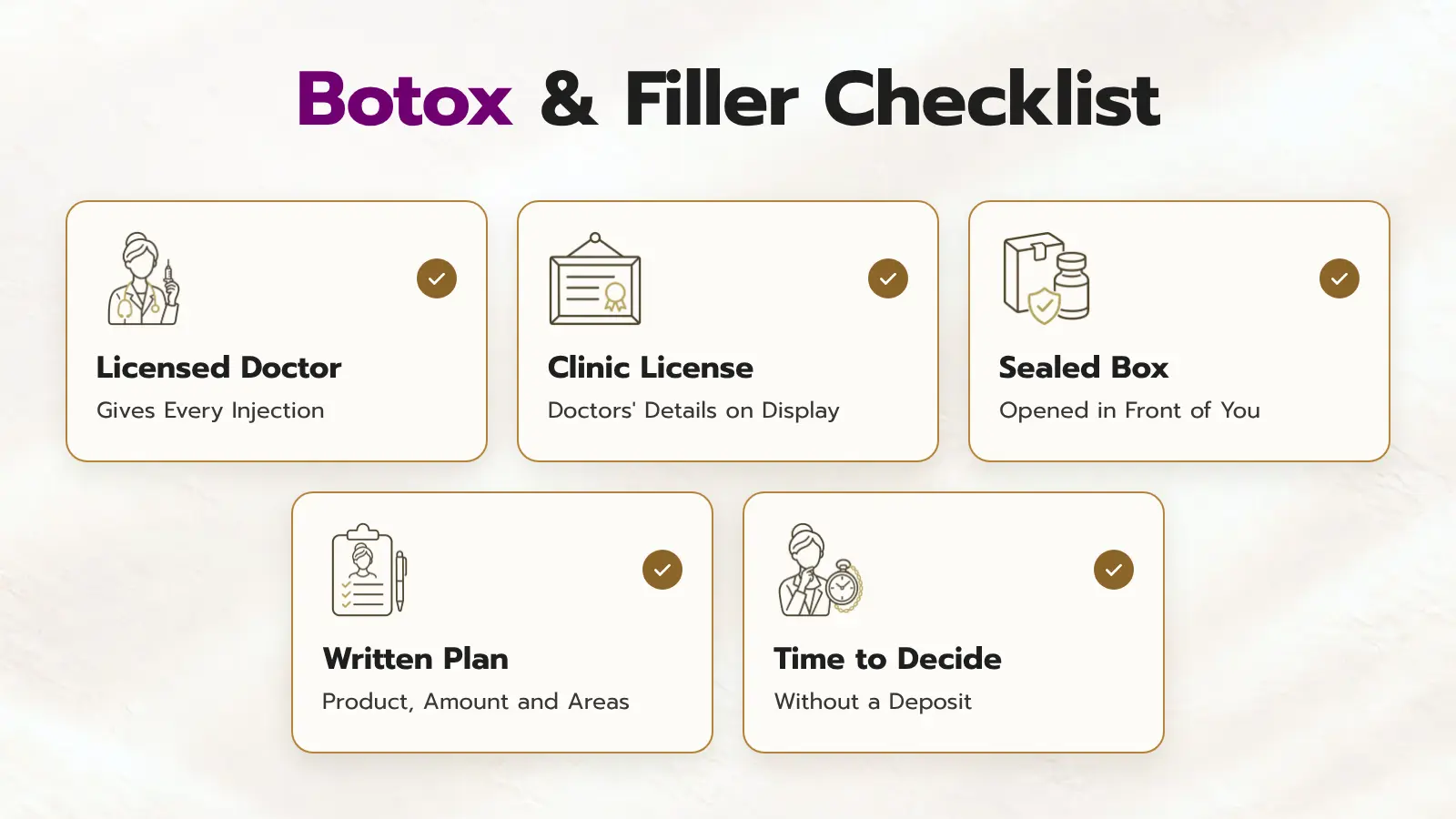
Use this short checklist when you compare clinics:
- Doctor: a licensed medical doctor gives every injection.
- Clinic license: the license and the doctors' details are on display.
- Product: the sealed box is opened in front of you.
- Device: the clinic names the laser or lifting machine it uses.
- Written plan: the product, amount and treated areas are written down first.
- Time to decide: you can leave and think without paying a deposit.
- Price: a very low price leads to more questions, not a quick booking.
The American Academy of Dermatology calls filler injection a medical procedure. Serious side effects are more likely, the academy notes, when the person injecting lacks adequate medical training and experience.
The US Food and Drug Administration (FDA) makes the same point in its guidance on dermal fillers: having filler injected should be considered a medical procedure, not a cosmetic treatment.
Language matters too, because you need to understand the risks before you agree. Ask whether the doctor consults in English, or whether staff can interpret at the consultation.
A Clinic or a Hospital: Which Do You Need?
A licensed aesthetic clinic is the right setting for Botox and filler, because these injections are short medical procedures. Surgery such as a facelift, an operation that tightens the face, is different, and a hospital or surgical centre may suit it better. Your doctor checks which setting fits your goal at the consultation.
A clinic that also offers surgery should tell you where each operation takes place. Ask whether it happens on site or in a hospital, and who looks after you if you stay overnight.
For injections alone, a clinic visit is enough, as long as a doctor holds the needle and the clinic license is current.
How to Check a Clinic License in Thailand
A clinic license in Thailand is checked by asking for the license number and matching it with the license on display. In Bangkok, the Department of Health Service Support, Ministry of Public Health, issues these licenses. A display shows what the clinic chooses to show, so pair it with the Medical Council of Thailand doctor search, an independent check you can run online yourself.
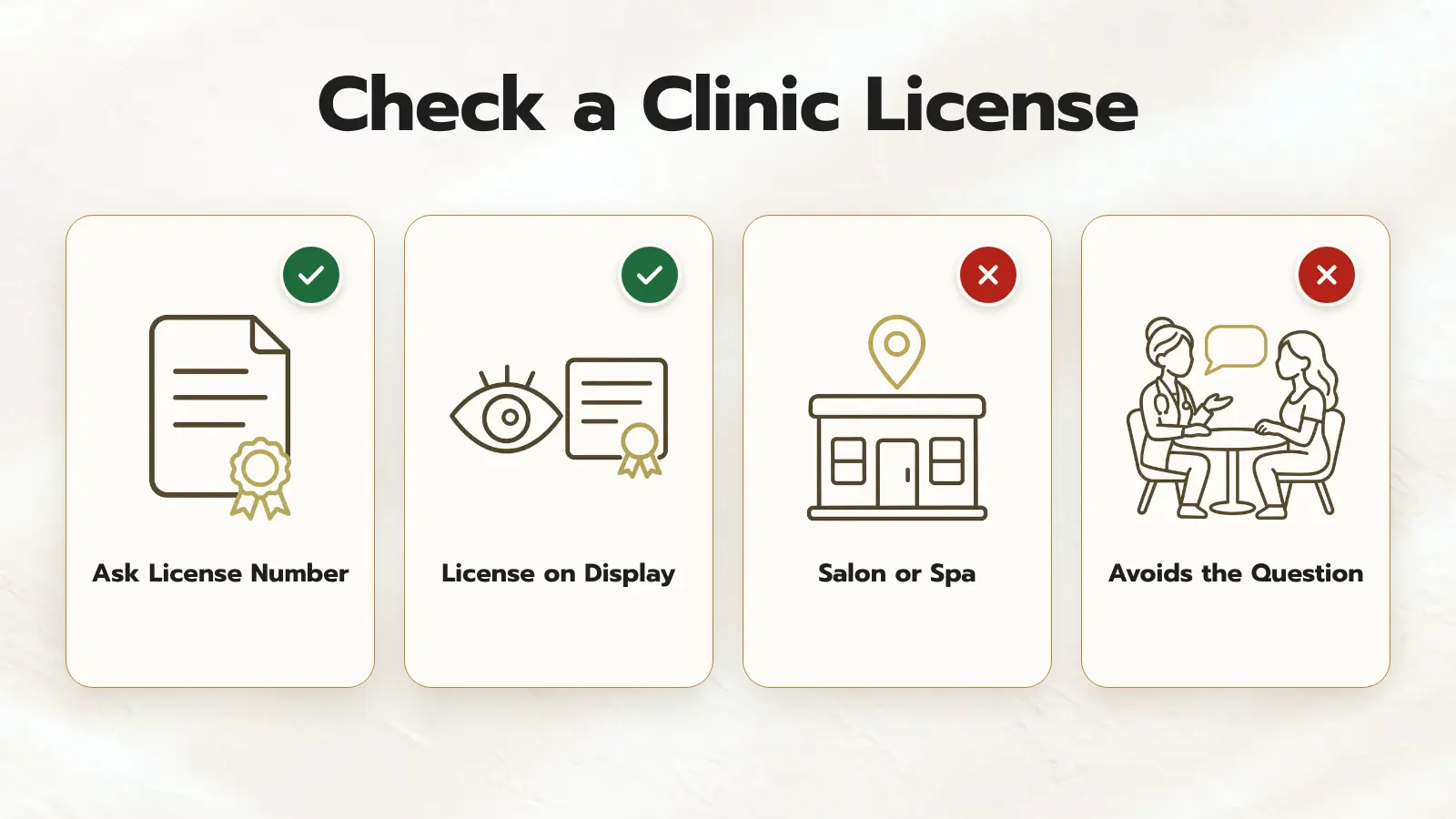
Clinics in Thailand are licensed under the country's medical facilities law. A beauty salon or spa is not a licensed medical facility, even if it looks clinical inside.
Asking for the number is a normal request. Most licensed clinics can share it in a message before you book. Any clinic that avoids the question, or uses a different name from its sign, deserves a closer look.
What a Licensed Clinic Should Display
Licensed clinics in Thailand should display their license and their doctors' details where patients can see them. Look for the clinic name, the license and the names of the doctors who treat patients there. If you cannot see them, ask to see the license before you book; a clinic that cannot show one is a reason to book elsewhere.
Note the license number or take a photo of it on your first visit. The number helps you confirm later that the clinic on the sign matches the one on your booking.
Why Injections Belong in a Licensed Clinic
Injections belong in a licensed clinic because Botox and filler are medical procedures for a licensed medical doctor. A salon, hotel room, condo or private home is not a medical setting. Every licensed clinic has to meet Thai rules for medical facilities, and a doctor is on hand if something goes wrong.
The American Academy of Dermatology warns that having a filler injected in a non-medical setting can be extremely dangerous.
For Botox, a US FDA alert on counterfeit Botox describes harm from fake Botox injected by people with and without a license, or in non-medical settings without a license.
Those were US cases, but the lesson travels: the setting is part of the safety check.
How to Check a Doctor License in Thailand
A doctor license in Thailand can be checked on the Medical Council of Thailand online doctor search. Enter the first and last name, plus the license number if you have it, to see the year licensed and any certified specialty. Only a licensed medical doctor should inject Botox and filler, and the clinic itself also needs a Ministry of Public Health license.
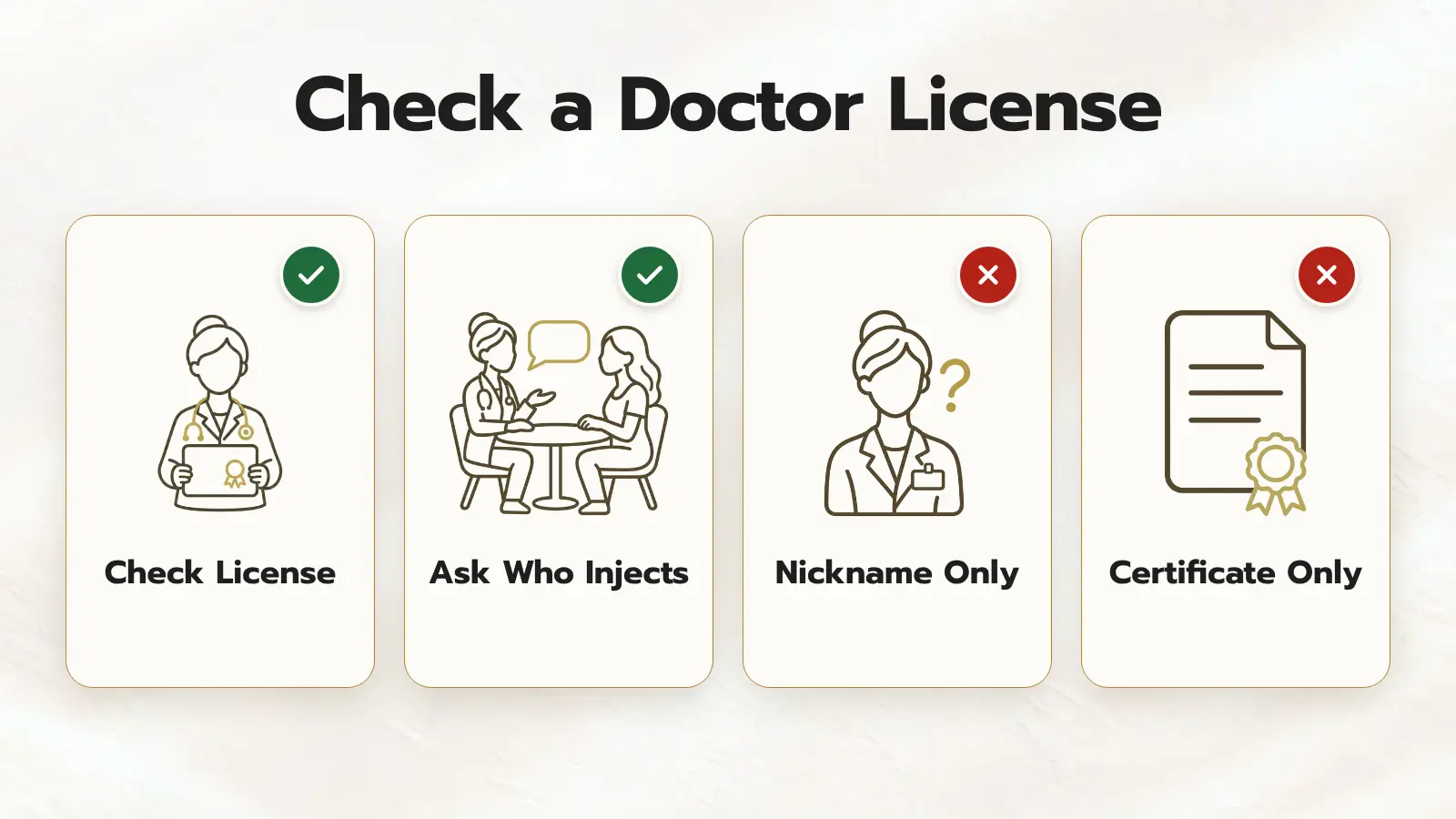
The council licenses medical doctors in Thailand, so its record is the one that counts. Checking a name takes a few minutes.
Search the Medical Council of Thailand Database
The Medical Council of Thailand database has an English doctor search page that anyone can use. Type the doctor's first and last name, and add the license number if you know it. Then check that the result matches the doctor who will treat you.
Ask the clinic for the doctor's full name as it appears on the license. A nickname alone, such as the short names Thai doctors often use, is hard to search.
Each result also lists the year licensed. A certified specialty appears only when the council has certified one, so a blank specialty does not mean the doctor lacks a license.
No result, or a name that does not match, is a reason to pause and ask the clinic.
Who Can Inject Botox and Filler in Thailand?
A licensed medical doctor registered with the Medical Council of Thailand is the person who should inject Botox and filler. Training certificates from a course do not replace a medical license, so look for a Medical Council license in the doctor's own name.
Ask who will hold the needle on the day, not only who owns or runs the clinic. If another person injects you, check that person's license too.
The same FDA alert advises asking your health care professional whether they are licensed and trained to give the product.
If a clinic cannot tell you the name of the doctor who will inject you, I would treat that as a reason to book somewhere else.
How to Tell If Botox and Filler Are Genuine
Genuine Botox and filler come in a sealed box that you can inspect before the injection. Check that the lot number and expiration date match on the box and the product inside, and look for the Thai registration number and label. Some brands also print security codes or holograms, and a very low price or an injection outside a licensed clinic is a warning sign.
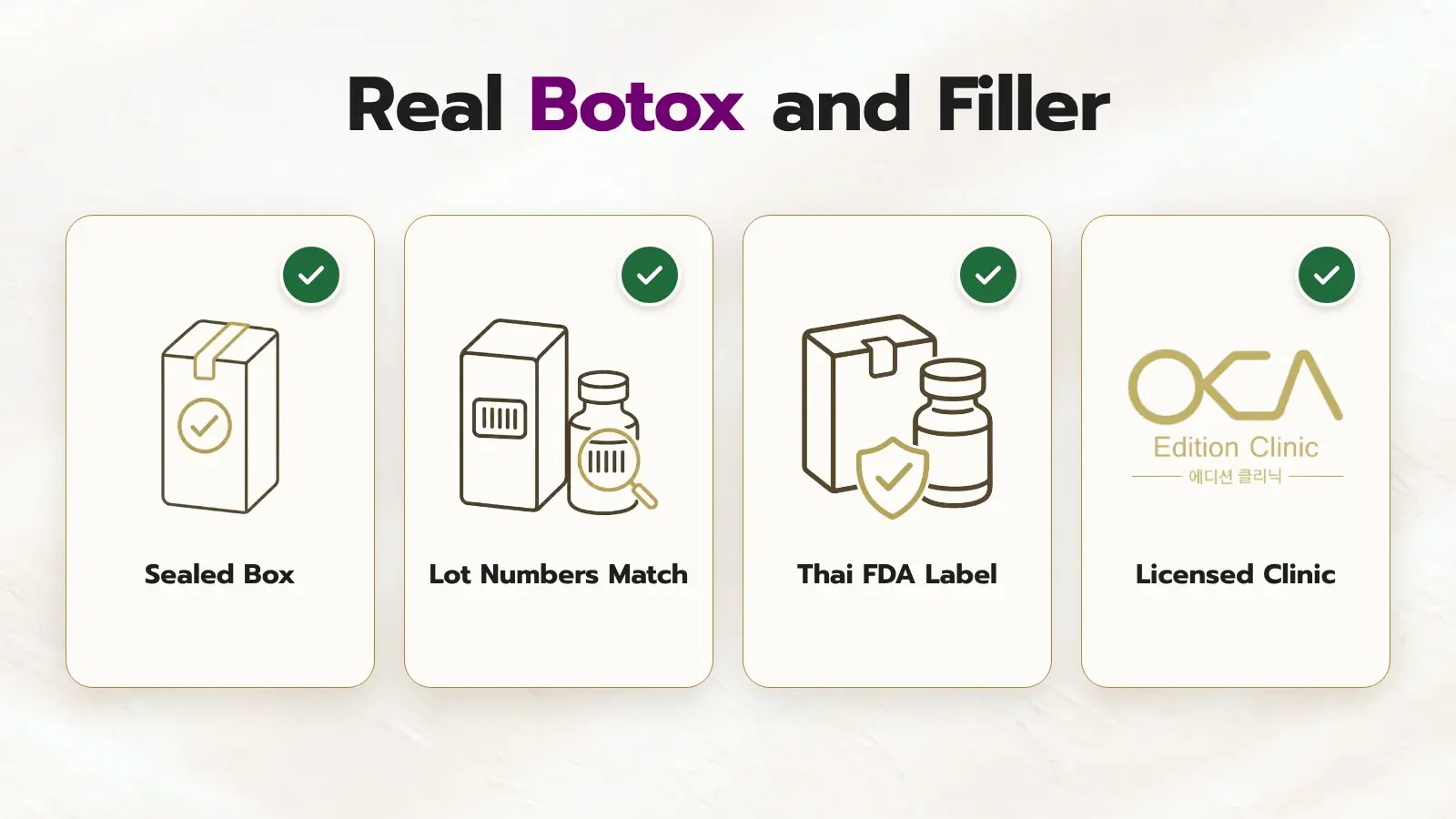
Product checks take a minute and are fair to ask for at any clinic. Ask where the clinic buys its products and how it stores them: the answer should be an authorized supplier, not an online shop.
Check the Box and Vial Before the Injection
The box and the vial, the small bottle that holds Botox, should be checked while the seal is still closed. Ask to see the brand name, lot number and expiration date, and check they match on the box and the vial or syringe. The product should then be opened in front of you.
In the 2024 FDA alert, counterfeit Botox boxes listed a general toxin name instead of OnabotulinumtoxinA, the ingredient name printed on genuine Botox. Some fake boxes also showed a unit size that AbbVie and Allergan do not make.
Genuine boxes in that alert name the maker as Allergan Aesthetics, an AbbVie company.
A 2024 investigation by the US Centers for Disease Control and Prevention (CDC) found 17 patients harmed by counterfeit or poorly handled toxin injections, and 13 patients needed hospital care. Some of the products had been bought from large online sellers.
The CDC advice is to get injections only from licensed, trained providers using products from authorized sources, with a short rule: if in doubt, do not get the injection.
Those details come from US cases. In Thailand, the same habit applies: read the box before anything is opened.
The Allergan Botox guide explains the original Botox brand in more detail.
For filler, the FDA's consumer advice on dermal fillers says the provider should use properly labeled, sealed vials or pre-filled syringes. The same advice tells you to know the type of product to be injected and where each product goes.
Certain brands add security features, such as a hologram or a code on the box that can be checked with the maker. If the box has one, ask the clinic to show you.
Check the Thai FDA Registration
Botox and filler imported legally into Thailand carry a Thai registration number and a Thai label on the box. The Thai Food and Drug Administration (Thai FDA) regulates botulinum toxin, the medicine in Botox, as a drug and dermal fillers as medical devices. A box with no Thai label at all is worth questioning before the seal is broken.
Ask the clinic to point out the registration number if you cannot find it. A product brought in outside the legal import route would not carry this Thai registration.
Keep a photo of the box, or ask for the product name and lot number in your record. Any doctor who sees you later can then tell exactly what was used.
Ask Which Device Is Used for Laser and Lifting
Laser and lifting treatments should come with the name of the device, so ask which machine will be used before you agree. Knowing the brand and model lets you read about it, while a vague answer gives you nothing to check. Your doctor chooses the device for your skin and should explain why.
For lifting devices that use focused ultrasound or radio waves, also ask how many shots are planned for each area.
Why Very Low Prices Are a Warning Sign
Very low prices are a warning sign because genuine products, a licensed doctor and a licensed clinic all carry real costs. A deal well under what other clinics charge needs every check before you pay: ask to see the sealed box, the lot number and the Thai registration, and confirm the doctor's license. A high price alone does not prove safety either.
The FDA also warns against buying dermal filler products online, because they could be counterfeit or not approved for use in the US.
To see what genuine products cost, the Botox brands and prices page and the filler brands and prices page list each option. Treat the price as one check among several, next to the license, the doctor and the sealed box.
What to Ask at Your Consultation
A good consultation tells you who will inject you and their training, what result to expect, how long it lasts and what the risks are. The doctor should also review your medical history, medicines and allergies, including pregnancy or breastfeeding. Before you agree, you should know the aftercare and who to contact if something feels wrong.

What a Good Consultation Covers
Each consultation should cover your goals, your face at rest and in motion, and your health before any product is chosen. Medicines, allergies, past treatments and recent Botox are all reviewed. Then the doctor explains whether the treatment suits you at all.
Botox is not a good choice when you are pregnant or breastfeeding. The same applies with a botulinum toxin allergy, an infection at the injection site, or a nerve or muscle condition.
Filler is not a good choice where the vascular risk, the chance of filler entering a blood vessel, is high and the benefit is limited.
If you take blood thinners or had Botox recently, tell the doctor. Never stop a prescribed medicine on your own; ask the doctor who prescribed it.
Questions to Ask the Doctor
Questions to ask the doctor should cover who injects, which product and amount, the expected result and the risks. Write them down before you go, so nothing is forgotten in the room. A clear, patient answer to each one is a good sign.
Questions worth bringing with you:
- Who will inject me, and can I check that license today?
- Which brand and how much product do you plan to use?
- Is this treatment the right option for my goals?
- What result can I expect, and how long will it last?
- What are the main risks, and what happens if something goes wrong?
- What aftercare should I follow, and who do I contact?
Get Your Treatment Plan in Writing
A written treatment plan records the brand, the amount, the treated areas and the aftercare before you agree to anything. Ask for it before the injection, not afterwards. The same note helps any doctor who sees you later, at home or abroad.
The American Society of Plastic Surgeons notes that you will be asked to sign consent forms, so that you fully understand the procedure, its risks and potential complications.
Red Flags at an Aesthetic Clinic
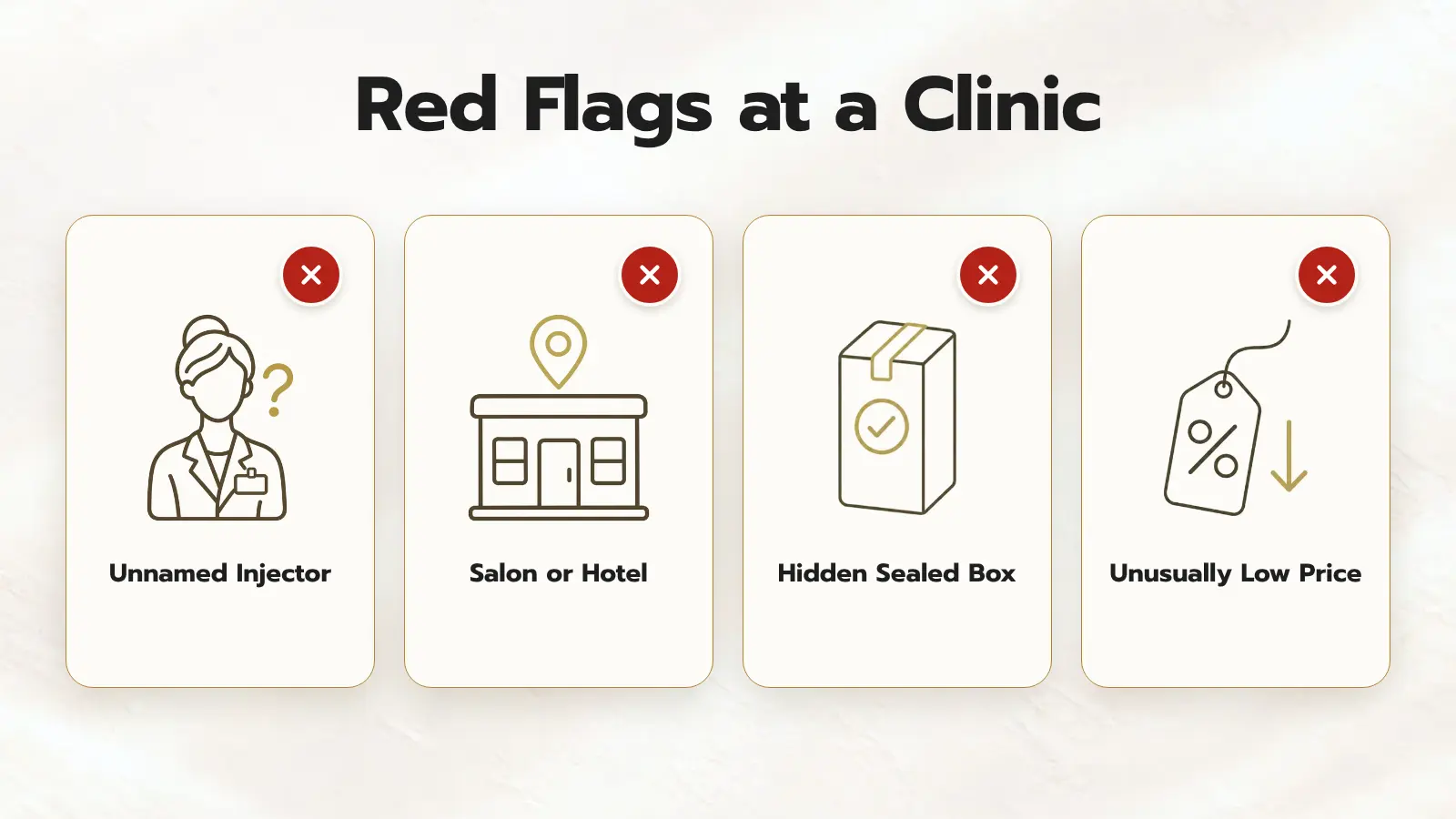
Red flags at an aesthetic clinic include credentials you cannot confirm, a non-medical or unclean room, and a hidden product. An unusually low price, or pressure to pay today, calls for more checks before you book. Watch for an unnamed device, promised results without talk of side effects, a skipped health assessment or no aftercare plan.
Watch for these warning signs when you visit or message a clinic:
- Credentials: nobody can say who injects, or the Medical Council search finds no match.
- Setting: injections in a salon, hotel room or home, or an unclean room.
- Product: the sealed box stays hidden, or the device has no name.
- Assessment: no questions about your health, medicines or allergies.
- Promises: a promised result with no mention of side effects.
- Pressure: a push to pay a deposit or add treatments today.
- Price: a deal far below the usual level, with no clear reason.
- Aftercare: no instructions and no way to reach the clinic.
The doctor license search and the sealed box check cover the details.
A missing clinic license, an injector nobody can name or check, or a non-medical setting is a reason to book somewhere else on its own. The other flags call for more questions before you decide.
What Aftercare Should a Clinic Provide?
Aftercare from a clinic should include written instructions, a way to reach the doctor and clear warning signs. Contact the clinic straight away, or go to emergency care, for unusual pain, vision changes or white, grey or blue skin near the injection. Spreading redness, warmth, pus or a fever can mean an infection and also needs a doctor quickly.
Mild swelling and bruising are common after injections and usually settle on their own. Warning signs get worse instead of better, and they need a doctor's eyes quickly.
I would rather you message me about a small worry than wait at home with a warning sign. Good aftercare means you always know who to contact and when.
How to Reach the Clinic After Treatment
Reaching the clinic after treatment should be easy, with a named contact by message or phone and clear opening hours. Before you leave, ask who answers if a question comes up in the evening or after you fly home. A good clinic replies quickly and arranges a review when one is needed.
Keep the written aftercare, the product record and the clinic contact together. The Botox aftercare guide explains what to avoid in the first days.
Planning Treatment Around Your Flight
Planning treatment around your flight works when you book early in the trip, leaving time for a check-up before you go. Side effects that start after you leave are harder for the doctor to assess. Your doctor plans the timing around your departure date and the treated area.
Flight timing after each treatment is covered in the guide to flying after Botox or filler. Share your arrival and departure dates in your first message.
Warning Signs That Need Urgent Care
Warning signs that need urgent care include unusual pain, vision changes, white, grey or blue skin near a filler injection, or signs of a stroke. After Botox, trouble swallowing, speaking or breathing, double or blurred vision, drooping eyelids or spreading weakness also need help straight away. Contact your clinic at once or go to emergency care.
The FDA Medication Guide for Botox Cosmetic warns that trouble swallowing, speaking or breathing, muscle weakness, double or blurred vision and drooping eyelids can appear hours, days or weeks after the injection.
A 2026 UK safety update from the Medicines and Healthcare products Regulatory Agency (MHRA) says these symptoms usually appear 4 to 8 days after treatment but can take up to 4 weeks.
Do not treat these signs yourself. Tell any doctor who sees you which product was used and when.
Why Choose Edition Clinic for Botox and Filler in Bangkok?
Edition Clinic is the official Bangkok branch of Edition Plastic Surgery, Seoul, and its Botox and filler injections are doctor-performed. Each visit starts with a free 1:1 consultation with the doctor, with no obligation to book treatment. You can also run every check in this guide on the clinic yourself.
Ask for the medical facility license number, 10101008267, and compare it with the license on display.
Dr. Natcha Prachayakul, the aesthetic doctor known as Dr. Mild, holds Thai medical license 74682. You can find her on the Medical Council of Thailand search page with that name and number.
Botox and filler are opened from sealed packaging in front of you. For Botox, you can ask to see the brand name, lot number and expiry date first, and for filler the brand and amount are explained before and after treatment.
A filler visit takes about 45 to 75 minutes at the clinic, including consultation and design, numbing cream and injection. After treatment, you receive aftercare instructions and follow-up support by message on LINE.
Consultation in English, Thai or Korean
Consultations are held directly with the doctor in English or Thai, so you can ask about products, risks and aftercare in your own words. Questions can also be sent by message before you arrive.
Korean-speaking staff help with booking and interpret during the doctor consultation if you prefer Korean. Mention your language when you book, so the right support is ready for your visit.
Getting Here and Booking
Edition Clinic is in Room A408, 4th Floor, Marche 150 Thong Lo, near BTS Thong Lo, open daily from 11:00 to 20:00, and you can book by LINE or WhatsApp.
- 📍 Address
- Room A408, 4th Floor, Marche 150 Thong Lo, Khlong Tan Nuea, Watthana, Bangkok 10110
- 🚆 Nearest BTS
- BTS Thong Lo
- 🕐 Opening hours
- Every day, 11:00–20:00
- 📞 Phone
- +66 92-255-8952
- 💬 How to book
- LINE @editionclinic or WhatsApp — free consultation
Clinic-wide patient count: 6,717 unique patients treated from 7 August 2023 to 1 October 2026, excluding repeat visits. This is not a treatment-specific count.
Choosing a Clinic for Botox and Filler in Bangkok: Summary
- Licenses: Before Botox and Filler, check the clinic license and the doctor on the Medical Council of Thailand search page.
- Product: For Botox and Filler, ask to see the sealed box, lot number and expiry date before it is opened.
- Walk away: Skip Botox and Filler at a clinic that hides the product, skips your health history or pushes you to pay today.
- Next step: Book a consultation for Botox and Filler where the doctor answers your questions and writes down the plan.
Frequently Asked Questions About Choosing a Clinic for Botox and Filler
1. Is it safe to get Botox in Bangkok?
Answer: It can be, when a licensed medical doctor injects genuine Botox inside a licensed clinic. Safety depends more on the doctor, the product and the setting than on the city, so check the doctor's license and the sealed box first.
In the US prescribing information for Botox Cosmetic, eyelid drooping occurred in 13 of 405 patients (3%) treated for frown lines, against 0 of 130 (0%) on placebo.
2. Can dermal fillers go wrong?
Answer: Yes, dermal fillers can go wrong, but severe problems are uncommon. The rare serious problem is filler entering a blood vessel, which needs urgent care at once. Choosing a licensed doctor, a licensed clinic and a sealed product is the part of the risk you can control.
The FDA names accidental injection into a blood vessel as the most serious filler risk; the chance is low, but the complications may be permanent.
The American Society of Plastic Surgeons calls severe filler complications uncommon, and the American Academy of Dermatology says minor side effects tend to clear within 7 to 14 days.
In the pivotal trial of one widely used cheek filler, published in Dermatologic Surgery (2013), 2 of 270 treated patients (0.7%) had a serious device-related event.
3. Can online reviews be trusted when choosing a clinic?
Answer: It depends on how you read them, because reviews describe comfort and service but cannot confirm a license or a genuine product. Use reviews to shortlist clinics, then run the license and product checks yourself before you book.
Reviews that name the doctor and describe the aftercare tell you more than stars.
4. Do I have to book a treatment after a consultation?
Answer: No, a consultation should never lock you into treatment. A good clinic explains the product and the risks, then lets you decide in your own time, and pressure to pay a deposit the same day is a red flag.
At Edition Clinic, the consultation is free, with no obligation to book treatment afterwards.
5. What should I bring to my first consultation?
Answer: Bring a list of your medicines, supplements, allergies and past treatments, with product names if you have them. Your written questions help too, and visitors should bring their travel dates so the plan fits the trip.
Tell the doctor about pregnancy, breastfeeding or blood thinners, and never stop a prescribed medicine on your own.
References
- American Academy of Dermatology. Fillers: FAQs. Accessed 2026. aad.org
- US Food and Drug Administration. Dermal Fillers (Soft Tissue Fillers). 2023. fda.gov
- US Food and Drug Administration. Counterfeit Version of Botox Found in Multiple States. 2024. fda.gov
- Medical Council of Thailand. Doctor license search. Accessed 2026. checkmd.tmc.or.th
- US Food and Drug Administration. Dermal Filler Do's and Don'ts for Wrinkles, Lips and More. 2023. fda.gov
- American Society of Plastic Surgeons. Dermal Fillers Risks and Safety. Accessed 2026. plasticsurgery.org
- Allergan/AbbVie. BOTOX Cosmetic Prescribing Information and Medication Guide. DailyMed. 2024. DailyMed
- Medicines and Healthcare products Regulatory Agency. Botulinum toxin type A products: updated warnings regarding risk of iatrogenic botulism. Drug Safety Update. 2026. gov.uk
- Jones D, et al. Volumizing hyaluronic acid filler for midface volume deficit: 2-year results from a pivotal single-blind randomized controlled study. Dermatol Surg. 2013;39(11):1602. PMID 24093664
Ready to Check a Clinic for Botox and Filler?
Book a free 1:1 consultation at Edition Clinic Bangkok and check the license and the doctor yourself.
