

Sculptra vs Radiesse: How the Two Biostimulators Compare

Table of Contents Show / Hide
Medically Reviewed by

- Medical Doctor, Chulalongkorn University — Second Class Honors
- 3 Years Experience in Aesthetic Medicine
- Specialized in Collagen Biostimulators & Injectable Aesthetics
Sculptra vs Radiesse: Both are injectable collagen biostimulators with different materials and different effects in the skin. Both encourage the body to make new collagen.
Sculptra is generally planned as a course, whereas a standard Radiesse contouring treatment often begins with one session. Radiesse can also be prepared in a hyperdiluted form for a different aim, such as improving neck skin quality with less emphasis on immediate bulk. The comparison therefore needs to consider the preparation and target as well as the product name: broader restoration, a defined contour and a skin-quality concern are not identical goals.
Key Takeaways
- Materials: Sculptra contains PLLA particles prepared with sterile water; Radiesse contains CaHA microspheres carried in a gel.
- Early effect: Radiesse adds structural support at injection. Sculptra relies on new collagen, so early fluid-related fullness is temporary and the lasting change develops gradually.
- Treatment goals: Sculptra suits broader facial hollowing and overall rejuvenation. Radiesse is often selected for a defined jawline or chin, deeper folds or hand volume loss.
- Development and duration: Sculptra develops over about 3–6 months and can last around two years or longer. Radiesse provides an earlier contour change with continuing collagen development; its usual duration is around 12–18 months.
- Home care: Sculptra commonly uses the 5-5-5 massage routine. Radiesse generally does not require a special massage routine; follow the treating doctor’s instructions.
What Is Sculptra?
Sculptra is an injectable collagen biostimulator made from poly-L-lactic acid (PLLA), intended to restore support and volume progressively. It is used for broader facial hollowing and changes in skin quality, with collagen-related support developing over weeks to months rather than appearing as an immediate filling effect.

PLLA is a synthetic, biocompatible material also used in absorbable sutures. It breaks down gradually in the body rather than remaining as a permanent implant.
Its US FDA-approved facial indications include nasolabial folds and cheek wrinkles; other uses may be off-label. Treatment is usually planned as a course, with home care explained by the doctor.
How Does Sculptra Work?
Sculptra encourages the body to build collagen gradually, rather than supplying an immediate structural filling gel.
- Placement: PLLA particles are prepared with sterile water and placed at a depth suited to the treatment area.
- Tissue response: A controlled response around the particles helps activate fibroblasts to build new collagen. Published work discusses type I and III collagen and changes in firmness and skin quality.
- Remodelling: As the particles break down gradually, the newly formed collagen provides the developing support.
Any fullness immediately after a Sculptra session mainly reflects the injected fluid and swelling. It can settle before the collagen-related improvement becomes visible. Radiesse works differently: its gel supplies earlier support while its particles stimulate further tissue development.
For product-specific treatment information, see Sculptra at Edition Clinic.
What Is Radiesse?
Radiesse is an injectable dermal filler and collagen biostimulator containing calcium hydroxylapatite (CaHA) microspheres in a water-based gel. The gel provides early volume and structural support, while the microspheres stimulate continuing collagen development.

CaHA is a mineral-like material comparable to the mineral component found in bone. In addition to collagen, the later tissue response also includes elastin, which contributes to skin resilience.
This FDA-approved product is used for selected volume deficits, deeper folds and structural definition. Radiesse (+) includes lidocaine, which needs to be considered when reviewing allergies.
How Does Radiesse Work?
Radiesse provides immediate volume and support through its gel carrier, followed by tissue stimulation from the CaHA microspheres.
- Initial support: The gel fills and supports the selected area when the product is placed.
- Collagen development: The microspheres form a scaffold that activates fibroblasts. Research describes development of collagen types I and III and elastin.
- Ongoing change: The carrier is gradually absorbed as the tissue response develops.
Dilution changes the treatment aim. Hyperdiluted Radiesse provides less immediate bulk and is used to target skin laxity or crepiness, rather than a sharply projected contour. Neck or hand skin-quality plans therefore need to be distinguished from a standard contouring preparation. Sculptra instead relies on a gradual collagen response without a structural filling gel.
Like Sculptra, Radiesse cannot be dissolved with hyaluronidase. Product selection and placement therefore need individual assessment.
For product-specific treatment information, see Radiesse at Edition Clinic.
Who Should Consider Sculptra or Radiesse?
Choosing between Sculptra and Radiesse depends on whether you want an immediate lift with crisp structural definition or gradual, widespread collagen building that gives softer, natural-looking and longer-lasting rejuvenation. Both are injectable collagen biostimulators, but their active ingredients differ and they work differently once injected.
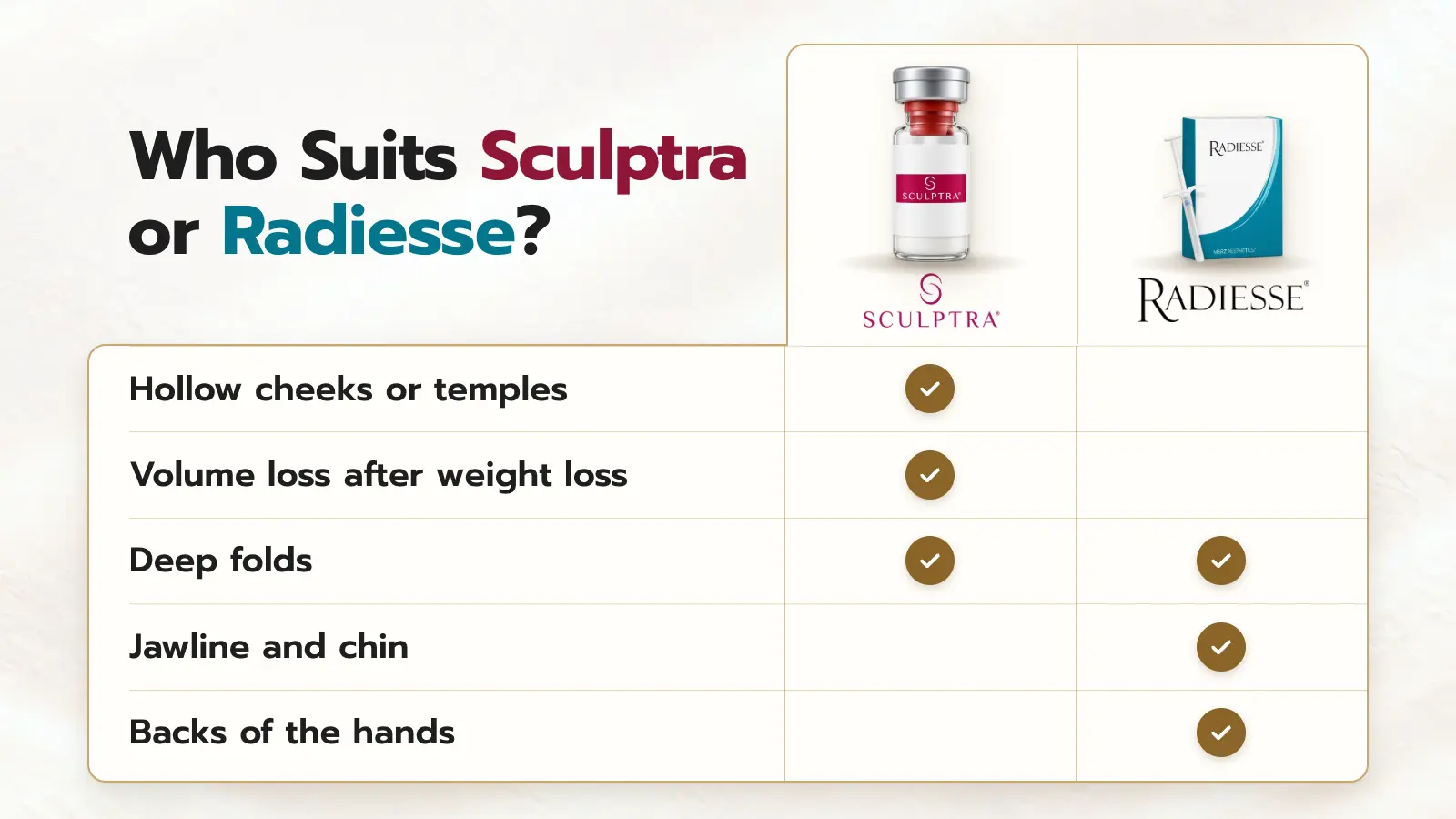
Radiesse, made of calcium hydroxylapatite (CaHA) microspheres in a gel carrier, lifts at once and then stimulates collagen and elastin; it suits the jawline, chin and deep folds, and when hyper-diluted it can also treat crepey skin on the neck and hands, with results lasting about 12–18 months.
Sculptra, made of poly-L-lactic acid (PLLA), builds collagen over about 3–6 months in hollow cheeks or temples, with results that can last up to two years.
Neither is automatically better. Sculptra usually needs 2–3 sessions and the 5-5-5 massage routine, while Radiesse often needs fewer sessions and no special massage; your anatomy, skin condition, medical history, and goals guide the final choice.
Ideal Candidates for Sculptra
Ideal candidates for Sculptra are adults with mild-to-moderate facial volume loss or skin laxity who are happy to wait for a gradual, natural-looking result rather than an instant change.
Because it rebuilds your own collagen instead of adding immediate volume like a traditional gel filler, it suits people who want to restore lost volume, smooth deep wrinkles and improve skin firmness and structural support over time.
Good candidates are typically aged about 30 to 65 and in good overall health.
Typical concerns include hollow cheeks or temples, deep folds such as nasolabial folds and marionette lines, thinning or crepey skin, and facial volume loss after significant weight loss or GLP-1 medicines such as Ozempic or Mounjaro. New collagen develops over about 3–6 months across a series of sessions.
Sculptra may not be suitable, or may need to be postponed, if you:
- Are pregnant or breastfeeding
- Have an active skin infection or inflammation at the planned treatment site
- Have a history of keloid or hypertrophic scarring
- Have a known allergy to any product component
- Have an active autoimmune condition or a weakened immune system
- Want immediate, one-session volume correction
Ideal Candidates for Radiesse
Ideal candidates for Radiesse are adults in their 30s to 60s with moderate-to-severe facial volume loss, deep wrinkles or skin laxity, looking for a non-surgical way to lift the face and boost collagen. It also suits people who want to define the jawline or restore volume to thinning skin on the backs of the hands.
Common treatment goals include smoothing nasolabial folds and marionette lines and restoring the cheeks and chin. Good candidates want both immediate volume correction from the gel carrier and long-term collagen and elastin stimulation, prefer minimal downtime with a quick recovery, and, if suitable, may choose Radiesse as a non-surgical alternative to a facelift or chin implant.
Radiesse may not be suitable, or may need to be postponed, if you:
- Are pregnant or breastfeeding
- Have an active skin infection or inflammation at the planned treatment site
- Have severe allergies or a known allergy to product components; Radiesse (+) also requires assessment for lidocaine allergy
- Have a bleeding disorder, or a history of keloid or hypertrophic scarring
Not Sure Which Biostimulator Is Right for You?
Our medical team can assess your concerns and recommend the most effective treatment plan during a personalized 1:1 consultation.
💬 Get a Free Consultation800+ reviews across Google & GoWabi · 6,700+ Patients Treated
Sculptra vs Radiesse: Materials and Treatment Differences
Sculptra and Radiesse differ in their materials, the speed of visible change and the treatment goals they suit.
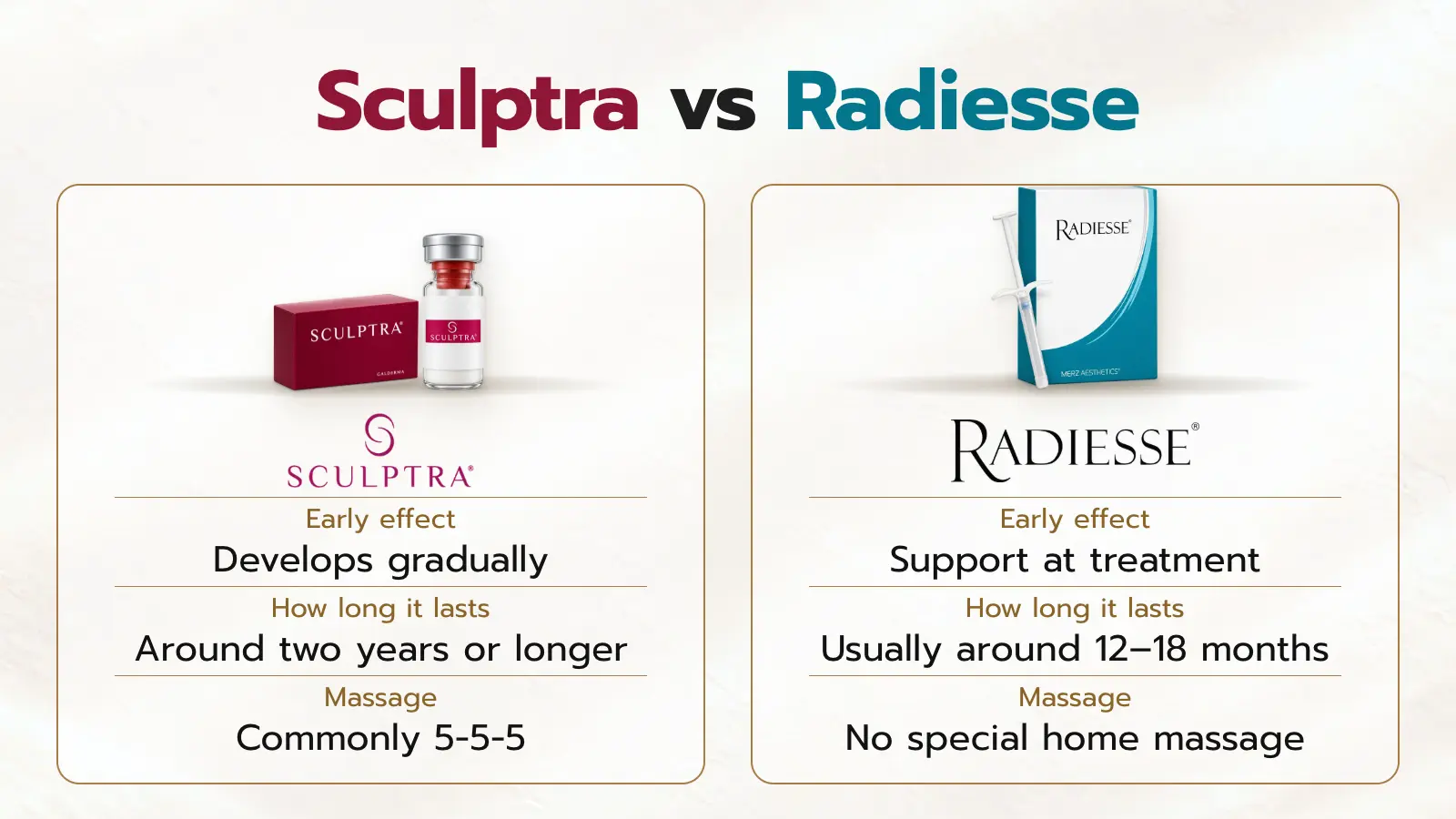
Hyperdiluted Radiesse is a useful qualification to a simple “volume now versus collagen later” comparison. A preparation used for neck or hand skin quality has less emphasis on immediate bulk than standard structural contouring.
| Feature | Sculptra | Radiesse |
|---|---|---|
| Main role | Broader, progressive volume restoration | Targeted structural definition; dilution can shift the aim toward skin quality |
| Initial appearance | Collagen-related change develops gradually; early fluid fullness settles | The gel can provide support at treatment |
| Typical duration | Around two years or longer after a suitable course | Usually around 12–18 months |
| Treatment course | Usually a short series of sessions | Often fewer initial visits, with review or touch-up as needed |
| Massage | A product-specific routine, commonly 5-5-5 | Generally no special home massage routine |
What Are Sculptra and Radiesse Made Of?
The active materials differ: Sculptra uses poly-L-lactic acid (PLLA), while Radiesse uses calcium hydroxylapatite (CaHA) microspheres in a gel carrier.
- Sculptra formulation: A synthetic, biocompatible and biodegradable polymer supplied as dry particles and prepared with sterile water. It does not contain a dense volumizing gel.
- Radiesse formulation: CaHA is a mineral-like material comparable to the mineral component of bones and teeth. Its microspheres are suspended in a water-based carboxymethylcellulose (CMC) gel.
How Soon Will You See Results?
Radiesse can provide an immediate visible contour change, whereas Sculptra develops its effect gradually over several weeks to months.
Sculptra's early improvement may become noticeable around six to eight weeks. This is the beginning of the response, rather than the fuller development assessed over the following months.
- On the treatment day: Radiesse's gel provides early support. Initial Sculptra fullness is largely fluid and swelling, rather than newly formed collagen.
- Over the following weeks: Sculptra's early fluid fullness settles, and a slower collagen-related improvement starts to emerge. Radiesse's contour is reviewed as swelling settles and tissue development continues.
- Fuller Sculptra development: The result commonly builds over about 3–6 months, with the course of sessions and individual response affecting the timeline.
Do not judge Sculptra's final effect from the first few days. For either treatment, allow time for recovery and review before planning an important event.
💡 Clinical Observation
At Edition Clinic, patients who prefer a "no one can tell" approach tend to favor Sculptra, while patients attending events or wanting faster visible improvement often choose Radiesse. Both can provide natural-looking, longer-lasting improvement when the product, treatment plan, and technique suit the patient.
How Long Do Sculptra and Radiesse Last?
Sculptra can last around two years or longer, while Radiesse usually lasts around 12–18 months.
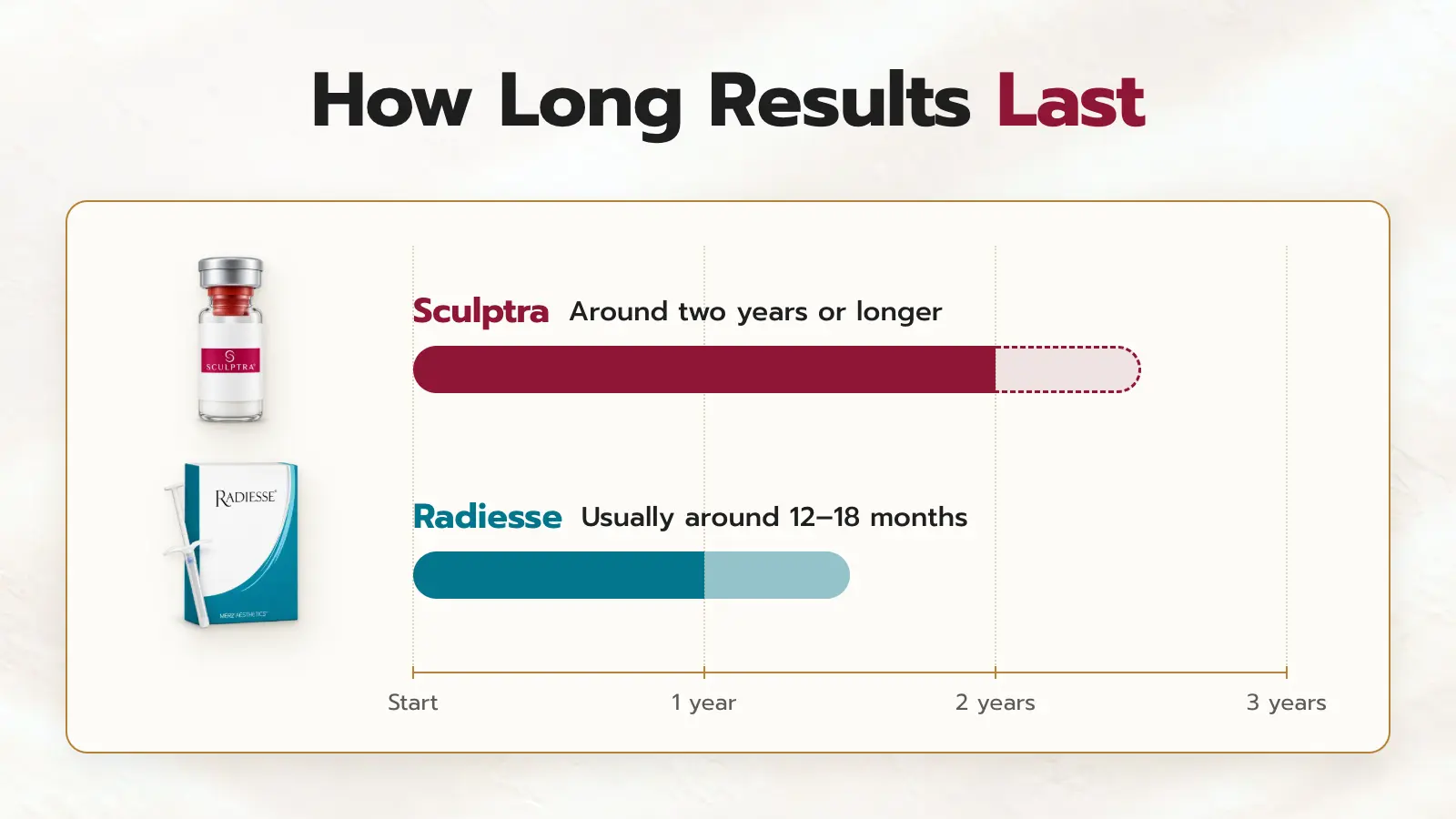
The Sculptra range refers to the result after a suitable treatment course. Some patients are described as retaining an effect for up to around three years, although that is not a guaranteed duration for everyone. Radiesse can last up to two years in some patients, but the usual planning range is shorter; annual maintenance is one approach discussed for selected plans. Area, product quantity, number of sessions and individual response all influence maintenance needs.
These ranges describe how long a result may remain visible; they do not set an automatic repeat-treatment date. Your doctor reviews the remaining effect and your goals before recommending maintenance.
Where Can Sculptra and Radiesse Be Used?
Sculptra and Radiesse can address selected facial and body concerns, but the appropriate areas and techniques differ with the treatment goal.
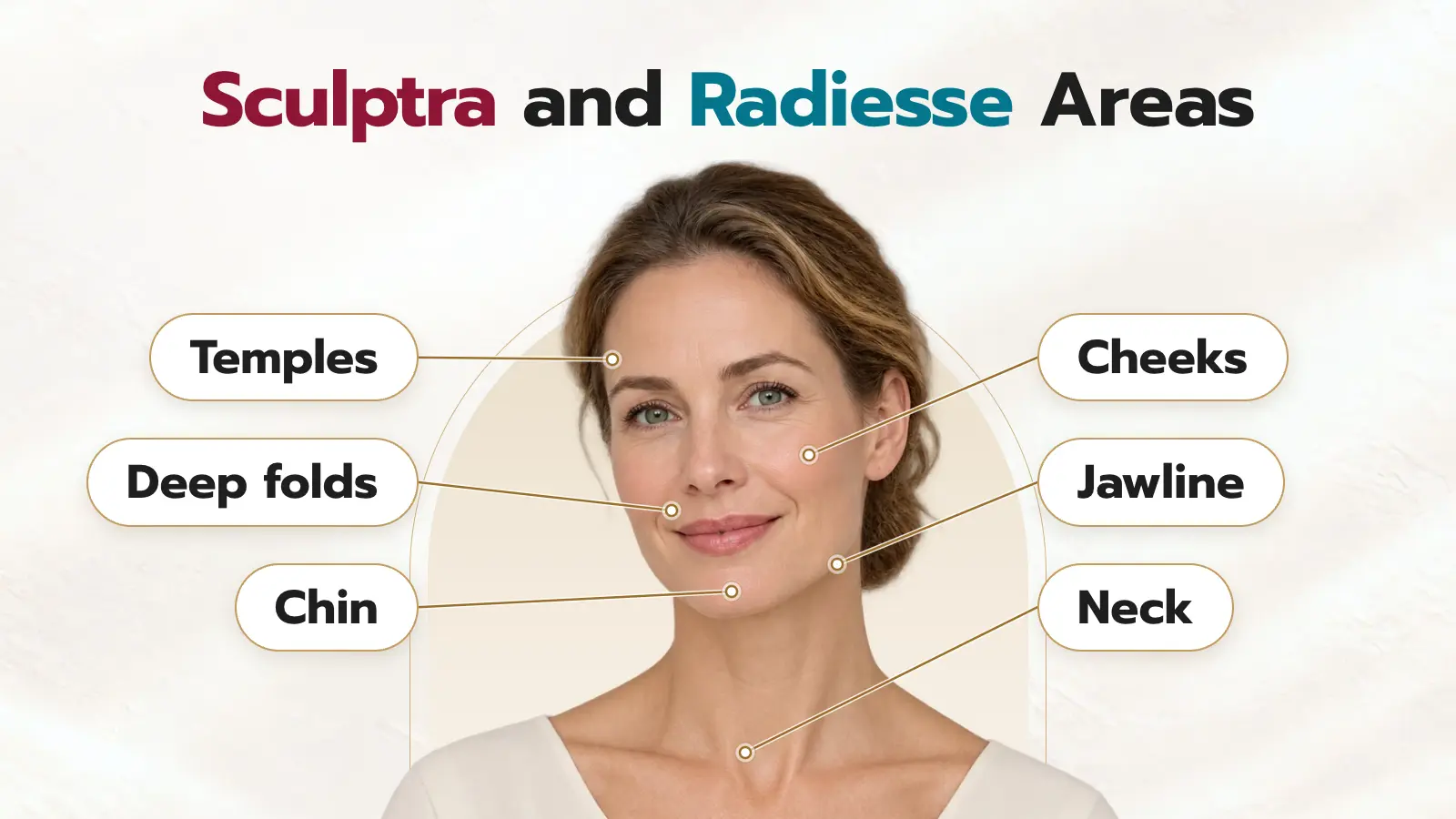
Sculptra Treatment Areas
- Cheeks and temples: Broader hollowing or loss of fullness.
- Jawline, chin and deeper facial folds: Gradual support across a wider region, rather than a sharply defined immediate projection.
- Selected body areas: Off-label applications include the buttocks, hip dips and upper chest. Neck treatment and superficial placement require particular care.
Sculptra's US facial indications and any proposed off-label use should be discussed for the individual treatment plan.
Radiesse Treatment Areas
- Cheeks, jawline and chin: Selected structural support and contour definition.
- Deep folds: Areas such as nasolabial folds and marionette lines.
- Backs of the hands: Volume restoration; Radiesse has a specific US hand-rejuvenation indication.
- Neck, chest and selected body skin: Hyperdiluted treatment targets skin quality with less immediate bulk.
Radiesse (+) has a specific US jawline indication. A 1:2 dilution has a US décolleté-wrinkle indication; neck use and selected body areas such as the upper arms, abdomen, thighs and above the knees are off-label in the US. Concentration and placement determine the aim.
Areas to Avoid for Both Treatments
Neither Sculptra nor Radiesse is generally recommended for the lips, under-eyes, nose or forehead, because high mobility and thin skin in these areas raise the risk of visible lumps or nodules.
Radiesse is also too thick and viscous for these delicate areas, the nose and forehead carry a higher risk of vascular complications, and both products are generally avoided between the eyebrows (glabella). For the lips and under-eye tear troughs, hyaluronic acid (HA) fillers remain the preferred standard.
Sculptra or Radiesse: Which Fits Your Goals?
Consider Radiesse when earlier structural definition is the priority, or Sculptra when you prefer gradual restoration across a broader area.
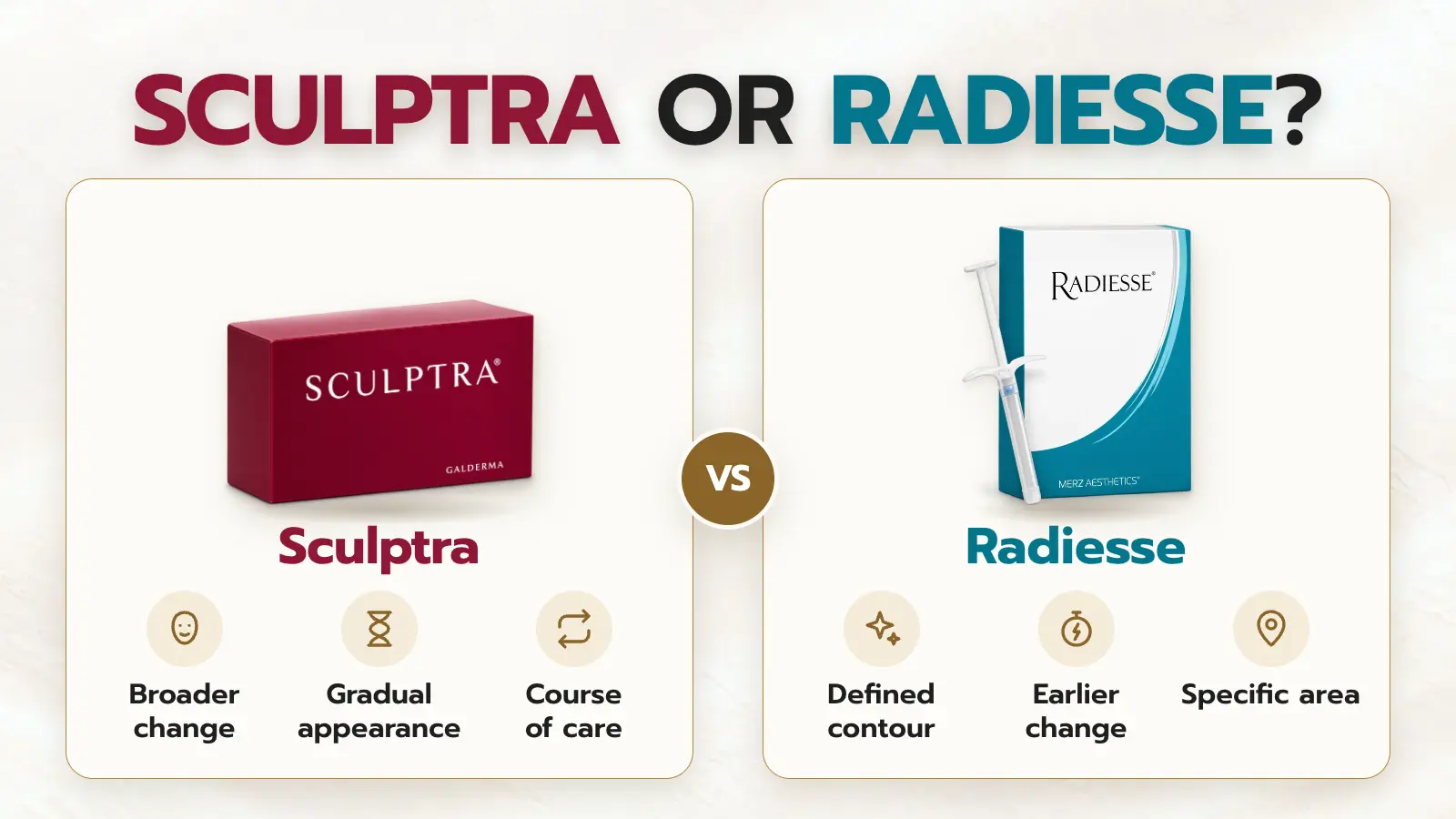
When weighing Sculptra vs Radiesse, the treatment area also matters. A neck, chest or hand skin-quality concern may lead to a discussion of hyperdiluted Radiesse rather than standard contouring. That choice involves a different preparation and aim from creating a defined jawline.
When Sculptra May Fit
- A broader change: Diffuse cheek or temple hollowing and an overall loss of support.
- A gradual appearance: You prefer change that develops over time.
- A course of care: You can attend a series of sessions and follow the massage instructions.
When Radiesse May Fit
- A defined contour: A selected jawline, chin or deeper fold needs structural support.
- An earlier visible change: You want a result from the carrier gel while later tissue development continues.
- A specific area: Hand volume loss or a suitable skin-quality concern may call for a different preparation and technique.
In Edition Clinic’s experience, some patients who request a conventional filler are better suited to a biostimulator when their concern is broader, longer-term rejuvenation, although this always depends on individual assessment.
Some concerns need another treatment or a combined plan, particularly when several tissue layers are involved or the target is a delicate area.
At Edition Clinic, a 1:1 doctor consultation reviews facial structure, medical history, previous injectables, and your timeline before recommending a plan.
Can Sculptra and Radiesse Be Used Together?
Yes, Sculptra and Radiesse can form part of one treatment plan, with the products placed in different areas or scheduled separately rather than mixed in the same spot at the same visit.
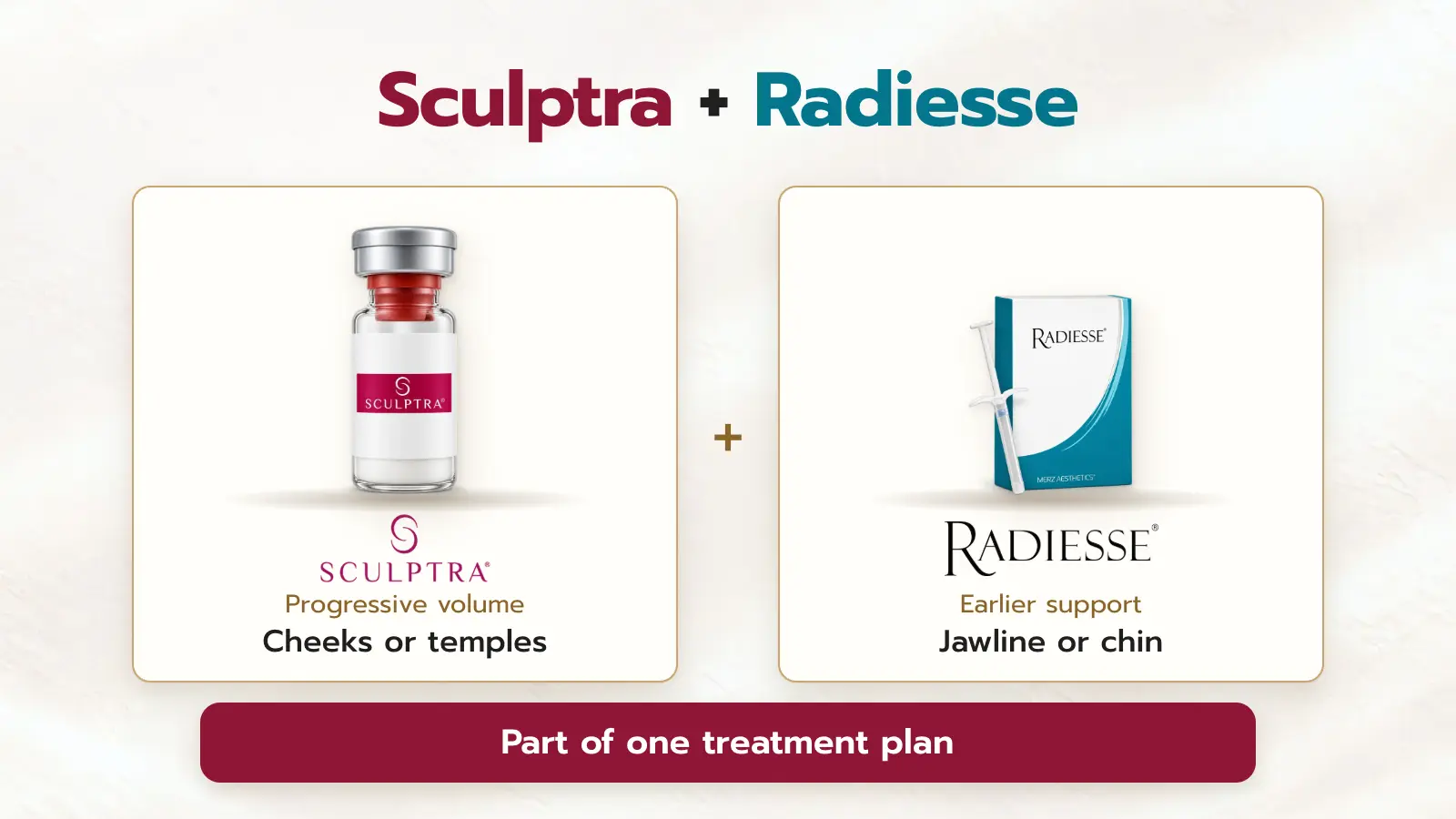
Sculptra and Radiesse are not reversed with hyaluronidase in the way an HA gel can be, which makes the initial placement plan particularly important. Combined plans may be separated by weeks or months when the response needs to be assessed before another product is added.
- Radiesse's role: Earlier support for a selected contour, such as the jawline or chin.
- Sculptra's role: Progressive volume and skin support across broader areas, such as the cheeks or temples.
Planning Placement and Timing
The doctor maps the tissue layers and target zones, considers previous injectables and reviews how the skin responds before adding treatment. Careful placement matters because uneven distribution or inappropriate layers can contribute to lumps or nodules.
There is no single waiting period for every combined plan. The sequence depends on the areas, intended effect and response. Delicate or highly mobile areas may need a different option, including selected hyaluronic acid (HA) fillers.
Sculptra vs Radiesse: Recovery and Aftercare
Most patients can return to routine activities soon after either treatment, although swelling, bruising, or tenderness may remain visible for several days. Sculptra usually needs a specific massage routine, while Radiesse care depends on the treated area and technique, so follow your doctor’s product-specific instructions.

- Swelling: Usually most noticeable in the first 24–48 hours, then settles over several days.
- Bruising: Can last several days and sometimes 1–2 weeks.
- Tenderness: Usually improves within a few days; report persistent or worsening symptoms.
Sculptra Aftercare
Sculptra aftercare commonly includes the 5-5-5 massage routine: gently massage the treated areas for 5 minutes, 5 times a day, for 5 days, unless your doctor advises otherwise. This helps distribute the product but does not remove every risk of a lump or nodule.
Radiesse Aftercare
Radiesse aftercare should follow the specific technique used. There is no universal 5-5-5 rule, so avoid unadvised pressure or vigorous massage on the treated area, and massage only if your doctor recommends it for that specific area or for a diluted protocol.
Ask the clinic about exercise, heat, makeup, and sleeping position, and allow recovery time before important events. Sudden vision changes, severe unusual pain, or pale or mottled skin need urgent medical assessment.
Are There Any Side Effects or Risks?
Yes, Sculptra and Radiesse can both cause temporary swelling, bruising, redness, tenderness, or itching, and both can cause lumps or delayed reactions. Rare injection into a blood vessel can cause serious harm, so product selection, anatomy, technique, and prompt recognition of complications matter.
Common Side Effects (Both Treatments)
Most of these reactions are mild and short-lived: swelling, redness and tenderness usually improve over several days, while bruising occasionally lasts 1–2 weeks. Severity varies by area, technique, and individual response; persistent or worsening reactions need review.
Sculptra Side Effects and Risks
Sculptra (poly-L-lactic acid) most commonly causes temporary injection-site reactions such as swelling, bruising, redness, pain and tenderness, while its serious risks are rare. As an FDA-approved collagen stimulator, it is generally safe when a trained professional injects it, but it carries specific short- and long-term risks.
Itching, warmth and minor bleeding can also occur, and these reactions usually settle within a few days to two weeks. Its main specific risk is small nodules or lumps that can appear weeks or months later, sometimes 6–12 months after treatment, and unlike hyaluronic acid fillers, Sculptra cannot be easily dissolved.
- Nodules and papules: More likely when the product is injected too superficially, improperly mixed or unevenly distributed; the 5-5-5 massage routine significantly reduces this risk.
- Delayed inflammatory reactions: Granulomas can appear later and may need corticosteroid injections or surgical management; report persistent or growing lumps.
- Infection and vascular occlusion: Both are rare; accidental injection into a blood vessel can block blood flow and cause tissue necrosis (skin death), vision impairment or blindness, and very rarely stroke, with the temples and the area around the eyes carrying the highest risk.
Radiesse Side Effects and Risks
Radiesse most commonly causes temporary injection-site reactions, including swelling, bruising, redness, pain and itching, whereas serious risks such as nodules and vascular occlusion are rare. Unlike hyaluronic acid (HA) fillers, this FDA-approved calcium hydroxylapatite (CaHA) filler cannot be dissolved with hyaluronidase if a complication occurs.
Tenderness is also common, and small lumps or temporary firmness can appear as the product settles; these effects usually clear within a few days to two weeks.
- Lumps and uneven correction: More likely with superficial placement, thin tissue, or high-movement areas, which is why the lips, nose and area around the eyes are avoided.
- Granulomas and delayed nodules: Uncommon, can appear months later, and may need steroid injections or surgical removal.
- Infection: Localized skin infection or reactivation of cold sores (herpes simplex) can occur.
- Allergy and vascular events: Radiesse (+) contains lidocaine, so allergy must be assessed; rare vessel injection can cause tissue death (necrosis), vision changes, or stroke.
⚠️ Important Safety Information
Rare vascular complications from either injectable can damage skin and, in severe cases, affect vision or cause stroke. Seek urgent medical care for sudden visual disturbance, severe unusual pain, or pale or mottled skin during or after treatment.
Active infection at the planned site should be treated before injection; allergies, bleeding disorders, immune-related conditions, pregnancy or breastfeeding, and relevant scarring history need product-specific medical assessment. Radiesse (+) also requires assessment for lidocaine allergy. All biostimulator treatments at Edition Clinic are performed by licensed medical professionals, and individual results vary.
Have Questions About Safety or Side Effects?
Our doctors will address all your concerns during a free, no-obligation consultation. Every treatment starts with a thorough 1:1 assessment.
💬 Ask Our Medical TeamAll treatments performed by licensed medical professionals
Why Choose Edition Clinic for Biostimulator Treatments?
Edition Clinic in Thonglor, Bangkok, is a premium aesthetic dermatology clinic that delivers Korean-standard treatments with personalized, results-driven care. For biostimulators such as Sculptra and Radiesse, the doctor’s technique and experience directly affect the results you can expect from treatment.

- 1:1 Personalized Consultation: Every patient receives a dedicated consultation with an Edition Clinic doctor to create a customized treatment plan — no cookie-cutter approaches.
- Established in 2023: Edition Clinic provides personalized care for each treatment.
- Treatment Support: The Edition Clinic treatment team provides care during and after your procedure.
- Nurse with 500+ Patient Care Experience: The clinic’s dedicated nurse has cared for over 500 patients, ensuring your comfort throughout the treatment process.
- 6,700+ Patients Treated: This is the clinic-wide patient count, not a treatment-specific count.
- Official Bangkok Branch: Edition Clinic is the official Bangkok branch of Edition Plastic Surgery, Seoul.
Our Philosophy: "Different Skills, Different Results. At Edition Clinic, we combine advanced Korean aesthetic techniques with 1:1 personalized care to deliver outcomes that truly make a difference."
Ready to Start Your Biostimulator Journey?
Book your session at Edition Clinic Bangkok. Expert doctors, premium facility, transparent pricing.
📅 Book Your Appointment800+ reviews across Google & GoWabi · 6,700+ Patients Treated
Clinic-wide patient count: 6,717 unique patients treated from 7 August 2023 to 1 October 2026, excluding repeat visits. This is not a treatment-specific count.
Frequently Asked Questions About Sculptra vs Radiesse
1. Is Sculptra or Radiesse better for facial volume loss?
Both are effective for facial volume loss, but they work differently. Sculptra is better for gradual, widespread volume restoration over multiple sessions, while Radiesse provides some immediate volume plus long-term collagen stimulation. Your doctor will recommend the best option based on your specific concerns and goals.
2. How many sessions of Sculptra do I need?
Most patients need 2–3 sessions of Sculptra spaced 4–6 weeks apart. The exact number depends on your age, the degree of volume loss, and your desired outcome. At Edition Clinic, doctors create a personalized treatment plan during your 1:1 consultation.
3. Does Radiesse give instant results?
Yes, Radiesse provides immediate volume and lift, because its calcium hydroxylapatite (CaHA) microspheres sit in a supportive gel. Over the following weeks and months, it also stimulates collagen and elastin, so firmness can continue to improve as the gel is absorbed.
4. How long does Sculptra last compared to Radiesse?
Sculptra results can last up to two years after a full course of 2–3 sessions, while Radiesse results generally last around 12–18 months. Duration varies with metabolism, lifestyle, treatment area, and product amount, and some studies report longer Radiesse effects, so your doctor plans maintenance individually.
5. Is Sculptra safe for under-eye hollows?
Sculptra is generally not recommended for the under-eye area due to the risk of nodule formation in thin-skinned areas. Dermal fillers like hyaluronic acid (HA) fillers are typically preferred for under-eye hollows. Consult with an experienced doctor to determine the safest approach.
6. What is the downtime after Radiesse treatment?
Downtime after Radiesse is minimal, usually 1–3 days. Most patients have mild swelling, redness, or bruising at the injection sites, although bruising can occasionally last 1–2 weeks. You can typically return to normal activities the same day, but avoid strenuous exercise for 24–48 hours.
7. Can I get Sculptra or Radiesse if I have sensitive skin?
Yes, both Sculptra and Radiesse are generally safe for patients with sensitive skin, as they are injected beneath the skin's surface. However, a thorough consultation is essential to review your medical history and any allergies. All treatments at Edition Clinic begin with a 1:1 consultation to ensure safety.
8. What age should I start collagen biostimulator treatments?
Collagen biostimulators are most commonly sought by adults aged about 30 to 65, when natural collagen production begins to decline noticeably. However, there is no strict age requirement. A consultation with a qualified aesthetic doctor can help determine if you are a good candidate.
9. How do I choose between Sculptra and Radiesse?
The choice depends on your goals, budget, and timeline. Choose Sculptra if you want gradual, natural-looking results over a longer period. Choose Radiesse if you want some immediate improvement alongside long-term collagen building. At Edition Clinic Bangkok, doctors provide personalized recommendations during your consultation.
Ready to Restore Your Youthful Volume?
Book your personalized Sculptra or Radiesse consultation at Edition Clinic Bangkok. Expert doctors, Korean-standard care, transparent pricing.
