

Botox for Wrinkles: How It Works
Table of ContentsShow / Hide
Written & Medically Reviewed by
- Medical Doctor, Chulalongkorn University — Second Class Honors
- Dermatology (International Program) 2024–2025, Chulabhorn International College of Medicine, Thammasat University
- 3 Years Experience in Aesthetic Medicine
Quick Answer
Botox for wrinkles is a botulinum toxin type A injection that temporarily relaxes targeted facial muscles, so dynamic wrinkles like frown lines between the brows soften while lines at rest improve only partly.
In Edition Clinic's guidance, results usually last about 3 to 6 months, mild redness or small bruises are common, and pregnancy or breastfeeding rules treatment out.
With Botox, wrinkles fold less while your face keeps moving, so you can still frown, smile and raise your brows. Many people worry about looking frozen or about lines coming back deeper later, and neither is the aim of treatment when the dose is planned with care.
At Edition Clinic, your doctor checks how each line behaves at rest and in motion before choosing a dose. Lines that stay visible with your face still are explained up front, so you know what to expect.
What Is Botox for Wrinkles?
Botox for wrinkles is an injection of a purified muscle-relaxing protein called botulinum toxin type A. A doctor injects small doses into the muscles that fold your skin, so lines caused by movement smooth out. The effect is temporary and fades over several months, so treatment is repeated to keep the result.

Allergan's product, BOTOX Cosmetic, contains onabotulinumtoxinA, which the US FDA prescribing information (revised 2024) describes as a purified botulinum toxin type A supplied in vials of 50 or 100 Units.
Many people use the word Botox for any wrinkle-relaxing toxin, the way a brand name becomes an everyday word. In this guide, Botox means botulinum toxin type A in general, and the brand mainly affects dose and price.
Botox is a prescription medicine, so a doctor assesses your face before any injection.
How Does Botox Work on Wrinkles?
Botox works by blocking the nerve signal that tells a targeted muscle to contract, so the muscle relaxes and the skin above stops folding. Lines that form with movement soften the most. The effect builds over the first days and fades as the nerve endings recover.
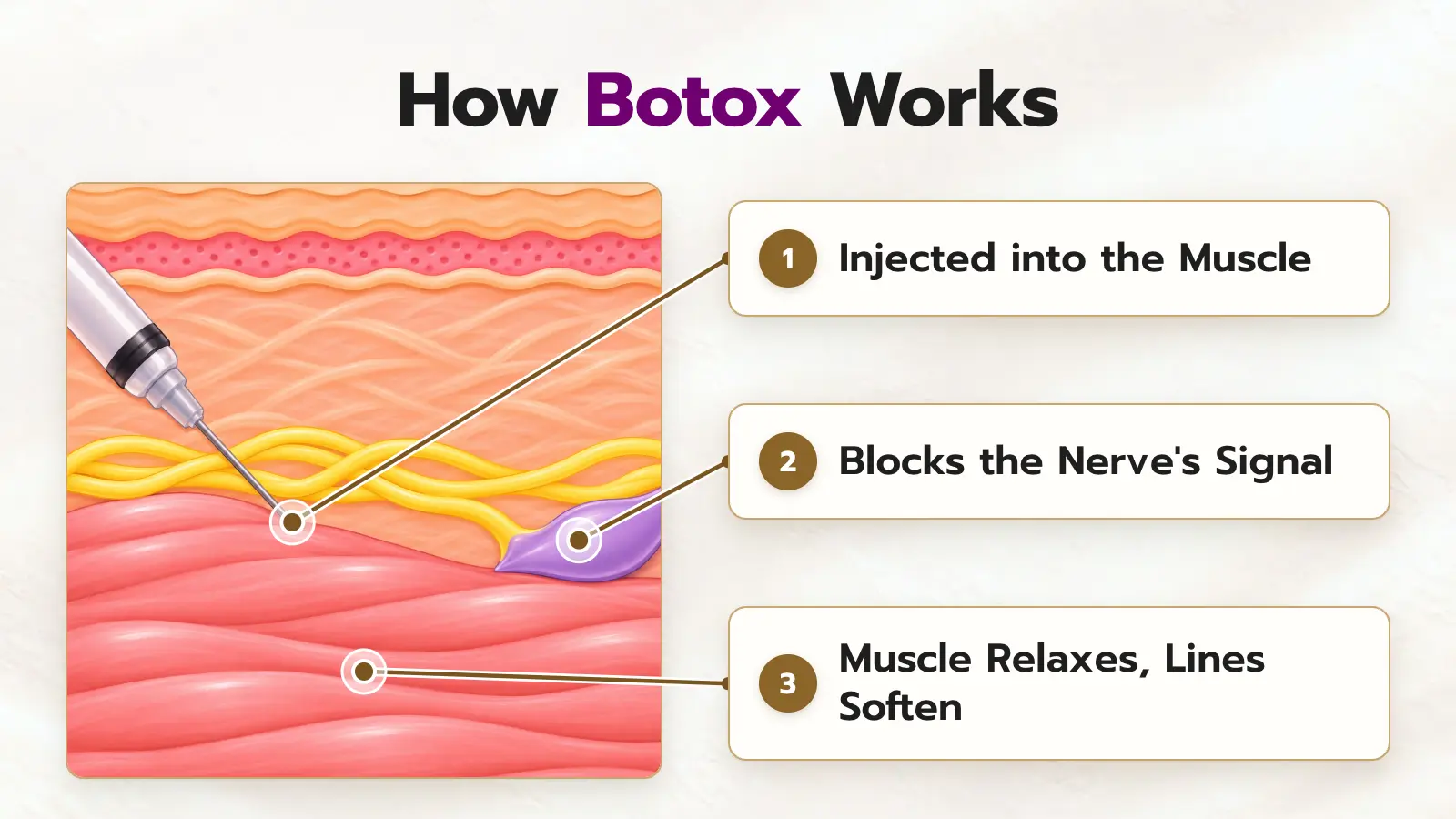
A 2014 review in American Family Physician explains that wrinkles form from thinning skin and repeated muscle contraction underneath.
The same review says botulinum toxin stops the release of acetylcholine, the chemical messenger that tells a muscle to contract, so small doses relax specific overactive muscles and smooth the skin over them.
According to the BOTOX Cosmetic prescribing information, muscle relaxation starts 1 to 2 days after injection and grows stronger over the first week.
Because the dose controls how much a muscle relaxes, your doctor sets it to soften the fold while keeping natural movement. A higher dose is not automatically a stronger result for your face.
Which Wrinkles Does Botox Work On?
Botox helps most with lines that appear when you move your face, but lines visible at rest only soften rather than disappear. Botox does not fix sun spots, dark patches, thinning skin or sagging, so deep resting lines may need filler or a treatment that renews the skin surface added. Your doctor checks each line with your face still and moving to tell the two apart.
Dynamic Wrinkles: Lines That Come and Go
Dynamic wrinkles are lines that appear when a muscle contracts and fade when your face relaxes, such as forehead lines when you raise your brows. Botox suits these lines well, because relaxing the muscle removes the fold that creates them. Frowning and squinting create the same kind of line.
The American Family Physician review notes that dynamic wrinkles, seen during muscle contraction, give more dramatic results than static wrinkles, which are visible at rest.
A simple test is to look in a mirror with your face relaxed, then frown. A line that appears only with the frown is a dynamic line.
Static Wrinkles: Lines Visible at Rest
Static wrinkles are lines you can still see when your face is completely still, often after years of folding, sun exposure and thinning skin. Botox can soften a static line by stopping the fold that keeps deepening it, but it rarely erases the line. Improvement is usually gradual and may take more than one session.
A Cleveland Clinic health article on the long-term effects of Botox notes that a provider may suggest adding dermal fillers for deeper lines.
Can Botox Prevent Wrinkles From Forming?
Botox may help delay expression lines from setting in, because a relaxed muscle folds the skin less often. Botox cannot stop aging. The right time to start depends on your skin and whether lines already show at rest, not on a fixed age.
The same Cleveland Clinic article says that mini doses in younger years, known as Baby Botox, may have a preventive effect that keeps wrinkles from developing as quickly or as intensely.
Prevention is a reasonable expectation rather than a proven result, so treat it as a possible benefit, not a promise. Starting later still softens lines that move.
Which Areas Can Botox Treat for Wrinkles?
Botox treats wrinkles mainly on the upper face: forehead lines, frown lines and crow's feet, the most commonly treated areas. Some doctors also treat bunny lines on the nose, lip lines and chin dimpling, a bumpy look on the chin, while cheek and hand wrinkles usually need a different approach.
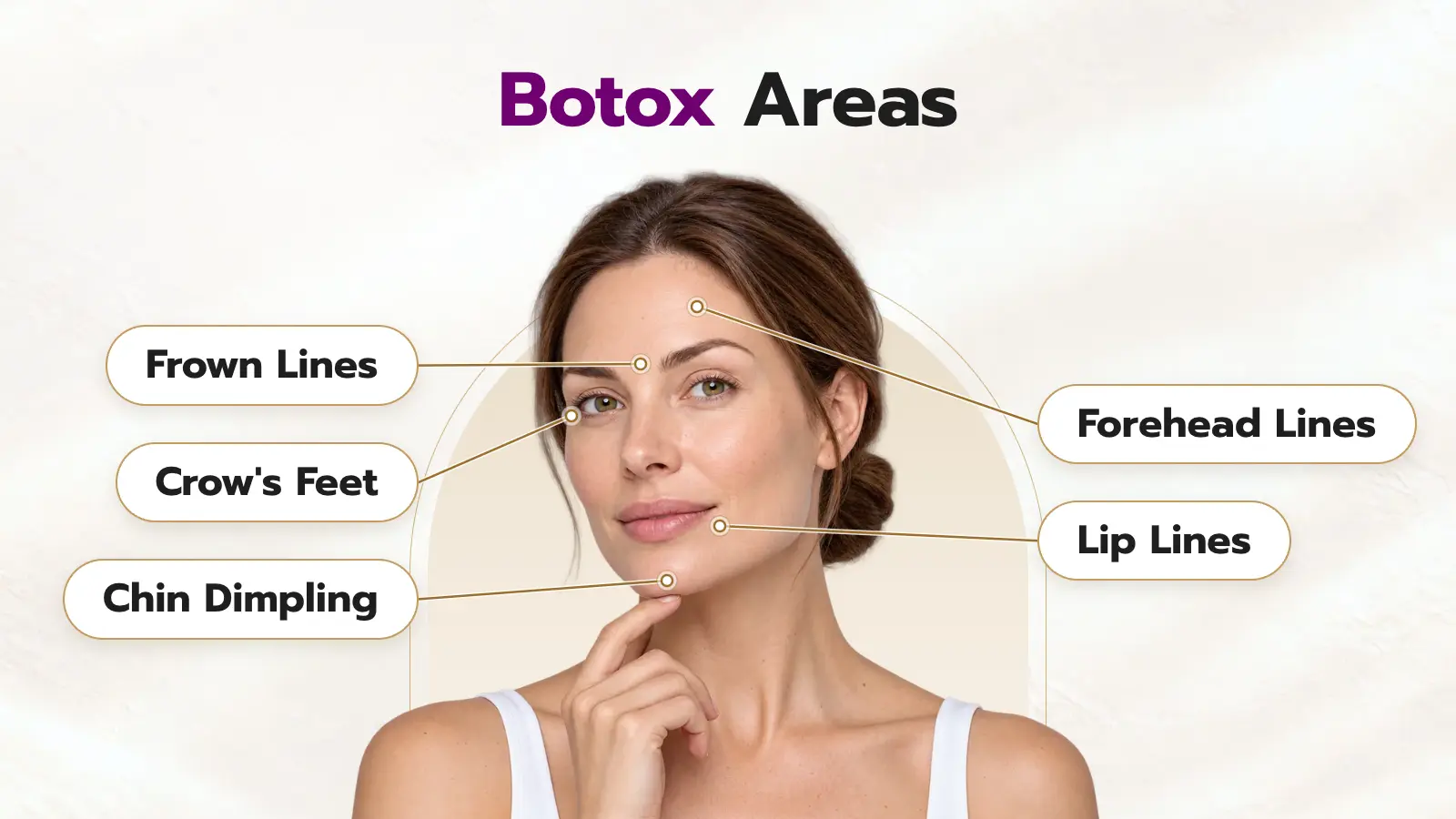
Forehead Lines, Frown Lines and Crow's Feet
Forehead lines, frown lines and crow's feet are the lines Botox treats most often, because each forms over a strong, busy muscle. Forehead lines run across the brow, frown lines sit between the brows, and crow's feet fan out from the outer corners of your eyes. Frown lines are often called the "11s" because of their shape.
Patient guidance from the American Society of Plastic Surgeons also names frown lines, forehead creases and crow's feet near the eyes as the most commonly treated areas.
The BOTOX Cosmetic prescribing information lists frown lines, crow's feet and forehead lines among its approved cosmetic uses.
Bunny Lines, Lip Lines and Chin
Bunny lines, lip lines and chin dimpling are areas some doctors treat with Botox when a muscle there causes the crease. Bunny lines form on the sides of the nose when you wrinkle it, and lip lines run upward from your top lip. Chin dimpling makes the chin skin look uneven, like orange peel.
The same society's guide lists lip lines, bunny lines and dimpling of the chin among the areas botulinum toxin can improve.
These areas sit close to the muscles you use to speak, smile and eat, so placement needs care.
Cheek and Hand Wrinkles
Cheek and hand wrinkles are generally not a first choice for Botox. These lines come mostly from thin skin, volume loss and sun damage rather than strong muscle pull. Relaxing a muscle does little for a line when no muscle is folding the skin there.
For these areas, your doctor may suggest other treatments, such as filler to restore volume or treatments that improve skin quality.
How Many Units Each Area Needs
The number of Botox units depends on which areas you treat, how strong the muscles are and which brand is used. Your doctor tailors the dose to your muscles and the brand, so two people may need different amounts for the same area. The figures below are label starting points, not fixed rules.
For BOTOX Cosmetic, the prescribing information recommends a total of 20 Units for frown lines, 24 Units for crow's feet on both sides and 40 Units for forehead lines treated together with frown lines.
Added together, those BOTOX Cosmetic label doses come to 64 units for all three upper-face areas.
The same prescribing information states that BOTOX Cosmetic units cannot be compared to or converted into the units of any other botulinum toxin.
A 2024 review in Toxins reached the same conclusion: units of different toxin products are not interchangeable or convertible using dose ratios.
A dose that suits one brand cannot simply be copied to another. Bring the brand and units from any earlier treatment, so your doctor can plan from them.
How Soon Does Botox Work and How Long Does It Last?
Botox results appear in about 3 to 7 days and reach their full effect at about 2 weeks, in Edition Clinic's guidance. Results usually last about 3 to 6 months for most people. When the effect fades, muscle movement returns gradually and lines go back to how they were, not worse than before.
Day-by-Day Results Timeline
The Botox results timeline moves from small changes in the first days to a settled result at about two weeks. Many people notice early softening within the first week, and the lines keep smoothing as the muscle relaxes further. Judge your result at the two-week mark, not the morning after.
What to expect after your injections:
- First days: you may see a little redness or a small bruise while the muscle begins to relax.
- Days 3 to 7: visible softening of the lines usually appears, in Edition Clinic's guidance.
- About 2 weeks: the result reaches its peak, and your doctor can judge it fairly.
- Months 3 to 6: movement slowly returns and the lines begin to show again.
In a 2011 open-label study in the Journal of Drugs in Dermatology, 45 women new to toxin treatment had onabotulinumtoxinA for frown lines, and 48% reported the effect starting on day 1.
By day 3, 93% of those women reported an effect. The study was small and had no comparison group, so its figures show how early some people notice a change.
For frown lines, the BOTOX Cosmetic prescribing information gives an effect lasting approximately 3 to 4 months.
A 2012 pooled analysis in Dermatologic Surgery combined four phase 3 trials of 621 patients given 20 Units for frown lines. Among responders, the median effect lasted 120 days when frowning and 131 days at rest.
How Often to Repeat Botox
Repeat Botox treatments are usually planned every 3 to 6 months, with at least three months between sessions. Your doctor sets the timing of the next session by how your lines move again, not by the calendar alone. Steady spacing also helps each treatment keep working well.
A 2025 narrative review on Botox that stops working in aesthetic patients lists intervals shorter than three months and top-up injections within 3 weeks among the triggers for losing the effect.
What Happens When Botox Wears Off
Wrinkles do not come back worse when Botox wears off. Muscle movement returns gradually, and your lines return to how they looked before treatment. Many people notice the movement first and the line later, so you can book your next visit when the line starts forming again, rather than waiting for it to set.
Cleveland Clinic's patient guide to Botox explains that within three to six months the toxin wears off, muscles regain movement and wrinkles return.
The Cleveland Clinic article on long-term effects adds that if you stop getting injections, the effects simply fade with time.
Botox or Filler for Wrinkles?
Botox and filler do different jobs: Botox relaxes the muscles behind movement lines, while filler adds volume where fullness has been lost. The two are often combined when medically appropriate, with each treating a different cause. The right choice for each line depends on what creates it.
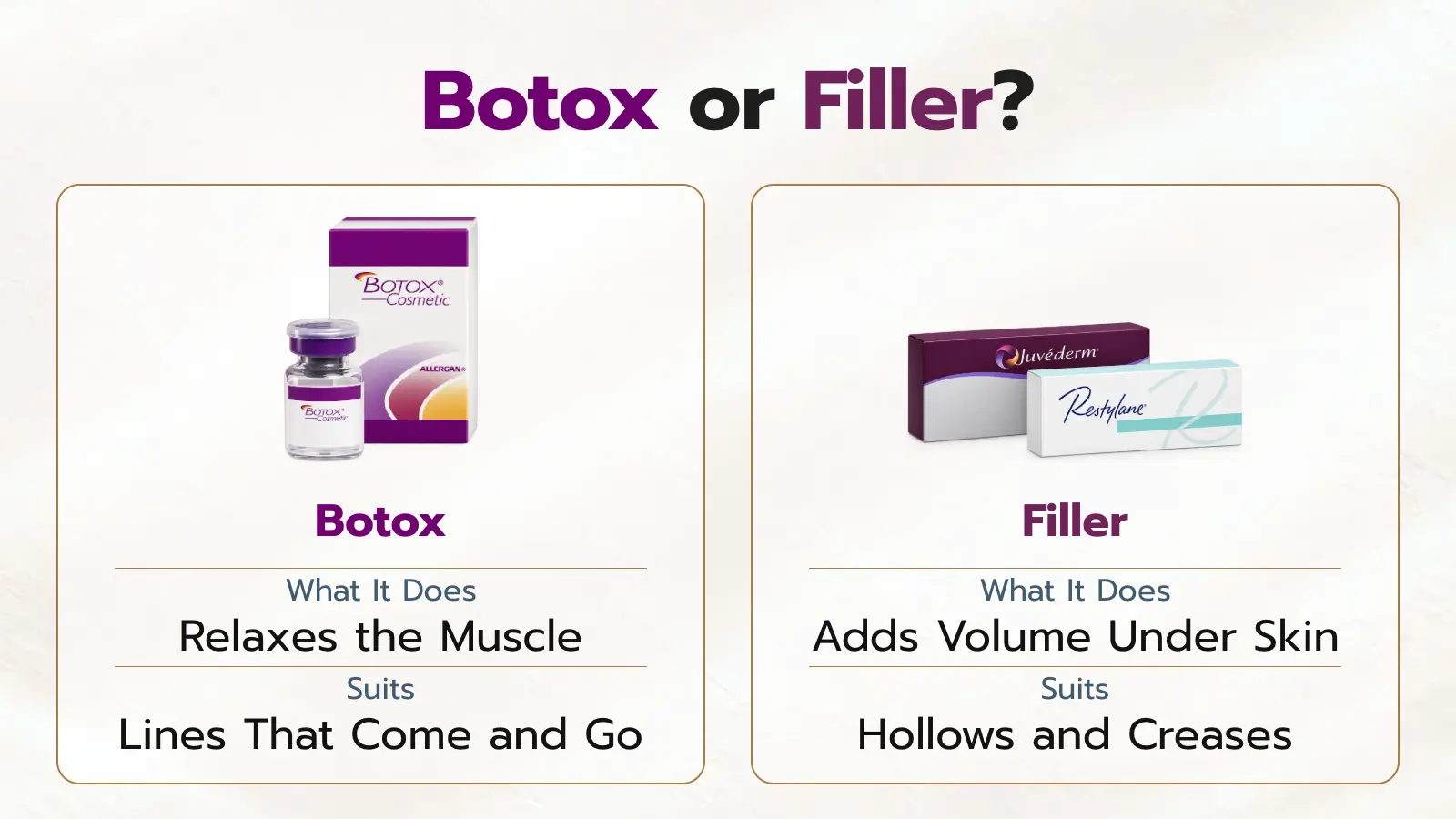
Cleveland Clinic's Botox guide describes the difference the same way: Botox injections temporarily paralyze muscles to reduce wrinkles, while dermal fillers add volume and help retain moisture.
Botox and filler side by side:
- Botox: relaxes the muscle that folds the skin, so it suits lines that come and go with movement.
- Filler: adds volume under the skin, so it suits hollows and creases that stay when your face is still.
The filler treatments in Bangkok page explains the filler options at Edition Clinic.
Using Botox and Filler Together
Botox and filler can be used together when your face has both movement lines and lost volume. Your doctor decides the order and timing of each treatment after the assessment. A combined plan treats the cause of each line instead of asking one product to do everything.
A common example is a frown line that folds with movement next to a hollow that stays at rest. Each needs its own tool.
Tell the doctor about any filler you already have, with the product name and date if you know them.
Other Options for Lines at Rest
Lines at rest that Botox only softens can also be treated with approaches that work on the skin itself. The options include skin resurfacing, which renews the top layer of skin, and energy-based devices, which heat deeper layers. The doctor recommends whether any of these suits your lines and timeline.
A third route is collagen-stimulating injections, which help the skin build more collagen, its firming protein, over time.
No single option suits every line, and none replaces Botox for lines that move. Each has its own downtime and cost, which the doctor explains at the consultation.
Pros and Cons of Botox for Wrinkles
Botox softens movement lines on the forehead, between the brows and around the eyes in a quick visit with no downtime. The drawbacks are that results are temporary, so repeat visits are needed, and deep lines at rest may need several sessions or added treatment. Careful dosing and placement keep the look natural, avoiding a heavy brow or stiff expression.
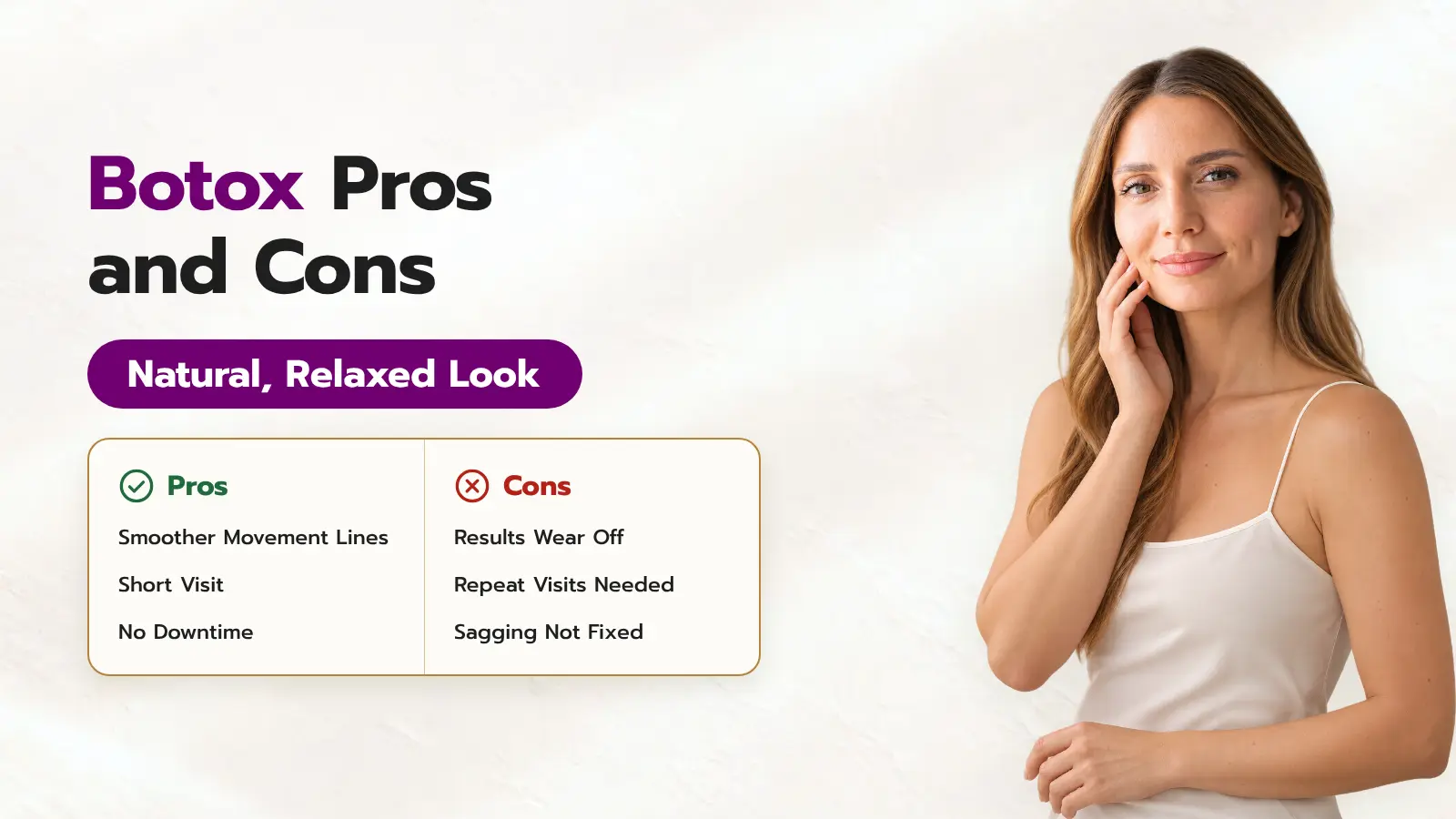
Benefits of Botox for Wrinkles
The main benefits of Botox for wrinkles are smoother movement lines, a short visit and no downtime. The aim at Edition Clinic is a relaxed, natural look, with conservative dosing that keeps your expressions. Most people return to their daily routine straight after the appointment.
The American Academy of Dermatology explains that botulinum toxin temporarily relaxes the targeted muscles, so fine lines and wrinkles diminish.
A good result looks like you on a well-rested day, not like a different face.
Drawbacks to Know
The drawbacks of Botox are plain: results wear off, repeat visits are needed, and deep resting lines and sagging skin are not fixed. Small bruises can also appear where the needle went in. Knowing these limits before you book helps you judge your result fairly.
Because the effect lasts months rather than years, Botox is an ongoing commitment of time and cost. Plan your visits around work, travel and events.
Less common effects, such as a heavy brow or eyelid, are covered with the other risks under side effects and warning signs.
Is Botox Safe? Side Effects and Who Should Avoid It
Botox is generally safe when a trained doctor injects a genuine product at suitable doses, and side effects are usually mild and short-lived. Pregnancy, breastfeeding and nerve or muscle conditions are reasons to avoid Botox or talk to the doctor first.
Cleveland Clinic's patient guide states that Botox is generally safe when administered by a licensed healthcare provider, and that most issues are mild and improve in a day or two.
A 2014 review in the Journal of Clinical and Aesthetic Dermatology found that side effects of toxin products are mostly mild and always self-limited, meaning they settle on their own.
Common Side Effects
Common side effects of Botox are mild redness, swelling or tenderness where the needle went in, small bruises and a mild headache. Bruises may take about a week to fade. Most reactions settle on their own without any treatment.
The American Academy of Dermatology notes that side effects tend to be mild and temporary, and that bruising, if it happens, lasts about 1 week.
In frown-line trials against a dummy injection, called a placebo, the BOTOX Cosmetic prescribing information reports a drooping eyelid in 13 of 405 treated patients (3%), against 0 of 130 on placebo (0%).
The academy describes a temporarily droopy brow or eyelid, caused by weakness in a neighboring muscle, as rare.
A drooping brow or eyelid wears off, but contact the clinic if it happens so the doctor can check it. Tell the clinic too if your expression looks uneven or stiff once the result has settled.
Rare Warning Signs to Know
Rare warning signs after Botox include trouble breathing, swallowing or speaking, general muscle weakness and double or blurred vision. Symptoms like these can mean the toxin has spread beyond the treated area, and they need medical help straight away. Do not wait to see whether they pass.
The FDA Medication Guide for BOTOX Cosmetic warns that these symptoms can appear hours, days or weeks after an injection, and advises getting medical help right away.
The prescribing information adds that no definite serious cases of distant spread have been reported at the 20-Unit dose for frown lines.
A July 2026 safety update from the UK medicines regulator says symptoms usually appear 4 to 8 days after treatment but can take up to 4 weeks, and that unlicensed or fake products greatly raise the risk.
The FDA warned in 2024 about counterfeit Botox, and the US Centers for Disease Control and Prevention advises injections only from licensed, trained providers using products from authorized sources; the guide to genuine Allergan Botox shows what to check.
Who Should Avoid Botox
Botox is not a good choice when you are pregnant or breastfeeding, allergic to botulinum toxin or have an infection where the injection would go. People with nerve or muscle conditions should talk to the doctor first. Your doctor checks whether Botox suits you before any treatment.
Tell the doctor first if any of these apply:
- Pregnancy: you are pregnant or breastfeeding.
- Allergy or infection: you have a botulinum toxin allergy or an infection at the injection site.
- Nerve or muscle conditions: you live with a condition that affects your nerves or muscles.
- Blood thinners: you take medicines that thin the blood.
- Recent Botox: you had Botox in the past 4 months.
Do not stop prescribed medicines without medical advice. The doctor decides whether to go ahead, wait or suggest another option.
Before I inject, I ask about pregnancy, your medicines and any recent Botox, because those answers decide whether treatment suits you today.
What Happens at a Botox Appointment?
A Botox appointment takes about 10 to 30 minutes at the clinic, including the consultation, cleansing, marking and injections. The doctor first checks your facial muscles and goals, then injects with very fine needles. Most people feel only a brief pinch, numbing cream or ice is available on request, and you can return to daily activities right away.
On your first visit, bring a list of your medicines and supplements, plus the names of any earlier Botox, filler or other cosmetic treatments.
If you have an event coming up, mention the date when you book, so the doctor can time your treatment to peak before it.
Consultation and Injection Steps
A Botox visit follows four simple steps, starting with a consultation where the doctor evaluates your facial muscles and goals. The injections themselves are quick and placed with fine needles. Most of the visit goes into the assessment and marking, because careful placement matters more than speed for a natural result.
The four steps at Edition Clinic:
- Assessment: the doctor evaluates your facial muscles and discusses your goals for a natural result.
- Preparation: the treatment area is cleansed, and the doctor marks precise injection points.
- Injections: the doctor gives quick, precise injections with fine needles.
- Aftercare: you receive simple aftercare instructions and return to daily activities straight away.
Does Botox Hurt?
Botox injections cause minimal discomfort for most people, because the needles are very fine and each injection is quick. Numbing cream or ice can be applied if you ask, which helps if you dislike needles. Mention it when you arrive, so there is time to prepare the area.
Cleveland Clinic's patient guide notes that some individuals describe a slight pinching or stinging sensation during the injections.
If you feel nervous, say so at the consultation. Talking through each step first often makes the injections feel easier.
Botox Aftercare: The First 24 Hours
Botox aftercare in the first 24 hours aims to keep the product where it was placed, so avoid lying down for 4 hours. For 24 hours, also skip strenuous exercise, saunas and facial massage, and do not rub or press on the treated areas. Everyday activities such as work, reading and walking can carry on as normal.
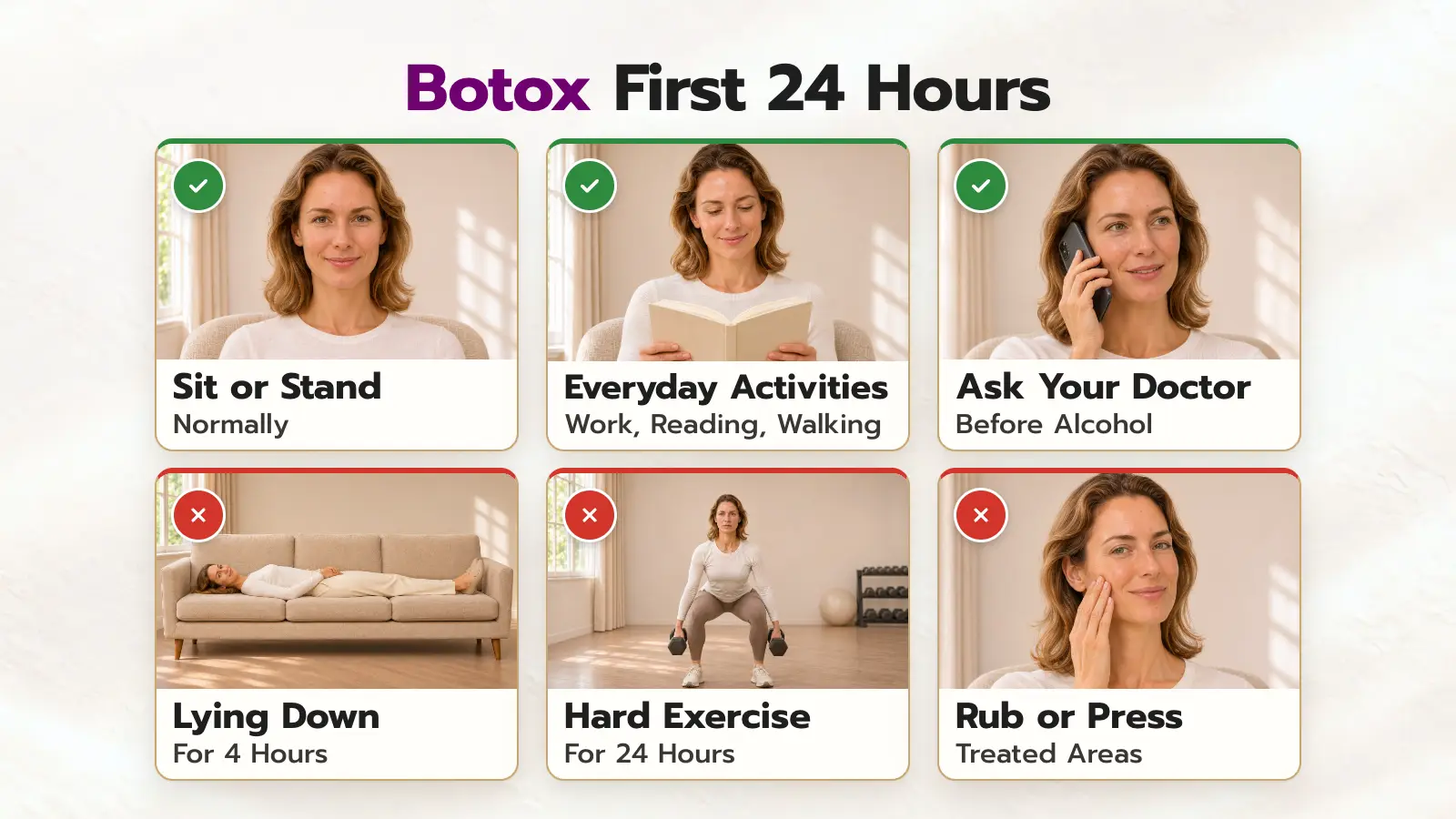
The first hours after injection matter most. Sit or stand normally, and if you feel tired, rest in a chair rather than lying flat or bending forward for long.
Ask your doctor before drinking alcohol or taking pain relievers on the first day, and keep taking any prescribed medicine as usual unless a doctor tells you otherwise.
Check with your doctor before booking a facial, peel or other skin treatment on the treated area in the days that follow.
At Edition Clinic, I go through the aftercare steps with you before you leave, so the first day feels simple rather than worrying.
Trouble breathing, swallowing or speaking is rare but needs urgent help, and the warning signs to know are listed in the safety section.
The full Botox aftercare guide covers the following days in more detail.
Most people can fly about 24 hours after Botox, and the guide to flying after Botox or filler explains how to plan a trip around treatment.
Botox Brands for Wrinkles at Edition Clinic
Edition Clinic uses three toxin brands: Allergan, Xeomin and Nabota, and each is opened in front of you. All three contain botulinum toxin type A and relax the muscles behind expression lines, but their units differ. Your doctor recommends the brand and dose for your lines at the consultation.

You can ask to see the brand name, lot number and expiry date on the box before your injection.
Allergan, Xeomin and Nabota at a Glance
Allergan, Xeomin and Nabota are botulinum toxin type A products from different makers, each with its own formula and unit strength. The list below gives one short fact about each brand. A detailed guide for each one is linked, if you want to compare them before your consultation.
The three brands at a glance:
- Allergan: Allergan's BOTOX Cosmetic contains onabotulinumtoxinA, described in its US prescribing information as a purified botulinum toxin type A; the Allergan Botox guide has more.
- Xeomin: Xeomin, a German brand made by Merz, has no complexing proteins, the extra proteins that surround the toxin in some products; see the Xeomin Botox guide.
- Nabota: Nabota is a Korean brand from Daewoong, approved in the US as a product called Jeuveau; the Nabota Botox guide explains it further.
A brand choice is partly a budget choice, but the right brand for you also depends on your muscles, your past results and the doctor's assessment.
Botox Prices at Edition Clinic
Botox prices at Edition Clinic depend on the brand and the number of units, starting at 4,900 THB for Nabota 50 units. The Botox price covers the full stated number of units of the brand you choose, with the product opened in front of you. The doctor confirms your dose at the consultation.
| Botox brand and units | Price |
|---|---|
| Nabota - 50 units | 4,900 THB |
| Nabota - 100 units | 8,990 THB |
| Xeomin 50 units | 8,900 THB |
| Xeomin 100 units | 15,900 THB |
| Allergan 50 units | 13,000 THB |
| Allergan 100 units | 20,000 THB |
Each brand comes in a 50-unit and a 100-unit option, so your total depends on the brand and the dose your doctor confirms for your lines.
The Botox in Bangkok page lists each brand with its current prices.
Why Choose Edition Clinic for Botox in Bangkok?
Edition Clinic is the official Bangkok branch of Edition Plastic Surgery, Seoul, and all premium procedures are performed by a medical doctor. Botox is planned and injected by Dr. Mild, an Aesthetic Doctor, using a genuine product opened in front of you. The aim is a natural result with conservative dosing, and the consultation is free.
Botox starts at 4,900 THB for Nabota 50 units, and the full stated units are included in every price. The Botox treatment page has booking details.
Men also choose Botox at Edition Clinic to soften wrinkles, with the same aim of a relaxed, natural-looking face.
Consultation in English, Thai or Korean
Consultations for Botox are held directly with the doctor in English or Thai. You can ask about your lines, brands, units and price in your own words before deciding anything.
If you prefer Korean, Korean-speaking staff help you book and interpret during the doctor's consultation. The consultation is free, and there is no obligation to book treatment afterwards.
Getting Here and Booking
Edition Clinic is at Marche 150 Thong Lo near BTS Thong Lo, open daily from 11:00 to 20:00, and you can book by LINE or WhatsApp.
- 📍 Address
- Room A408, 4th Floor, Marche 150 Thong Lo, Khlong Tan Nuea, Watthana, Bangkok 10110
- 🚆 Nearest BTS
- BTS Thong Lo
- 🕐 Opening hours
- Every day, 11:00–20:00
- 📞 Phone
- +66 92-255-8952
- 💬 How to book
- LINE @editionclinic or WhatsApp — free consultation
Clinic-wide patient count: 6,717 unique patients treated from 7 August 2023 to 1 October 2026, excluding repeat visits. This is not a treatment-specific count.
Botox for Wrinkles in Bangkok: Summary
- How it works: Botox relaxes the muscles that fold the skin, so lines that appear with movement soften the most.
- Who it suits: Botox suits forehead lines, frown lines and crow's feet that come and go when you move your face.
- Limits to know: Botox only softens lines visible at rest and does not fix sagging skin, sun damage or lost volume.
- Who should wait: Botox is not a good choice during pregnancy or breastfeeding, and your doctor checks whether Botox suits you before treatment.
- Next step: Botox starts at 4,900 THB for Nabota 50 units, after a free consultation where the doctor confirms your dose.
Frequently Asked Questions About Botox for Wrinkles
1. Why do I still have wrinkles after Botox?
Answer: Wrinkles after Botox usually mean it is too early, the line is static, or nearby muscles are working harder. Full results take about 2 weeks, and lines visible at rest only soften. Contact the clinic at the 2-week mark if lines still show, so the doctor can review the dose and placement.
The American Family Physician review notes that botulinum toxin effects take about two weeks to fully develop, and that dynamic wrinkles yield more dramatic results than static wrinkles, which are visible at rest.
Sometimes a nearby muscle that was not treated works harder and shows a line, or the dose needs a small review. Your doctor checks the result at that point and decides whether anything should change.
2. Is long-term Botox safe?
Answer: Yes, repeat Botox is generally safe when a trained doctor uses a genuine product at suitable doses, and the main long-term question studied is resistance. Resistance means the body makes antibodies that stop the toxin working, and studies show it is uncommon. Your doctor plans the dose and timing of each visit with this in mind.
In the BOTOX Cosmetic prescribing information, binding antibodies appeared in 14 of 916 treated people (1.5%), and neutralizing antibodies, the kind that can block the toxin, appeared in 0 (0%).
The prescribing information adds that the chance of antibodies can be reduced with the lowest effective dose given at the longest feasible intervals.
A 2023 meta-analysis in Toxins of 33 onabotulinumtoxinA registration trials across 10 uses found neutralizing antibodies after treatment in 27 of 5,876 evaluable patients (0.5%), and 5 of them were judged to have stopped responding.
A 2022 meta-analysis in Aesthetic Surgery Journal pooled 43 studies covering 8,833 people and found neutralizing antibodies in 0.3% of those given onabotulinumtoxinA, rising with longer treatment. Those studies covered medical conditions treated at higher doses, so the figures do not transfer directly to cosmetic use.
3. Do Botox creams work like injections?
Answer: No, creams sold as "Botox-like" are skincare products, not botulinum toxin, so they do not relax muscles the way injections do. A cream sits on the skin surface, while Botox is placed into the muscle that folds the skin. Only an injection reaches the muscle behind an expression line.
Skincare such as sunscreen and moisturiser still has a place alongside Botox, because it cares for the skin itself. Ask the doctor at your consultation which products suit your skin.
4. What do Koreans use instead of Botox?
Answer: Botox is still widely used in Korea for expression lines. Skin boosters such as Rejuran, injections aimed at skin quality such as hydration and texture, are also popular, but they serve a different goal from relaxing expression lines. A skin booster does not replace Botox for lines that move.
The two can be planned together when both suit you, and your doctor decides the order. The Rejuran skin booster in Bangkok page explains how Rejuran is used at Edition Clinic.
References
- FDA. BOTOX Cosmetic (onabotulinumtoxinA) prescribing information and Medication Guide. Allergan Aesthetics, an AbbVie company. DailyMed, US National Library of Medicine. Revised 2024. DailyMed setid 485d9b71-6881-42c5-a620-a4360c7192ab
- Small R. Botulinum toxin injection for facial wrinkles. Am Fam Physician. 2014;90(3):168–175. PMID 25077722
- American Society of Plastic Surgeons. Botulinum Toxin. plasticsurgery.org. Accessed 2026. plasticsurgery.org
- Cleveland Clinic. What Are the Long-Term Effects of Botox? Cleveland Clinic Health Essentials. Accessed 2026. health.clevelandclinic.org
- Brin MF, et al. Update on Non-Interchangeability of Botulinum Neurotoxin Products. Toxins (Basel). 2024. PMID 38922160
- Beer KR, et al. Rapid onset of response and patient-reported outcomes after onabotulinumtoxinA treatment of moderate-to-severe glabellar lines. J Drugs Dermatol. 2011;10(1):39–44. PMID 21197522
- Glogau R, et al. OnabotulinumtoxinA: a meta-analysis of duration of effect in the treatment of glabellar lines. Dermatol Surg. 2012;38(11):1794–1803. PMID 23106853
- Cleveland Clinic. Botox (Botulinum Toxin). Cleveland Clinic Health Library. Accessed 2026. my.clevelandclinic.org
- American Academy of Dermatology. Botulinum toxin therapy: FAQs. aad.org. Accessed 2026. aad.org
- Walker TJ, Dayan SH. Comparison and overview of currently available neurotoxins. J Clin Aesthet Dermatol. 2014;7(2):31–39. PMID 24587850
- Medicines and Healthcare products Regulatory Agency (MHRA). Botulinum toxin type A products: updated warnings regarding risk of iatrogenic botulism. Drug Safety Update, GOV.UK. July 2026. gov.uk
- US Food and Drug Administration. Counterfeit Version of Botox Found in Multiple States. Drug Alerts and Statements. 2024. fda.gov
- US Centers for Disease Control and Prevention. Harmful Reactions Linked to Counterfeit Botox or Mishandled Botulinum Toxin Injections. Botulism Outbreaks. 2024. cdc.gov
- Kroumpouzos G, et al. Exploring Nonresponse to Botulinum Toxin in Aesthetics: Narrative Review of Key Trigger Factors and Effective Management Strategies. JMIR Dermatol. 2025;8:e69960. PMID 40273416
- Jankovic J, et al. Neutralizing Antibody Formation with OnabotulinumtoxinA (BOTOX) Treatment from Global Registration Studies across Multiple Indications: A Meta-Analysis. Toxins (Basel). 2023;15(5). PMID 37235376
- Rahman E, et al. Immunogenicity to Botulinum Toxin Type A: A Systematic Review With Meta-Analysis Across Therapeutic Indications. Aesthet Surg J. 2022;42(1):106–120. PMID 33528495
Ready to Soften Your Expression Lines?
Book a free 1:1 consultation for Botox at Edition Clinic Bangkok, and Dr. Mild will check which of your lines Botox can help.
