

HIFU vs Ultraformer: What's the Real Difference and Which One Should You Choose?

Table of Contents
Written & Medically Reviewed by

- Medical Doctor, Chulalongkorn University — Second Class Honors
- Dermatology (International Program) 2024–2025, Chulabhorn International College of Medicine, Thammasat University
- 3 Years Experience in Aesthetic Medicine
If you have been researching non-surgical face lifting in Bangkok, you have probably seen both "HIFU" and "Ultraformer" used almost interchangeably. They are not the same thing, and the difference affects what you pay and what you get.
This guide breaks down the technology, compares the two side by side against published clinical data, and explains what to check before booking anywhere.
Key Takeaways
HIFU is the technology category; Ultraformer MPT is a specific Classys device within it. The practical difference is depth range and comfort: standard HIFU reaches 4.5mm, while Ultraformer MPT covers 1.5mm to 13mm across 10 applicator heads.
At Edition Clinic, Ultraformer MPT starts from 7,400 THB, and cheeks and jowls (400–800 shots) start from 14,000 THB.
What Is HIFU and How Does It Work?
HIFU delivers focused ultrasound energy to a fixed depth below the skin, creating small thermal coagulation zones that trigger collagen remodelling. It reaches the SMAS layer that surgeons manipulate during a facelift, without incisions.
The thermal injury zones are roughly 1 cubic millimetre each. They are placed at predetermined depths so the surrounding tissue and the skin surface are left intact.
The healing response that follows produces new collagen and elastin over the following weeks. According to a systematic review published in the International Journal of Environmental Research and Public Health, 92% of patients (n = 337) showed investigator-rated improvement in skin tightening and/or wrinkle reduction at day 90.
How HIFU Reaches the SMAS Layer
The SMAS sits roughly 4.5mm below the surface and acts as the structural sling holding facial tissue in position. Lasers and most radiofrequency devices cannot reach it.
Because the energy is focused rather than diffuse, it passes through the epidermis without heating it. That is why there is no visible wound and no recovery period.
What the Measured Results Actually Look Like
The same review reported brow lifts of 0.47mm to 1.7mm and a 26–45 mm² reduction in the submental area after a single treatment. These are real, measurable changes — and they are subtle.
Patient-reported improvement climbed from 42% at 90 days to 53% at 360 days, which tells you the effect builds slowly rather than appearing at once.
Not All HIFU Devices Are Equivalent
The category covers everything from FDA-cleared medical systems to unbranded units sold without published clinical data. The main devices you will encounter in Bangkok:
- Ultraformer MPT (Classys, South Korea): MMFU with Micro-Pulse delivery, 1.5mm to 13mm.
- Ultraformer III (Classys, South Korea): The previous generation, still widely used.
- Ultherapy (Merz, USA): The first FDA-cleared HIFU lifting device, known for DeepSEE imaging.
- Doublo Gold (HIRONIC, South Korea): A Korean HIFU platform for facial lifting.
In our experience, the question patients almost never ask — and should — is which specific model the clinic owns. A quoted price of "HIFU 300 shots" tells you nothing until you know the device and the generation.
What Is Ultraformer MPT?
Ultraformer MPT is the current-generation HIFU platform from Classys, a South Korean medical device manufacturer. It combines MMFU (Micro and Macro Focused Ultrasound) with Micro-Pulse Technology.
Standard HIFU fires each shot as one continuous burst of energy. Ultraformer MPT splits that same shot into a rapid sequence of micro-pulses instead.
The thermal effect at the target depth is preserved, but the peak sensation the patient feels is lower. That single design change is what makes the treatment faster and more tolerable.
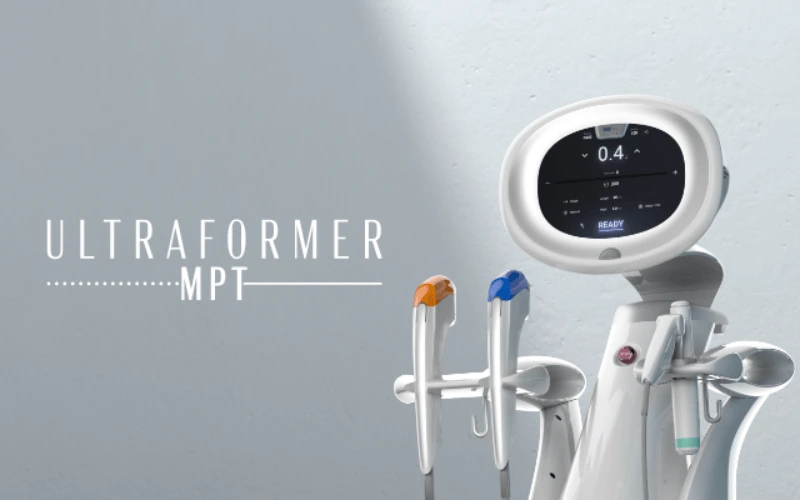
Image: Ultraformer MPT by Classys Inc.
What Micro-Pulse Technology Changes
Delivering energy as micro-pulses rather than a single burst allows the applicator to move faster across the treatment area. Classys reports treatment speeds up to 2.5 times faster than the previous Ultraformer generation.
For a full-face session, that is the difference between roughly 60–90 minutes and 30–45 minutes on the bed.
MMFU vs MFU: Why the Depth Range Matters
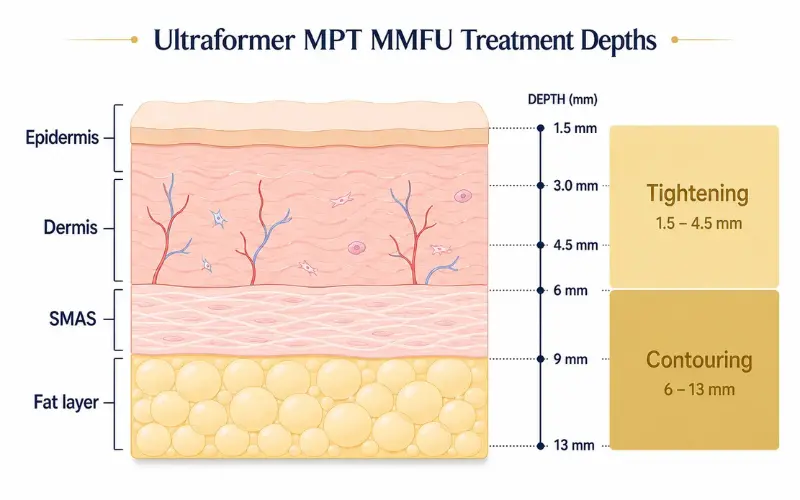
Most HIFU devices use MFU and operate at 1.5mm, 3.0mm and 4.5mm. Those three depths address the dermis and the SMAS — tightening and lifting.
Ultraformer MPT adds macro-focused depths at 6mm, 9mm and 13mm. Those reach the subcutaneous fat layer, which is why it can address a soft under-chin or the upper arms rather than only tightening the skin above them.
How We Use It at Edition Clinic
Every session starts with a 1:1 consultation to set the depth, energy level and line count. We do not run a fixed protocol.
In our experience, the most common adjustment we make is reducing energy over the lower cheek in patients with thin subcutaneous fat, where a standard setting can leave the face looking hollow rather than lifted.
HIFU vs Ultraformer MPT: What Are the Key Differences?
HIFU is the category and Ultraformer MPT is a device within it, so the comparison is really between an unspecified generic HIFU machine and a named current-generation platform.
That distinction matters commercially. When a clinic advertises "HIFU" without naming the device, you cannot verify the depth range, the energy control, or whether the transducer cartridges are genuine.
The table below compares typical standard HIFU specifications against Ultraformer MPT.
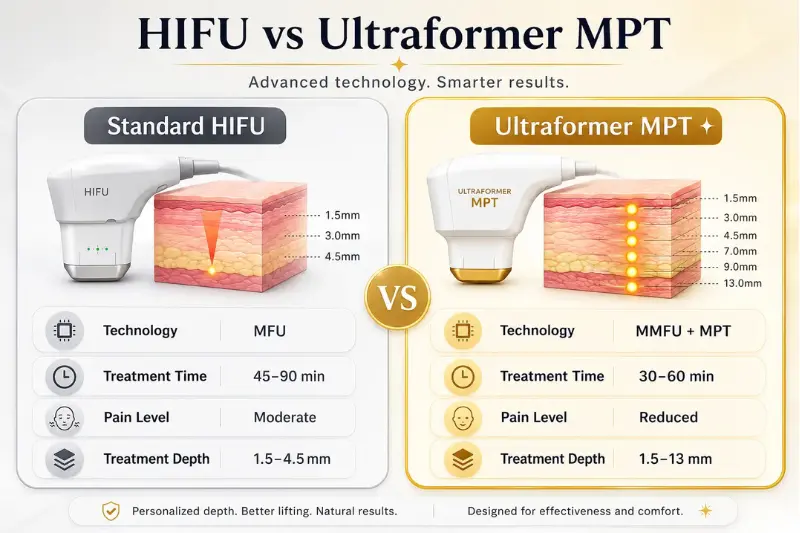
| Feature | Standard HIFU | Ultraformer MPT |
|---|---|---|
| Technology | MFU (Micro-Focused Ultrasound) | MMFU + Micro-Pulse Technology |
| Treatment Speed | 45–90 minutes | 30–60 minutes (up to 2.5x faster) |
| Energy Delivery | Single continuous burst | Rapid micro-pulses per shot |
| Treatment Depths | 1.5mm, 3mm, 4.5mm | 1.5mm to 13mm (10 heads, 20 modes) |
| Fat Layer Access | Limited or none | Yes (6mm, 9mm, 13mm) |
| Skin Rejuvenation Mode | No | Yes (Ultraboost handpiece) |
| Results Duration | 4–6 months | 6–12 months |
| Manufacturer | Various (some unbranded) | Classys, South Korea |
Where the Difference Is Real, and Where It Is Marketing
The depth range and the pulse delivery are verifiable hardware differences. The "results duration" row is the softest claim on the table, because longevity depends more on your age and collagen baseline than on the machine.
A 2024 study in Plastic and Reconstructive Surgery – Global Open found the most pronounced Ultraformer MPT lifting effects in the posterior cheek, jawline and neck. Those are the areas where the device outperforms; the forehead is not one of them.
How This Compares to RF Lifting
Ultrasound and monopolar radiofrequency solve overlapping problems differently — focused points versus bulk volumetric heating. If you are weighing both, our guide to Oligio X and RF skin tightening covers where each one fits.
Why we run Ultraformer MPT: we chose it as our primary lifting platform for the depth range, not the marketing. Being able to treat 4.5mm and 9mm in the same session is what makes single-visit jawline work possible.
Not Sure Which Treatment Is Right for You?
Our doctor provides a free 1:1 consultation to assess your skin, recommend the right device and settings, and give you a clear, upfront quote — no pressure, no hidden fees.
💬 Get a Free Consultation800+ reviews across Google & GoWabi · 6,700+ Patients Treated
What Are the Benefits of Ultraformer MPT Over Standard HIFU?
The advantages are speed, comfort, depth range and the ability to combine tightening with mild contouring in one visit. Each of these traces back to a specific hardware feature rather than a general claim.
What follows is what those differences look like in practice, and where they matter less than you would expect.
Shorter Time on the Bed
Micro-pulse delivery lets the operator move continuously rather than pausing between shots. A full-face treatment that runs 60–90 minutes on older platforms typically finishes in 30–45 minutes.
For patients treating during a work break, this is often the deciding factor.
Lower Peak Discomfort
Pain has always been the main reason people avoid a second HIFU session. Pooled data across MFU studies record a mean pain score of 4.85 out of 10 — moderate, not trivial.
Splitting each shot into micro-pulses lowers that peak. We also apply topical numbing cream and leave it for 20–30 minutes before starting.
"Numbing cream helps, but what actually determines comfort is line placement. If you rush the bone-adjacent areas — the jaw border, the zygomatic arch — the patient feels it every time. I slow down there, which is why my full-face sessions run closer to 45 minutes than 30."
— Dr. Natcha Prachayakul (Mild), License ว. 74682
Ten Applicator Heads, Twenty Modes
The cartridge range is what allows a single device to handle fine periorbital skin and a submental fat pad in the same appointment. Depth, energy and spacing are all adjustable per zone.
This is also where operator skill matters most — more settings means more ways to get it wrong.
Lifting Plus Skin Quality
The Ultraboost handpiece targets the superficial dermis for texture and hydration rather than structural lifting. It can be layered onto a lifting session.
It is a genuine addition, but it is not a substitute for a dedicated skin booster if texture is your primary concern.
What Ultraformer MPT Cannot Do
It will not remove excess skin. If the laxity is advanced enough that tissue hangs rather than sags, ultrasound tightening produces a change you can measure and barely see.
It also does not address volume loss. A hollow mid-face needs replacement volume, not tightening, and tightening a hollow face can make it look more drawn.
Which Areas Can Be Treated with Ultraformer MPT?
The device treats most facial and body areas where skin laxity or a soft fat pad is the concern. The depth selected determines whether the target is the SMAS, the dermis or the subcutaneous layer.
Below are the zones we treat most often, and what each one realistically achieves.
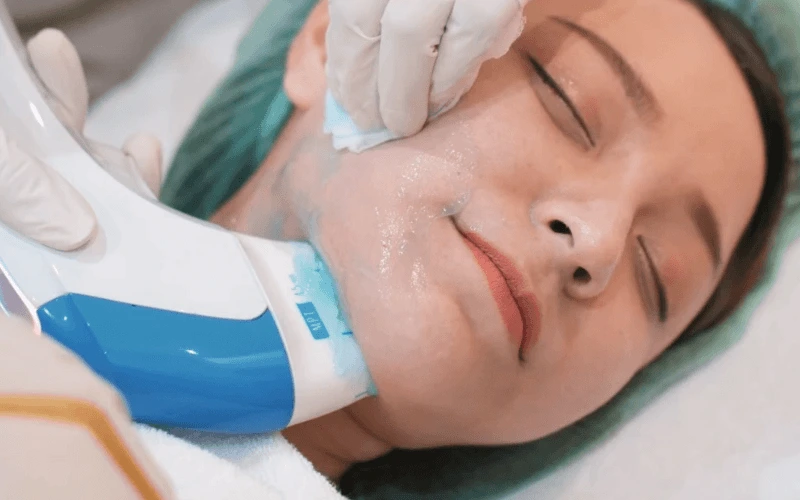
Face
- Forehead: Modest brow elevation. Published single-session brow lifts measure 0.47mm to 1.7mm.
- Under-eyes: Superficial 1.5mm work to firm thin periorbital skin.
- Cheeks: Mid-face lift at 4.5mm, targeting the posterior cheek where response is strongest.
- Nasolabial folds: Indirect softening by tightening the tissue above the fold, not filling it.
- Jawline: The most consistent responder — sharper contour and reduced jowling.
- Double chin: Combined 4.5mm tightening with 6–13mm fat reduction.
Neck and Body
- Neck: Horizontal lines and loose skin below the jaw border.
- Upper arms: Skin firming on the inner arm; shot count and price are confirmed at consultation.
- Abdomen: Mild tightening with some subcutaneous fat reduction.
V-Line Contouring
Our most requested combination targets the jawline, jowls and submental area in one session, using tightening and fat-layer depths together.
The contour develops over 8 to 12 weeks. Our protocols follow the Korean-standard techniques we share with our partner clinic in Gangnam, Seoul.
What Happens During an Ultraformer MPT Session?
The appointment runs about 60 to 90 minutes door to door, of which 30 to 45 minutes is actual treatment. The rest is consultation and numbing.
There is no preparation required beforehand and nothing you need to arrange for afterwards.
Before
The session opens with a 1:1 consultation covering target areas, depth settings and line count. Numbing cream is then applied for 20 to 30 minutes.
This is the point to raise anything relevant — recent filler or toxin, implants, pregnancy, or a planned facelift.
During
Ultrasound gel is applied and the handpiece is moved systematically across each mapped zone. You will feel warmth and short prickling sensations as energy reaches depth.
The sensation is strongest over bone. Most patients find it manageable with numbing cream applied.
After
Mild redness or warmth is common and usually settles within 1 to 2 hours. You can apply makeup and return to normal activity immediately.
We ask patients returning to our Thonglor clinic, near BTS Thong Lo, to book the follow-up review at around 12 weeks rather than earlier — before then there is little to assess.
Results Timeline
- Immediately: Slight tightening in some patients from collagen contraction.
- 2–4 weeks: Skin begins to feel firmer.
- 8–12 weeks: Full effect visible.
- 6–12 months: Results maintained; maintenance typically at 6 months.
Want to Know If Ultraformer MPT Suits Your Skin?
Message us on WhatsApp to book a free consultation. Our medical team will assess your skin and give you honest advice — including if a different treatment would work better for you.
💬 Message Us on WhatsAppAll treatments performed by licensed medical professionals
Ultraformer MPT vs Ultherapy: How Do They Compare?
Ultherapy was the first HIFU device cleared by the FDA for non-invasive lifting and remains the reference point in the category. Edition Clinic does not offer Ultherapy; we include it here because patients ask.
The two devices differ most in imaging and depth range, and those two differences pull in opposite directions.
| Feature | Ultherapy | Ultraformer MPT |
|---|---|---|
| Technology | MFU + DeepSEE visualization | MMFU + Micro-Pulse |
| Treatment Speed | 60–90 minutes | 30–60 minutes |
| Treatment Depths | 1.5mm, 3mm, 4.5mm | 1.5mm – 13mm |
| Fat Layer Access | No | Yes |
| Real-Time Imaging | Yes (DeepSEE) | No |
| Energy Delivery | Continuous burst | Micro-pulsed |
| Available at Edition Clinic | No | Yes, from 7,400 THB |
What Imaging Actually Buys You
DeepSEE lets the operator see tissue layers before firing, which is a real safety and accuracy advantage in atypical anatomy. It is not a small feature.
The trade-off is speed, cost and a fixed 4.5mm ceiling.
"Ultherapy's real-time visualization is genuinely useful, and I won't pretend otherwise. But for the patients I see in Bangkok — most of whom want jawline definition and some submental contouring in one visit — the depth range matters more than the imaging."
"Ultraformer MPT reaches 13mm. Ultherapy stops at 4.5mm. That single difference decides most of my treatment plans."
— Dr. Natcha Prachayakul (Mild), License ว. 74682
Who Is a Good Candidate for Ultraformer MPT?
The best candidates have mild to moderate laxity and realistic expectations. The literature is specific about who responds poorly: outcomes decline as skin laxity and BMI increase.
A BMI above 30 and advanced laxity are both flagged as relative contraindications, which is a more useful screening rule than age.
Good Candidates
- Mild to moderate laxity: Softening along the jawline, cheeks or neck that has not progressed to hanging skin.
- Late 20s to early 40s, preventive: Maintaining firmness before significant descent occurs.
- Post-surgical maintenance: Extending facelift results without further surgery.
- All Fitzpatrick skin types: Ultrasound does not target melanin.
Who Should Not Have It
- Active skin infection or open wounds in the treatment area.
- Pregnancy or breastfeeding.
- Electronic or metallic implants near the treatment zone, including pacemakers.
- Filler or toxin injections within the previous 2 weeks.
- Severe laxity where a surgical lift is the appropriate option.
"The patients who are disappointed with HIFU are almost always the ones who needed a facelift. If the skin has lost its elasticity entirely, no amount of ultrasound energy will rebuild the scaffolding."
"I turn away roughly one in ten consultations for this reason, and I would rather do that than take the booking."
— Dr. Natcha Prachayakul (Mild), License ว. 74682
Are There Side Effects or Risks?
The most common reactions are transient redness and swelling, and they resolve without treatment. A systematic review of microfocused ultrasound found that adverse effects beyond these were rare, occurring in roughly 2% of cases.
A separate 2025 systematic review in Aesthetic Surgery Journal reviewing HIFU for skin tightening and body contouring reached a comparable safety conclusion.
Common and Temporary
- Redness: Usually gone within 1–2 hours.
- Swelling: Mild, resolving within hours.
- Tenderness: Warmth or sensitivity fading within a day.
Rare (approximately 2%)
- Dysesthesia: Temporary numbness or hypersensitivity.
- Bruising and stinging: More likely in thin or sensitive skin.
- Surface thermal effects: Reported where technique or settings were incorrect, which is why operator training matters.
⚠️ Important Safety Information
All Ultraformer MPT treatments at Edition Clinic are performed by licensed medical professionals trained on the device. Results may vary depending on skin condition, age and lifestyle.
A consultation is conducted before every treatment to confirm suitability and set expectations.
How Much Does Ultraformer MPT Cost in Bangkok?
At Edition Clinic, Ultraformer MPT starts from 7,400 THB. Nasolabial folds (200–600 shots) start from 7,400 THB; double chin (300–400 shots) from 10,500 THB; cheeks and jowls (400–800 shots) from 14,000 THB; and full face (800–1,200 shots) from 25,600 THB. Final shot count is confirmed after consultation.
Full Ultraformer MPT treatment prices in Bangkok are listed by area and shot count on our treatment page.
What Drives the Price
- Shot count: The single largest variable. The required count varies by area; listed full-face plans use 800–1,200 shots.
- Depth combination: Sessions using both tightening and fat-layer depths require more cartridge use.
- Combination treatments: Pairing with Botox, fillers or Rejuran adds cost.
Why the Cheapest Quote Is Usually the Wrong Comparison
A low per-shot price often means fewer shots, an older device generation, or cartridges of uncertain origin. The shot count is the number to compare, not the headline price.
Ask any clinic three questions: which device model, how many lines, and at which depths. A clinic that cannot answer all three is not quoting the same treatment.
Ready to Book Your Ultraformer MPT Session?
Genuine Ultraformer MPT by Classys · From 7,400 THB · Cheeks & jowls (400–800 shots) from 14,000 THB · Free 1:1 doctor consultation included.
📅 Book Your Appointment800+ reviews across Google & GoWabi · 6,700+ Patients Treated
Why Choose Edition Clinic for Ultraformer MPT in Bangkok?
Plenty of clinics in Bangkok run HIFU. The differences worth checking are the device generation, who operates it, and whether the quoted shot count is honest.
Here is what we do and how we are set up.
Doctor-Led Consultation and Treatment
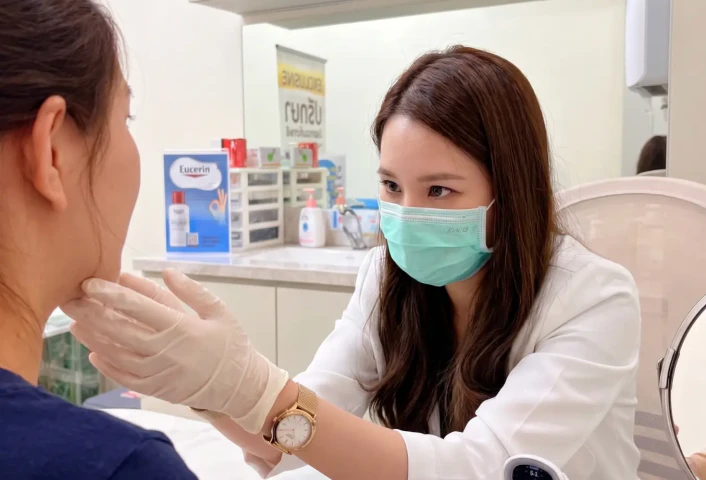
Every treatment plan is set by Dr. Mild, and the mapping is done per patient rather than from a template. No fixed protocol is applied across different faces.
Korean-Standard Protocols
Edition Clinic is the official Bangkok branch of Edition Plastic Surgery in Gangnam, Seoul, and follows the same layering and depth-selection techniques used there. Consultations at our Thonglor clinic apply that protocol directly.
Verified Equipment
We use a genuine Ultraformer MPT with manufacturer-supplied cartridges. You are welcome to ask to see the device and the cartridge packaging before your session.
What Edition Clinic Offers
- 1:1 personalized consultation with the doctor
- Established in 2023
- Nursing team with 500+ patient care experience
- 6,700+ Patients Treated
- Official Bangkok Branch of Edition Plastic Surgery, Seoul
Clinic-wide patient count: 6,717 unique patients treated from 7 August 2023 to 1 October 2026, excluding repeat visits. This is not a treatment-specific count.
>Frequently Asked Questions About HIFU and Ultraformer
1. Is HIFU the same as Ultraformer?
No. HIFU (High-Intensity Focused Ultrasound) is the technology category. Ultraformer is a specific device brand within that category, manufactured by Classys in South Korea.
Ultraformer MPT uses Micro and Macro Focused Ultrasound (MMFU), which delivers energy across a wider range of depths than most standard HIFU machines.
2. Is Ultraformer MPT better than regular HIFU?
For most treatment goals, yes. Ultraformer MPT works up to 2.5 times faster than the previous Ultraformer generation, reduces discomfort through Micro-Pulse delivery, and offers 10 applicator heads with 20 modes.
It reaches depths from 1.5mm to 13mm, while standard HIFU devices typically stop at 4.5mm. Results may vary depending on skin condition and age.
3. How long do Ultraformer MPT results last?
Results typically last 6 to 12 months. In a pooled analysis of microfocused ultrasound studies, patient-reported improvement continued to rise from 42% at 90 days to 53% at 360 days.
That suggests collagen remodelling keeps working long after the session. Most patients book a maintenance session at the 6-month mark.
4. Does Ultraformer MPT hurt?
It is noticeably more comfortable than older HIFU devices, because Micro-Pulse Technology splits each shot into rapid smaller pulses instead of one intense burst.
Pooled data from MFU studies still record a mean pain score of roughly 4.85 out of 10, so this is not a painless treatment. We apply topical numbing cream before every session.
5. How many Ultraformer MPT sessions do I need?
Most patients see visible improvement after a single session, which is why published studies assess single-treatment outcomes.
We generally recommend 1 to 2 sessions per year. Your doctor will confirm the right interval based on your degree of skin laxity.
6. Which is better for a double chin, Ultraformer MPT or fillers?
They solve different problems. Ultraformer MPT uses macro-focused energy at 6mm to 13mm to reduce submental fat and tighten the skin above it.
Fillers add volume and cannot reduce fat. If your concern is a soft, full under-chin area, Ultraformer MPT is the more direct option.
7. What is the difference between Ultraformer MPT and Ultherapy?
Ultherapy uses MFU with DeepSEE real-time imaging, which lets the operator see tissue layers during treatment.
Ultraformer MPT uses MMFU with Micro-Pulse delivery and covers 1.5mm to 13mm, including the fat layers Ultherapy does not reach. Edition Clinic does not offer Ultherapy; we use Ultraformer MPT.
8. When will I see results after Ultraformer MPT?
Some immediate tightening is possible from initial collagen contraction, but the meaningful change develops over 8 to 12 weeks as new collagen forms.
Published brow-lift measurements after a single MFU session range from 0.47mm to 1.7mm, which is real but subtle. Expect gradual improvement, not an overnight change.
9. Is there downtime after Ultraformer MPT?
There is essentially no downtime. Mild redness or slight swelling can appear immediately after treatment and usually settles within 1 to 2 hours.
Most patients apply makeup and return to work the same day.
10. Is Ultraformer MPT safe for darker skin tones?
Yes. Ultrasound energy does not target melanin the way laser energy does, so the risk of post-inflammatory hyperpigmentation is not driven by skin tone.
This makes it suitable across Fitzpatrick skin types, including patients who are poor candidates for certain lasers.
11. How much does Ultraformer MPT cost in Bangkok?
At Edition Clinic, Ultraformer MPT starts from 7,400 THB. Double chin (300–400 shots) starts from 10,500 THB, cheeks and jowls (400–800 shots) from 14,000 THB, and full face (800–1,200 shots) from 25,600 THB.
The final cost depends on the treatment area and the number of lines required. Full pricing by area is listed on our Ultraformer MPT page.
12. Who should not have Ultraformer MPT?
Patients with severe skin laxity, active infection or open wounds in the treatment area, electronic or metallic implants nearby, or who are pregnant or breastfeeding.
A BMI above 30 and advanced laxity have both been identified in the literature as relative contraindications, because outcomes decline as laxity and BMI increase.
Ready for Firmer, Lifted Skin?
Book a free Ultraformer MPT consultation at Edition Clinic Bangkok and get an honest assessment before you commit.