

Oligio vs Ultraformer: Which One Do You Need? (2026)


Table of Contents
Written & Medically Reviewed by

- Medical Doctor, Chulalongkorn University — Second Class Honors
- Dermatology (International Program) 2024–2025, Chulabhorn International College of Medicine, Thammasat University
- 3 Years Experience in Aesthetic Medicine
If you have searched for non-surgical lifting in Bangkok, you have seen Oligio and Ultraformer quoted side by side as if they were rivals. They are not competing for the same job.
One heats the dermis across an area. The other fires focused energy into the layer a surgeon lifts. This guide covers what each one physically does, what happened when researchers tested them against each other, and when running both is the honest answer.
Quick Answer
Oligio X uses monopolar radiofrequency to heat the dermis broadly, while Ultraformer MPT sends focused ultrasound to the SMAS layer at up to 13mm. A randomised split-face trial found no significant difference between them. At Edition Clinic, Oligio X starts from 11,000 THB and Ultraformer MPT from 7,400 THB.
Oligio vs Ultraformer: What Is the Real Difference?
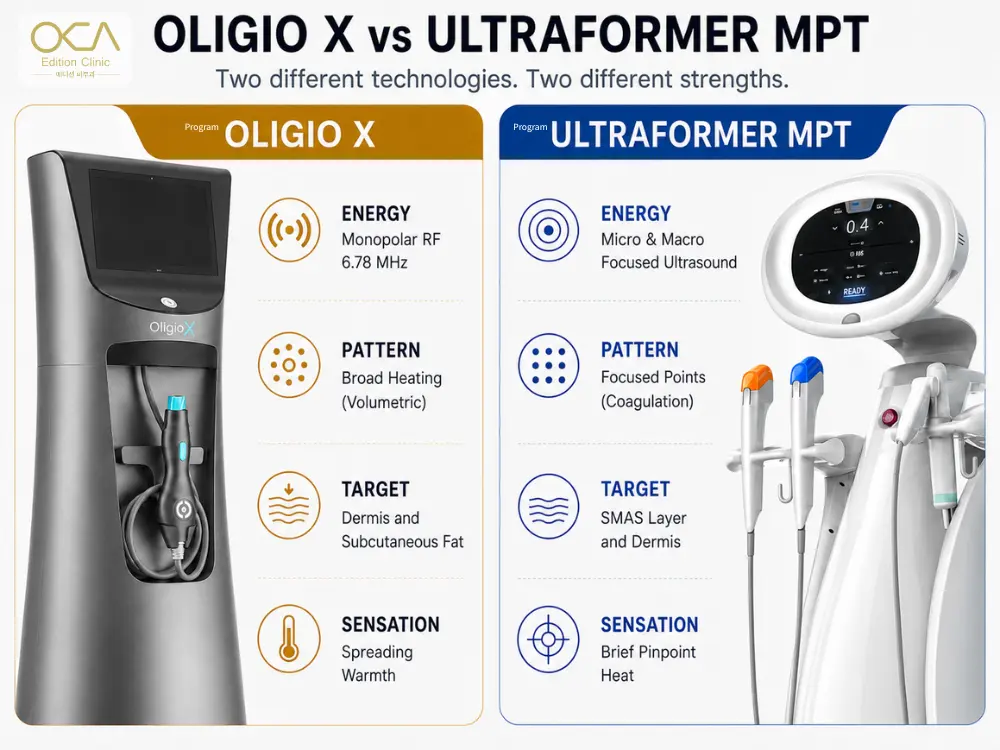
The difference is the shape of the energy. Radiofrequency heats a volume of tissue evenly, like warming a room. Focused ultrasound concentrates energy into tiny points at set depths, like driving in a row of nails. Both stimulate collagen; they simply do it in different geometry.
That geometry decides what each device is good at, and it also explains why the two are not interchangeable.
A Note on Generations
Most comparison articles you will find still describe the previous generation of both platforms. Oligio has been succeeded by Oligio X, and Ultraformer III by Ultraformer MPT.
We run the current generation of both, which is why the specifications below differ from older comparison tables.
The distinction matters commercially. A clinic quoting "Oligio" without the X, or "Ultraformer" without MPT, may be running hardware two generations behind the article you read.
Side by Side
The table compares the two platforms we actually operate. Both are Korean-manufactured and both are used in our Bangkok clinic.
| Feature | Oligio X | Ultraformer MPT |
|---|---|---|
| Manufacturer | WONTECH, South Korea | Classys, South Korea |
| Energy type | Monopolar RF, 6.78 MHz | Micro and macro focused ultrasound |
| Energy pattern | Volumetric — heats an area | Focal — coagulation points |
| Primary target | Dermis and subcutaneous fat | SMAS layer and dermis |
| Depth control | Dual mode, tip-dependent | 1.5mm to 13mm, 10 cartridges |
| Typical sensation | Spreading warmth | Brief pinpoint heat |
| Session length | 30–45 minutes | 30–60 minutes |
| From (Edition Clinic) | 11,000 THB | 7,400 THB |
How Does Oligio X Work?
Oligio X passes a high-frequency alternating current through the skin from a treatment tip to a return pad on your back. Tissue resists that current and converts it to heat, warming the dermis and the fat beneath it while the tip actively cools the surface.
Nothing is absorbed and nothing is targeted. The heat follows electrical resistance, which is why the effect is spread rather than concentrated.
Why 6.78 MHz Matters
Frequency determines how deeply the current travels before it dissipates. At 6.78 MHz, monopolar radiofrequency reaches the full thickness of the dermis and the fibrous septa running through subcutaneous fat.
This is the same frequency used across the established monopolar RF device class, so the physics is well characterised rather than proprietary.
The Temperature Window
Collagen contracts when heated into a specific band and denatures above it. Monopolar RF protocols aim for roughly 40 to 60°C in the target tissue, warm enough to trigger remodelling without injuring the epidermis above.
Holding that window is what the cooling and the impedance sensors are for. Too cool does nothing; too hot causes surface damage.
Dual-Mode Delivery
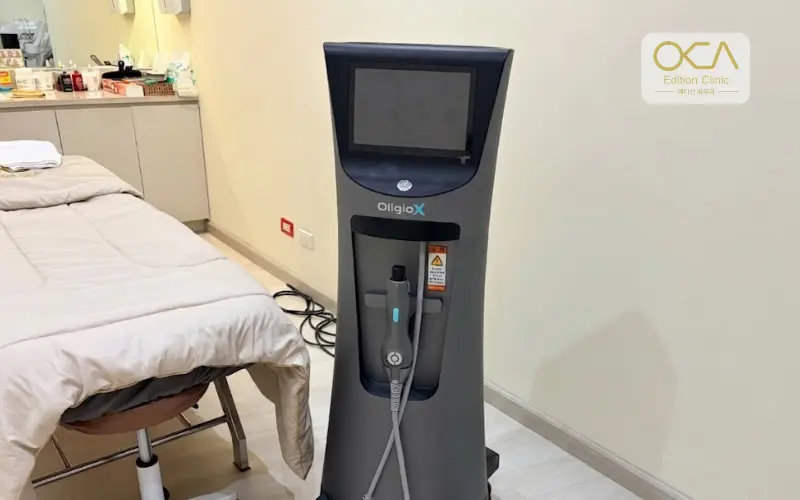
Oligio X sequences two treatment modes within one session rather than running a single fixed setting. A gliding mode warms the upper dermis broadly, and a stamping mode drives energy deeper into the dermis and subcutaneous layer.
Running both in sequence is what allows one device to address surface texture and deeper laxity in the same visit.
Impedance Matching
Skin resistance differs between a thin eyelid and a thick jawline, and between patients. According to the device's FDA 510(k) summary, Oligio X uses impedance-matching technology to keep energy delivery consistent across varying tissue impedance.
In practice this means the machine adjusts output continuously rather than firing a fixed setting into whatever it meets.
Regulatory Status, Stated Precisely
Oligio X was cleared by the US FDA under 510(k) K243929 on 21 January 2025. The cleared indication is non-invasive electrocoagulation and haemostasis of soft tissue.
That is the standard classification for this device category. It is not a cosmetic lifting claim, and any clinic telling you the device is "FDA approved for skin tightening" is overstating the paperwork.
How Does Ultraformer MPT Work?
Ultraformer MPT focuses ultrasound waves so they converge at a precise depth below the skin. At that convergence point the tissue reaches coagulation temperature and forms a thermal injury zone roughly one cubic millimetre in size, while everything above stays untouched.
Repeat that across a mapped grid and the healing response pulls the tissue tighter as it lays down new collagen.
The SMAS Layer
The superficial musculoaponeurotic system sits around 4.5mm below the surface and acts as the structural sling holding facial tissue up. It is the layer a surgeon repositions during a facelift.
Radiofrequency does not reach it in any meaningful way. This is the single most important functional difference between the two devices.
Micro-Pulse Delivery
Older ultrasound platforms fire each shot as one continuous burst. MPT splits the same shot into a rapid sequence of micro-pulses, which preserves the thermal effect at depth while lowering the peak sensation the patient feels.
Classys states that MP mode delivers ultrasound energy 2.5 times faster than the device's own standard delivery mode.
Ten Cartridges, 1.5mm to 13mm
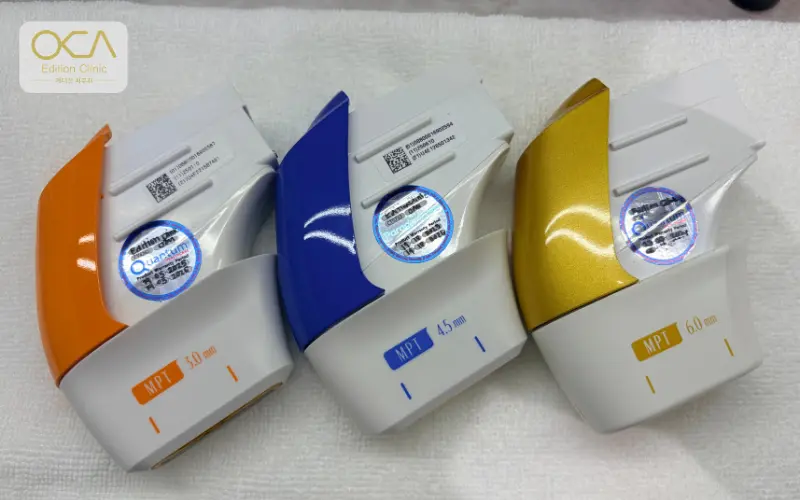
The cartridge range spans 1.5mm to 13mm, which is what lets one device treat thin periorbital skin and a submental fat pad in the same appointment.
Classys supplies 6mm, 9mm and 13mm cartridges for the deepest treatment planes. In practice, most facial sessions at our clinic use the 1.5mm, 3.0mm and 4.5mm depths. We cover the generational detail in our Ultraformer MPT versus Ultherapy comparison.
What the Depth Range Cannot Do
Reaching 13mm does not mean the device removes tissue. Ultrasound tightening will not take away excess skin, and it does not replace lost volume.
If skin hangs rather than sags, the honest recommendation is surgical, not ultrasonic.
Not Sure Which Layer Is Actually Your Problem?
Our doctor examines your skin, identifies whether the laxity is dermal or structural, and tells you which device fits — including when neither is the right answer.
💬 Get a Free Consultation5.0 ⭐ from 800+ reviews · 6,000+ patients treated
Which Skin Layers Does Each Device Actually Reach?
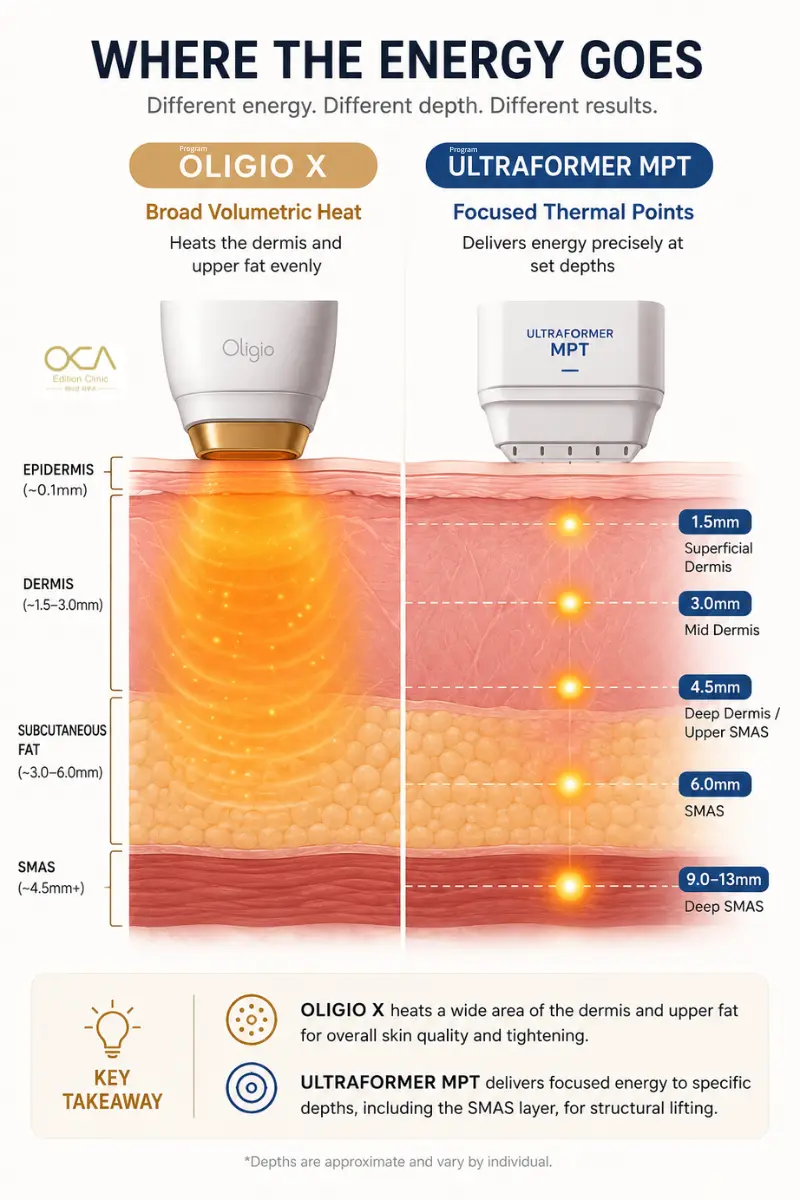
Oligio X works across the dermis and the upper subcutaneous fat as a continuous heated volume. Ultraformer MPT places discrete coagulation points at selected depths, including the SMAS at 4.5mm and the fat layer down to 13mm. The overlap is partial, not complete.
Understanding this is what turns the question from "which is better" into something answerable.
Why This Changes the Question
Once you know the layers, "which device is better" stops being a sensible question. It becomes "which layer has changed in my face", and that has an examination answer rather than a marketing one.
It also explains why two people can have opposite experiences with the same machine.
The Dermis: Both, Differently
Radiofrequency heats the whole dermal sheet at once, which suits diffuse crepiness and texture. Focused ultrasound at 1.5mm and 3.0mm treats the dermis in points, which suits targeted lines.
A 2024 study in Cosmetics using an Oligio device recorded improved elasticity and increased collagen and elastic fibre density on biopsy.
The SMAS: Ultrasound Only
Monopolar RF energy dissipates before it can deliver useful thermal effect at the SMAS. Focused ultrasound is the only one of the two that reaches it reliably.
If your jawline is descending because the structural sling has loosened, no amount of dermal heating will address the cause.
Subcutaneous Fat: Both, for Different Reasons
RF warms the fibrous septa running through the fat layer, tightening the scaffolding around it. The deeper ultrasound cartridges create coagulation points within the fat itself.
Neither is a fat reduction treatment, and we do not present them as one.
Dr. Mild: "The examination question I ask myself is simple. If I lift the cheek skin gently upward and the fold improves, that is structural and the answer is ultrasound. If the surface still looks crepey when I do that, the dermis is the problem and radiofrequency does more. Most faces over forty give me both answers at once."
Which One Works Better? What the Head-to-Head Trials Found
Two randomised trials have compared monopolar radiofrequency directly against microfocused ultrasound. Neither found a clear winner on measured laxity. That result is more useful than a marketing claim, because it moves the decision away from ranking devices.
Here is what each study actually measured, and what the numbers do not establish.
The Split-Face Trial
In a 2019 trial published in Dermatologic Surgery, 20 patients with mild to moderate laxity received focused ultrasound on one side of the face and monopolar RF on the other, on the same day, then were followed for six months.
Both sides improved significantly from day 30 onward, and the improvement held through day 180. There was no statistically significant difference between the two sides.
The Neck Trial
A separate randomised trial on neck laxity randomised 20 patients to one device or the other. Investigator-assessed neck laxity grade fell from 2.7 to 0.86 in the RF group at 180 days, and from 2.8 to 1.4 in the ultrasound group.
The sample is small, so this is a signal rather than a verdict. It does suggest the neck is not automatically ultrasound territory.
Why the Sample Sizes Matter
Both trials enrolled 20 patients. That is enough to detect a large difference between technologies and not enough to rule out a small one, which is the honest reading of a null result at this scale.
No larger head-to-head trial has been published. Anyone claiming one device is clinically proven superior is going beyond the evidence.
What Monopolar RF Achieves on Its Own
In a pilot study of 32 patients using multiple assessment tools, 53.1% reported over 50% improvement at two months, with histology showing increased collagen and elastic fibre density and no severe adverse events.
These are meaningful but modest numbers. Results may vary considerably depending on baseline laxity and age.
How to Read This Honestly
Two devices performing comparably on a laxity scale does not mean they are interchangeable. It means the scale is too coarse to capture what each one does well.
In our experience, patients who chose purely on price were usually the ones treated for the wrong layer.
Which One Fits Your Concern?
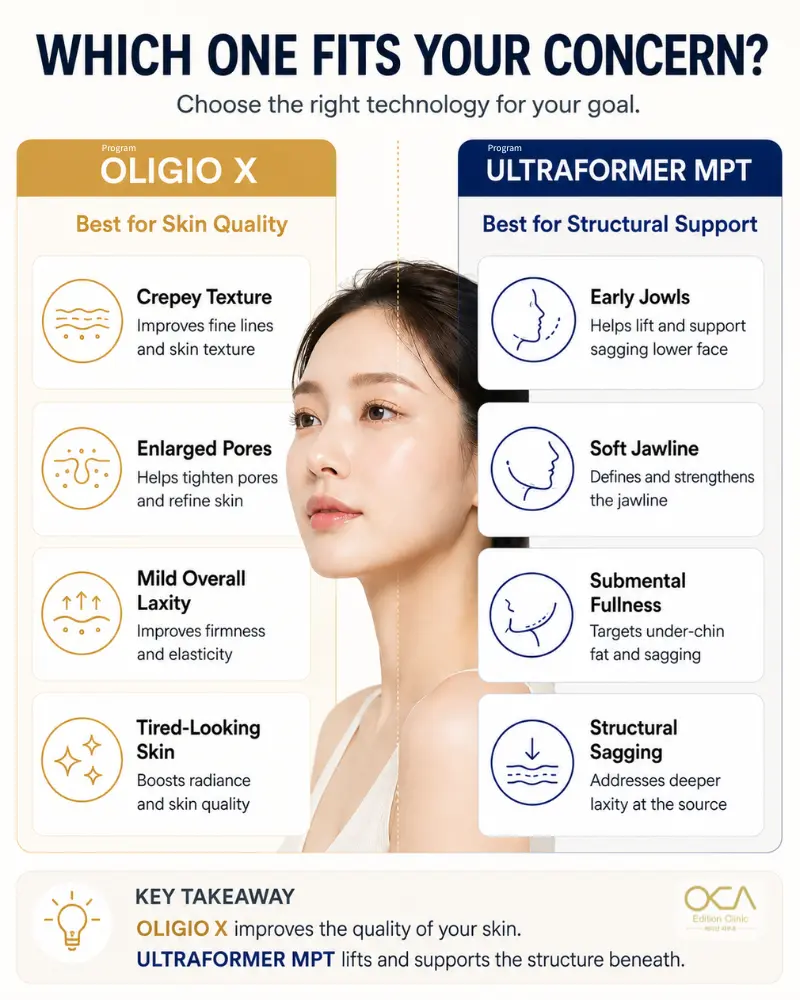
Choose Oligio X when the problem is surface quality across an area: crepey texture, mild overall slackness, enlarged pores, a face that looks tired rather than fallen. Choose Ultraformer MPT when a specific structure has dropped: jowls, a softening jawline, a heavy submental area.
The list below is how we sort it at consultation, and the sorting is anatomical rather than budgetary.
Oligio X Tends to Suit
- Diffuse crepiness: Fine surface laxity across the cheeks or neck without a defined fold.
- Texture and pore concerns: Where skin quality matters more than contour.
- Lower pain tolerance: Continuous cooling makes the session read as warmth.
- Preventive maintenance: Patients in their thirties with no structural descent yet.
- Body areas: Abdomen and arms, where broad coverage is practical.
Ultraformer MPT Tends to Suit
- Early jowling: The most consistent responder in our practice.
- Jawline definition: Where the goal is a sharper contour line.
- Submental fullness: Combined tightening and fat-layer work in one session.
- Periorbital skin: Superficial 1.5mm work on thin eyelid skin.
- Post-surgical maintenance: Extending facelift results without further surgery.
How We Decide at the Consultation
We examine the face at rest and then with the skin gently supported upward. What improves with support is structural; what stays unchanged is dermal. That two-minute test decides more treatment plans than any device specification sheet.
In our experience, patients who describe their concern as "tired-looking" usually need dermal work, while those who say "my face has dropped" almost always need the deeper layer treated.
When Neither Is Right
Severe laxity where tissue hangs rather than sags needs a surgical lift. A hollow mid-face needs volume, and tightening a hollow face can make it look more drawn.
We turn away a meaningful share of lifting consultations for exactly these two reasons.
Dr. Mild: "Patients arrive having decided which machine they want, usually from a friend's recommendation. I ask them to let me look first. About half the time the device they came in asking for is treating a layer that is not their problem, and switching costs them nothing at that stage."
Want an Honest Assessment Before You Book Anything?
Every treatment plan is set by our doctor after a 1:1 examination, using genuine WONTECH and Classys equipment you are welcome to inspect.
💬 Message Us on WhatsAppAll treatments performed by licensed medical professionals
Can You Combine Oligio X and Ultraformer MPT?
Yes, and for most patients over forty it is the better plan. Because the two devices deposit energy in different layers, combining them addresses dermal quality and structural support in the same visit without doubling the thermal load on any one tissue.
This is not a package invented for the price list. It follows from where the energy goes.
The Clinical Rationale
A retrospective study of combination therapy in Malaysia sets out the logic directly: monopolar RF accelerates collagen and elastin formation in the upper reticular dermis, while focused ultrasound reaches the deeper dermis and the SMAS.
The layers are complementary rather than redundant, which is why the combined effect is not simply two treatments stacked.
Sequence and Timing
We run both in a single appointment, starting with Oligio X and following with Ultraformer MPT. When the neck is treated alongside the face, we complete both devices on the face first, then repeat the same pair on the neck.
Total chair time is around 90 minutes including consultation and numbing. There is no separate recovery period between the two.
What Happens at the 12-Week Review
We book a review at around twelve weeks because that is when collagen remodelling has largely completed. Reviewing at four weeks shows you an incomplete result and tempts everyone into unnecessary top-up sessions.
At that appointment we reassess both layers separately and decide whether the next maintenance visit needs one device or two.
Who Should Not Combine
Combination is unnecessary if only one layer is affected. A patient in their early thirties with good structure and slight surface crepiness gains nothing from the ultrasound component.
We also separate the two visits when a patient is unusually sensitive, or when the treatment area is small enough that one device covers it.
Dr. Mild: "The combination is not automatically better. It is better when both layers have changed, which is a clinical finding, not an age bracket. I have declined it for patients who were ready to pay for it, because the second device would have been treating a layer that was still holding up perfectly well."
What the Combination Will Not Do
Running both devices does not produce a surgical result. The improvement is still measured in millimetres and develops over weeks.
Results may vary with age, baseline laxity and lifestyle, and we set that expectation before treatment rather than after.
How Much Do Oligio X and Ultraformer MPT Cost in Bangkok?
At Edition Clinic, Oligio X starts from 11,000 THB for a 200 to 300 shot area such as the double chin or nasolabial folds. Ultraformer MPT starts from 7,400 THB for a 200 shot area. Our combined Dual-Layer Lift starts from 24,900 THB.
Full pricing by area and shot count is listed on each treatment page, because a price without a shot count means nothing.
What Drives the Price
- Shot count: The largest single variable on both platforms.
- Treatment area: A full face uses several times the shots of a targeted zone.
- Depth selection: Sessions using both tightening and fat-layer depths consume more cartridge.
- Combination planning: Running both devices together is priced below the sum of separate sessions.
Where to Find the Full Lists
Area-by-area pricing is published on our Oligio X treatment page and our Ultraformer MPT page in Bangkok.
Both list shot counts alongside prices, because a quote without a shot count is not a quote.
What a Usable Quote Contains
A quote you can actually compare has four things in it: the device model and generation, the number of shots, the depths being treated, and whether numbing is included.
If a clinic will not put those in writing before you arrive, the number they gave you is not comparable to anything.
Why the Cheapest Number Is the Wrong Comparison
A low headline price usually means fewer shots, an older device generation, or tips of uncertain origin. The unit to compare is cost per shot at a named device.
Ask any clinic three things: which exact model, how many shots, and at which depths.
Ready to Book Your Session?
Genuine WONTECH Oligio X and Classys Ultraformer MPT · Oligio X from 11,000 THB · Ultraformer MPT from 7,400 THB · Dual-Layer Lift from 24,900 THB · free 1:1 doctor consultation included.
📅 Book Your Appointment5.0 ⭐ from 800+ reviews · 6,000+ patients treated
Are There Side Effects, and Who Should Avoid Them?
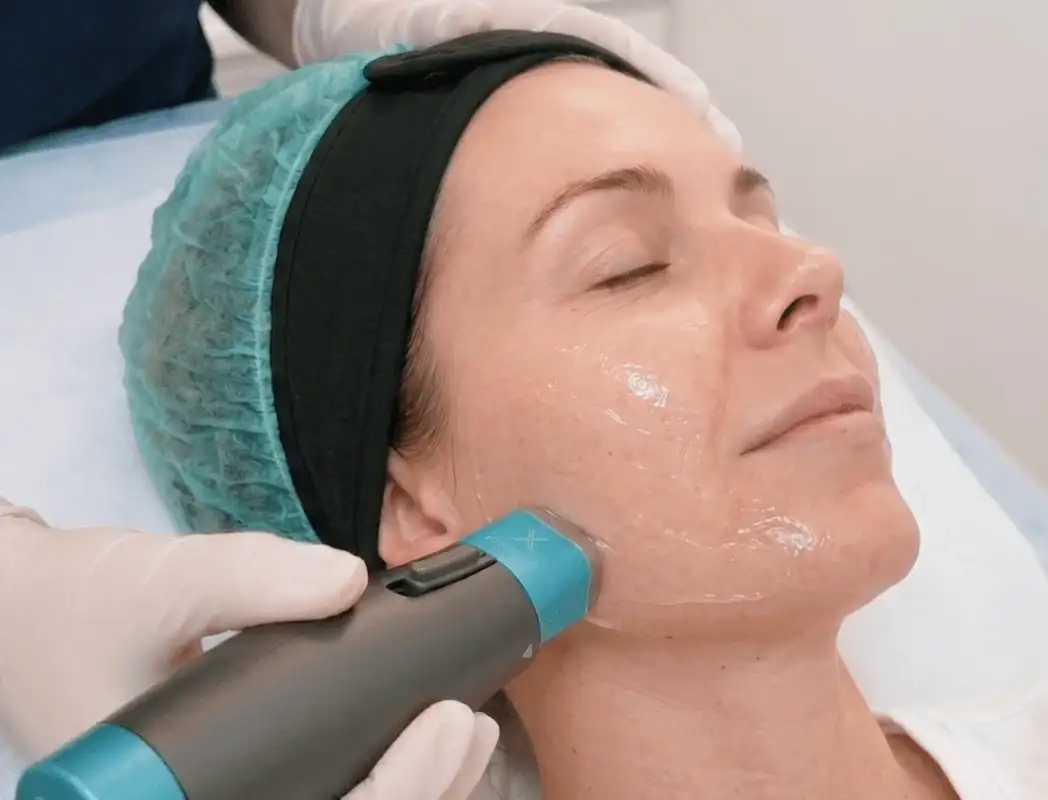
Both devices produce transient redness and mild swelling that settle within a few hours. Serious adverse events are rare in the published literature for either technology. The contraindication lists differ in one important respect, which is metal and electronic implants.
Every session at our clinic begins with a screening conversation covering these points.
Common and Temporary
- Redness: Usually resolves within one to two hours.
- Mild swelling: Settles the same day in most patients.
- Tenderness: Warmth or sensitivity fading within about a day.
- Temporary numbness: Occasionally reported after focused ultrasound.
Why Implants Matter More for RF
Radiofrequency passes current through the body to a return pad, so pacemakers, defibrillators and implanted electronic devices are a firm contraindication.
Focused ultrasound does not conduct current, but metallic implants near the treatment zone still require caution and are assessed individually.
Shared Contraindications
- Active skin infection or open wounds in the treatment area
- Pregnancy and breastfeeding
- Filler or botulinum toxin in the area within the previous two weeks
- Severe laxity where surgery is the appropriate option
- Recent RF or ultrasound treatment within roughly four weeks
⚠️ Important Safety Information
All Oligio X and Ultraformer MPT treatments at Edition Clinic are performed by licensed medical professionals trained on each device. A consultation is conducted before every treatment to confirm suitability. Results may vary depending on skin condition, age and lifestyle.
Why Do We Run Both Platforms at Edition Clinic?
Owning one device forces every patient into that device's strengths. Running both means the recommendation can follow the examination rather than the inventory, which is the only reason a comparison like this one is worth writing.
Here is how that works in practice, and what you can verify yourself before treatment.
Doctor-Led Assessment
Depth, energy and shot count are set by Dr. Mild per patient. We do not apply a fixed protocol across different faces, and the plan is explained before anything is switched on.
Verified Equipment
We use genuine WONTECH and Classys units with manufacturer-supplied tips and cartridges. You are welcome to ask to see the device and the packaging before your session.
Korean-Standard Protocols
We work in partnership with Edition Plastic Surgery in Gangnam, Seoul, and follow the same layering and depth-selection approach used there. Consultations at our Thonglor clinic, near BTS Thong Lo, apply that protocol directly.
Related Energy Treatments
If your concern is acne scarring or pores rather than laxity, RF microneedling is usually the better route, and we compare the options in our Potenza and Morpheus8 guide.
For volume loss alongside laxity, our collagen biostimulator comparison covers the injectable side.
Frequently Asked Questions About Oligio X and Ultraformer MPT
1. Is Oligio X the same as Thermage?
Answer: No, but they belong to the same device class. Both deliver monopolar radiofrequency at 6.78 MHz through a disposable tip with surface cooling. Oligio X is made by WONTECH in Korea; Thermage is a separate American platform. Edition Clinic does not offer Thermage.
2. Which one hurts more, Oligio X or Ultraformer MPT?
Answer: Most patients report Ultraformer MPT as the sharper sensation, because focused ultrasound concentrates energy into small points. Oligio X spreads heat over a wider area with continuous surface cooling, which reads as warmth rather than pinpoint heat. Individual pain thresholds vary considerably.
Topical numbing is applied before either treatment.
3. How long do Oligio X results last?
Answer: Results typically last 6 to 12 months. Collagen remodelling continues for roughly two to three months after the session, so the visible effect keeps improving before it plateaus. Most patients book a maintenance session once or twice a year. Results may vary with age and skin condition.
4. How many sessions do I need?
Answer: Both devices are designed around single-session protocols, which is why published trials assess outcomes after one treatment. Most patients see measurable change from one session of either platform. Your doctor confirms the interval based on how much laxity is present at the review appointment.
5. Can I have Oligio X and Ultraformer MPT on the same day?
Answer: Yes, and that is how we usually run the combination. The two devices heat different depths, so sequencing them in one visit does not stack thermal load in the same tissue. Total chair time runs roughly 90 minutes including numbing and consultation.
6. Is Oligio X safe for darker skin tones?
Answer: Yes. Radiofrequency heats tissue through electrical resistance rather than being absorbed by melanin, so skin tone does not drive the risk profile the way it does with many lasers. The same applies to focused ultrasound. Both suit the full range of Fitzpatrick skin types.
7. Will Oligio X reduce facial fat?
Answer: Monopolar radiofrequency heats the subcutaneous fat layer alongside the dermis, and some patients notice a modest softening of a full lower face. It is not a fat reduction treatment, and we do not position it as one. Tightening is the reliable outcome; volume change is incidental.
8. How soon will I see results?
Answer: Some tightening appears immediately from collagen contraction, but the meaningful change develops over 8 to 12 weeks as new collagen forms. This timeline is similar for both devices. We schedule the review at around 12 weeks because assessing earlier gives you very little to look at.
9. Can I have these treatments after filler or Botox?
Answer: Yes, with timing adjustments. We generally wait two weeks after toxin or filler before applying either device, because heat in the treated area can affect product placement and longevity. Tell your doctor exactly what you had and when, including treatments done elsewhere.
10. Is Oligio X FDA-cleared?
Answer: Oligio X received US FDA 510(k) clearance under K243929 on 21 January 2025. The cleared indication covers non-invasive electrocoagulation and haemostasis of soft tissue in dermatologic and general surgical procedures, which is the standard classification for this device category rather than a cosmetic lifting claim.
Firmer Skin, Sharper Contours — Assessed Properly First
Book a free consultation at Edition Clinic Bangkok and find out whether Oligio X, Ultraformer MPT, or both is the right plan for your skin.