

Filler vs Botox: Which Do You Need?

Table of ContentsShow / Hide
Written & Medically Reviewed by

- Medical Doctor, Chulalongkorn University — Second Class Honors
- Dermatology (International Program) 2024–2025, Chulabhorn International College of Medicine, Thammasat University
- 3 Years Experience in Aesthetic Medicine
Quick Answer
Filler vs Botox: both are non-surgical injections, but Botox relaxes muscles behind expression lines, while filler adds volume to hollows and folds at rest.
Botox shows in 3 to 7 days and lasts about 3 to 6 months; filler shows immediately, and many people use both.
Deciding on filler vs Botox comes down to whether a line appears only when you move or stays visible at rest. Expression lines usually suit Botox, while lines at rest and hollows from lost volume usually suit filler.
At Edition Clinic, the doctor checks your facial muscles and volume at the free consultation. Dr. Mild may then suggest Botox, filler or both, so the Botox vs filler choice fits your own face.
What Is the Difference Between Botox and Filler?
Botox and filler are non-surgical injections that work in opposite ways. Botox relaxes muscles behind frown lines and crow's feet, while filler is a gel that adds volume to cheeks and lips. Rare risks differ, from eyelid droop with Botox to a blocked blood vessel with filler, and many people use both.
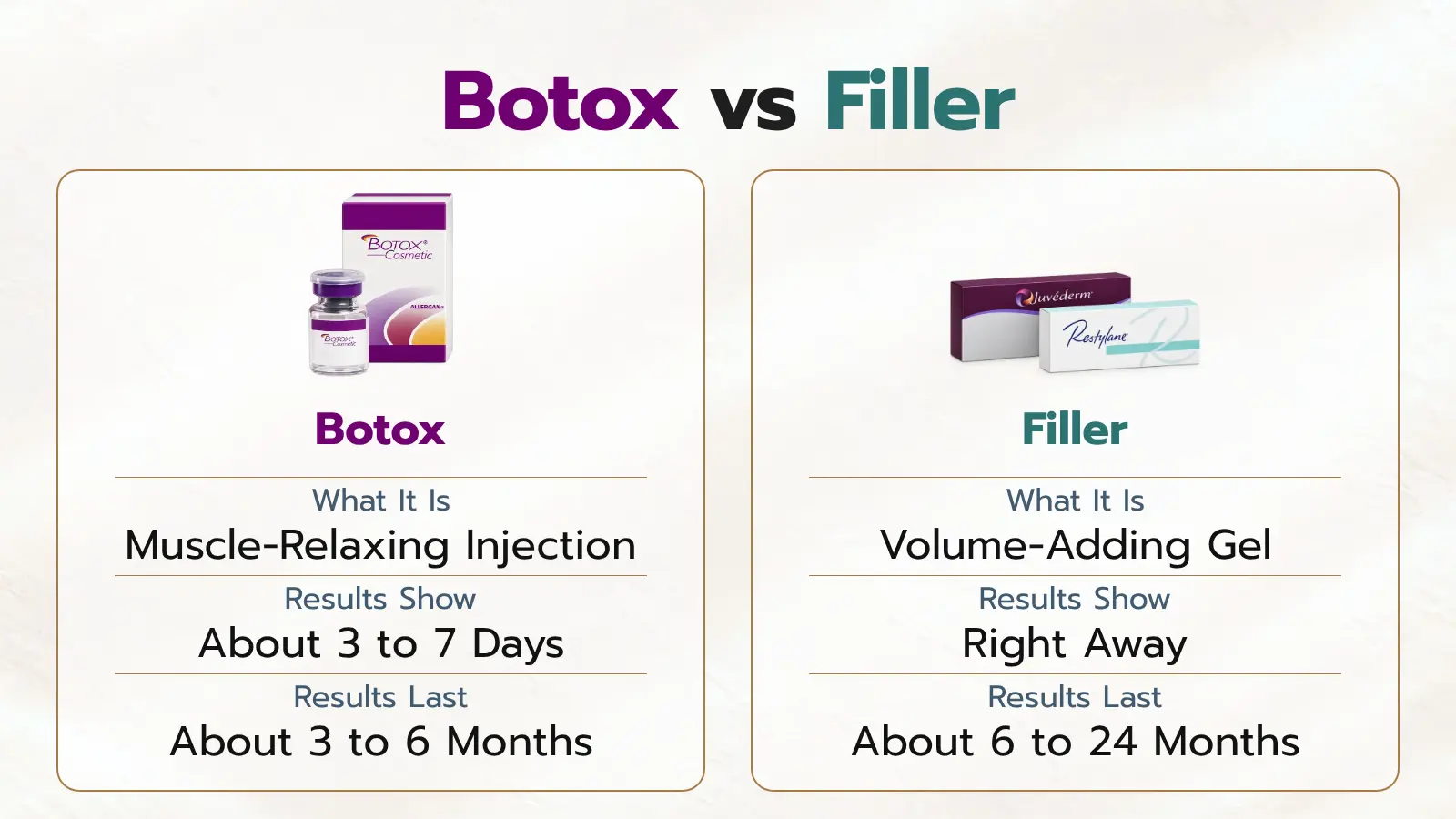
Neither injection replaces the other. A line that deepens when you frown needs a different fix from a hollow that is there all day, so naming your main concern is the first step.
Botox and Filler Side by Side
The side-by-side view shows that the two injections differ in what they are, how they work and when results appear. The biggest practical difference is timing: filler changes the shape at once, while Botox softens movement over several days. Starting prices are included so you can compare cost as well.
| Feature | Botox | Filler |
|---|---|---|
| What it is | A muscle-relaxing injection | A volume-adding gel, mostly hyaluronic acid |
| How it works | Blocks the nerve signal that makes a muscle contract | Fills space under the skin to restore volume and contour |
| Usually chosen for | Lines that appear when you move, such as frown lines and crow's feet | Hollows, folds and lines visible at rest, plus lips, cheeks and chin |
| When results show | About 3 to 7 days | Right away |
| How long results last (clinic guidance) | About 3 to 6 months | About 6 to 24 months, by area |
| Downtime | None; daily activities right away | Minimal; some swelling or bruising |
| Can it be reversed | No; it wears off as nerve signals recover | Yes; hyaluronic acid filler can be dissolved |
| Starting price | From 4,900 THB (Nabota 50 units) | From 4,990 THB per 1 ml (Neuramis) |
Each injection answers a different problem, so the table helps you match a treatment to your concern rather than rank them. Note the reversal row too: filler at Edition Clinic can be dissolved by the doctor, while Botox simply wears off.
Pros and Limitations of Botox and Filler
Botox and filler each have clear strengths and clear limits, because they fix different problems. Neither one does the other's job: Botox cannot add volume, and filler cannot stop a muscle from creasing the skin. Knowing these limits helps you ask the doctor the right questions.
What Botox does well, and where it stops:
- Quick visit: about 10 to 30 minutes in the chair, including consultation, cleansing and marking, and injections.
- No downtime: you can go back to your daily activities right away.
- Natural expression: conservative dosing softens lines while your face still moves.
- No added volume: Botox does not fill hollows or fix deep folds.
- Wears off: results fade within months, so repeat visits are needed.
What filler does well, and where it stops:
- Visible right away: added volume shows as soon as the injections are done.
- Volume and contour: filler restores fullness to hollows, cheeks, lips and the chin.
- Can be dissolved: the fillers used at Edition Clinic can be dissolved by the doctor if needed.
- Longer visit: about 45 to 75 minutes in the chair, including consultation and design, numbing cream and injections.
- More swelling: swelling or bruising is more common than after Botox, and it usually settles.
- Rare vessel risk: filler can very rarely block a blood vessel.
- Moving lines stay: filler does not relax the muscles that crease the skin.
How Botox and Filler Prices Compare
Botox starts at 4,900 THB for 50 units and filler at 4,990 THB per 1 ml, but each is priced in a different unit. Toxin prices depend on the brand and the number of units, while filler prices depend on the brand and the amount used. The doctor confirms the dose or amount at the consultation.
| Treatment | Brand and amount | Price |
|---|---|---|
| Botox | Nabota 50 units | 4,900 THB |
| Botox | Nabota 100 units | 8,990 THB |
| Botox | Xeomin 50 units | 8,900 THB |
| Botox | Xeomin 100 units | 15,900 THB |
| Botox | Allergan 50 units | 13,000 THB |
| Botox | Allergan 100 units | 20,000 THB |
| Filler | Juvederm (per 1 ml) | 18,900 THB |
| Filler | Belotero (per 1 ml) | 15,900 THB |
| Filler | Restylane (per 1 ml) | 15,900 THB |
| Filler | Neuramis (per 1 ml) | 4,990 THB |
Compare Botox rows within one brand, because a higher price can reflect a different brand rather than more units. Each filler row is the price of 1 ml, so your total depends on the amount confirmed at the consultation.
The Botox price covers the full stated number of units of the brand you choose, with the product opened in front of you.
The filler price covers 1 ml of the brand you choose and the doctor consultation, with the syringe opened from sealed packaging in front of you.
Full unit options are on the Botox in Bangkok page, and every filler brand is listed on the dermal filler in Bangkok page.
What Is Botox?
Botox is an injection made from botulinum toxin, a purified protein that relaxes the muscle it is placed in. The injection temporarily blocks nerve signals to the muscle, stopping the release of acetylcholine, the chemical messenger that tells muscles to contract. With less movement, dynamic lines such as frown lines, forehead lines and crow's feet soften, and the effect wears off as nerve signals recover.

Botox does not add volume, so it cannot fill hollows or soften deep folds that stay when your face is still.
Several toxin brands exist, and their formulas differ, which matters when you compare doses.
How Botox Relaxes Facial Muscles
Botox relaxes facial muscles by blocking the signal that makes them contract, so the skin above them creases less. Conservative dosing keeps your natural expression, softening lines rather than freezing your face. The doctor chooses which muscles to treat and how much product each one needs.
The American Academy of Dermatology explains in its patient guidance that botulinum toxin temporarily relaxes the targeted muscles, so fine lines and wrinkles diminish.
A US Food and Drug Administration consumer update makes the same point from the other side: toxin injections are not dermal fillers but injectable drugs that keep muscles from tightening, so wrinkles show less.
Because the muscle is only relaxed, you can still raise your brows and smile. The aim is softer lines, not a blank look.
Botox Brands at Edition Clinic
Edition Clinic uses three Botox brands: Allergan, Xeomin and Nabota, each opened in front of you. Your doctor recommends a brand for your area and goals at the consultation, with no brand ranked above the others. You can ask to see the brand name, lot number and expiry date before the injection.
The FDA prescribing information for Botox Cosmetic states that its units cannot be compared to or converted into the units of any other botulinum toxin.
A 2024 review in the journal Toxins reached the same view: units of different toxin products cannot be swapped or converted, so each product needs its own dose.
A unit count therefore only compares within one brand. You can read more in the Allergan Botox guide, the Xeomin guide and the Nabota guide.
What Is Dermal Filler?
Dermal filler is a gel injected under the skin to restore volume and shape contours such as the cheeks and lips. Most fillers are made of hyaluronic acid (HA), a natural sugar molecule that breaks down gradually and can be dissolved if needed. Other filler materials are not dissolved the same way, and permanent ones are not absorbed by the body. Like any injection, filler also carries rare risks.

The FDA consumer update on dermal fillers notes that most approved fillers are temporary, because the body eventually breaks down and absorbs the materials they are made from.
That is why filler results fade gradually, and why your doctor reviews any earlier filler before adding more.
What Fillers Are Made Of
Most cosmetic fillers are hyaluronic acid, a sugar molecule found naturally in the skin that binds water. All dermal fillers at Edition Clinic are hyaluronic acid brands: Juvederm, Belotero, Restylane and Neuramis. Your doctor chooses the brand to match the area being treated and the look you want.
Less common filler materials include:
- CaHA, or calcium hydroxylapatite: a mineral that is a major component of bone.
- PLLA, or poly-L-lactic acid: a synthetic material that the body slowly breaks down.
- PMMA, or polymethylmethacrylate: tiny plastic beads used in long-lasting fillers.
- Fat: your own fat, taken from another part of the body and injected.
Most of these materials cannot be dissolved the way hyaluronic acid can, so they are harder to correct if you change your mind.
Sculptra, a collagen-stimulating injectable, builds results gradually over months instead of adding volume at once. The Sculptra vs filler comparison explains how the two approaches differ.
Can Filler Be Dissolved?
Hyaluronic acid filler can be dissolved with hyaluronidase, an enzyme that breaks the gel down, if the result needs correcting. At Edition Clinic, the doctor can dissolve hyaluronic acid filler if it is ever medically necessary. Botox cannot be dissolved, so its effect wears off as nerve signals recover.
The FDA page on dermal fillers warns that filler material may be difficult or impossible to remove, especially permanent fillers or those not made of hyaluronic acid.
Knowing which filler you already have matters before any new treatment, so bring any records of past injections to your consultation.
Botox or Filler: Which One Do You Need?
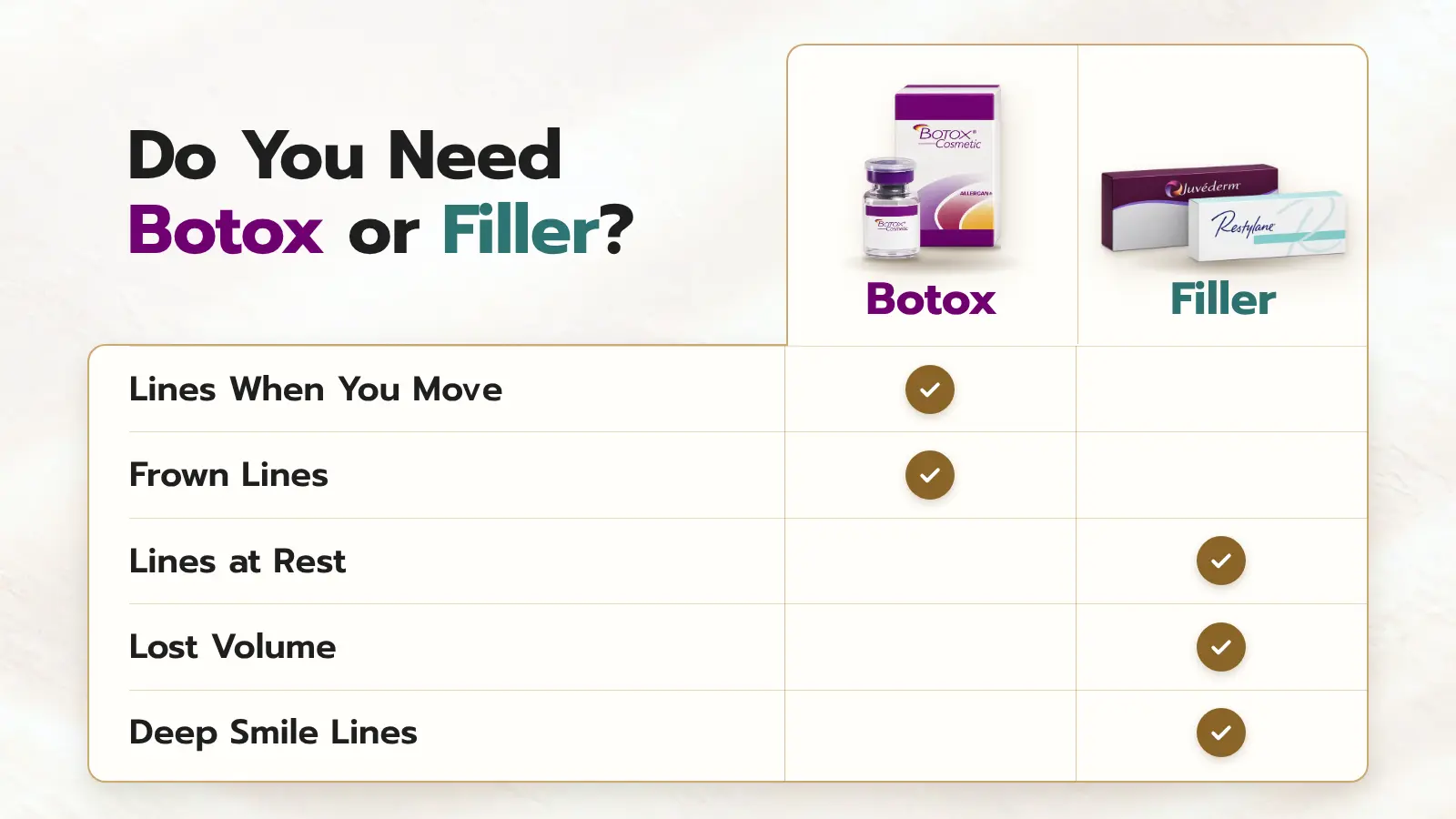
Botox suits lines that appear when you move, while filler suits lost volume and lines that stay at rest. Many people need both, one for each concern. Dr. Mild checks how your face looks and moves first, as filler also carries a rare blood-vessel risk.
Choose Botox for Lines That Appear When You Move
Lines that appear only when you frown, squint or raise your brows usually suit Botox. A frown line between the brows is a typical example, because the crease comes from a muscle pulling on the skin. Softening that pull makes the line look smoother.
A quick mirror test helps. Relax your face, then frown: if the line fades when you relax, Botox is usually the option your doctor discusses first.
Choose Filler for Volume Loss and Lines at Rest
Lines and hollows that stay visible when your face is completely still usually suit filler. These creases often come from lost volume rather than movement, so gel placed under the skin softens the fold or fills the hollow. A deep smile line is a typical example.
Filler can also shape the lips or chin, where the goal is contour rather than smoothing a line.
Botox or Filler for Each Face Area
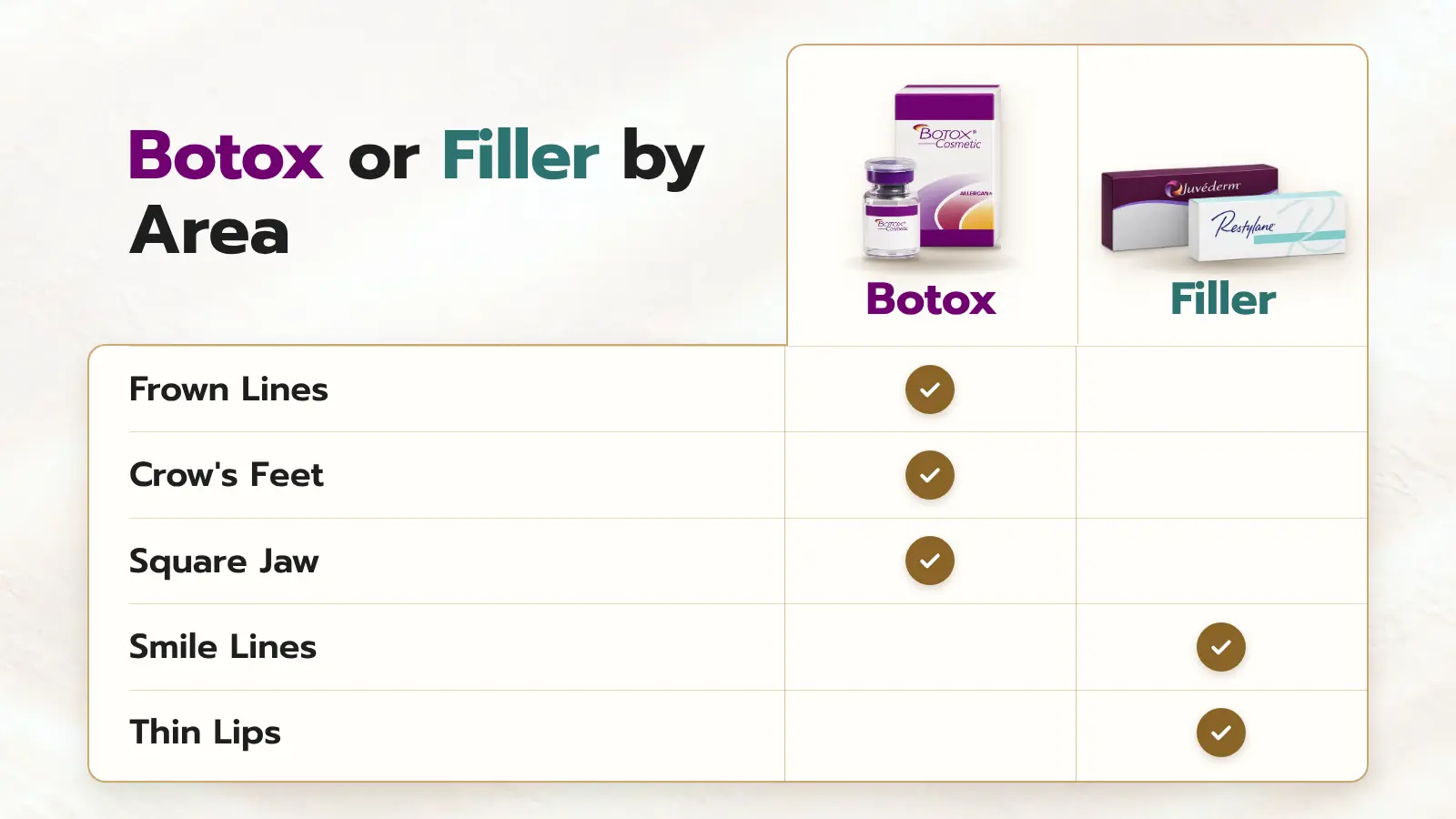
The upper face usually suits Botox, while the lips, chin and folds around the mouth usually suit filler. Each area is judged on its own. One face can need Botox in one place and filler in another, and the doctor explains each choice at the consultation.
Forehead and Frown Lines
Forehead lines and frown lines between the brows usually suit Botox, because both appear when the muscles above the eyes move. Botox is usually the first choice for this part of the face. Less movement means the skin folds less often, and the lines look smoother.
The doctor will not inject filler into the forehead or the nose bridge at Edition Clinic, because the blood-vessel risk is high and the benefit is limited.
Deep lines etched at rest are assessed case by case, and the Botox for wrinkles guide covers this area in more detail.
Crow's Feet and Under-Eye Hollows
Under-eye hollows and crow's feet sit close together but usually need different treatments. Crow's feet usually suit Botox, because they deepen when you smile or squint. Hollows under the eyes come from lost volume, so filler is the option for them when the skin allows it.
Tear troughs, the hollows between the lower eyelid and the cheek, sit under very thin skin. Filler is not a good choice where the skin is too thin, so your doctor checks skin thickness first.
Smile Lines and Marionette Lines
Smile lines beside the nose and marionette lines, the creases running down from the mouth corners, usually suit filler when they show at rest. Filler is usually the main option here, because it restores lost volume and softens the fold. Botox may support it by relaxing the muscle that pulls the mouth corners down.
Your doctor decides at the consultation whether this extra step suits your face.
Lip Filler vs Botox Lip Flip
Lip filler and a Botox lip flip change the lips in different ways, so the choice depends on your goal. Lip filler adds real volume and shape, which makes it the usual option for thin or uneven lips. A lip flip adds no volume at all.
When people compare lip filler vs Botox, the real question is volume versus a subtle change in lip shape.
A lip flip, a small dose of Botox in the muscle around the mouth, relaxes the upper lip so it rolls outward slightly. Your doctor advises whether it suits you.
Lip filler options are on the lip filler in Bangkok page.
Jawline and Chin: Filler vs Masseter Botox
Jawline and chin concerns fall into two types: a lack of structure, or a wide, square jaw. Filler adds structure and projection to a soft jawline or a small chin. Botox in the masseter, the large chewing muscle at the angle of the jaw, can slim a square lower face.
Masseter slimming is an off-label use, meaning it is not a use listed on the product label. Dr. Mild sets a dose for your face after checking how strongly you clench.
The masseter Botox guide explains jaw slimming step by step.
How Long Do Botox and Filler Last?
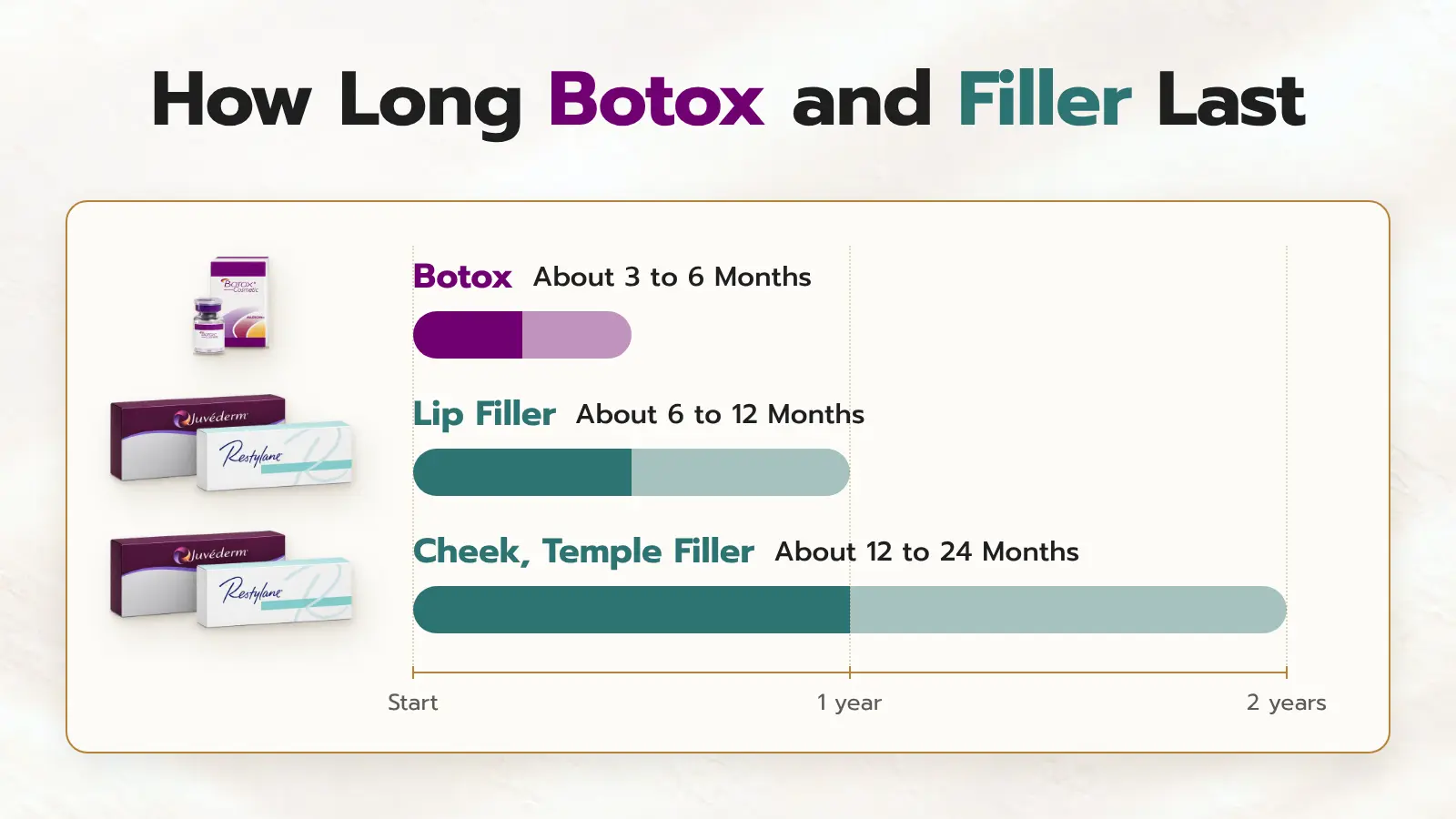
Botox usually lasts about 3 to 6 months, and filler lasts about 6 to 24 months depending on the area. The product, the dose, your muscle strength and your metabolism also change how long results last. Both ranges are Edition Clinic guidance, not study results.
When You See Results
Filler results show as soon as the injections are finished, while Botox results build over several days. Botox usually starts to show in about 3 to 7 days and peaks at about 2 weeks, according to Edition Clinic guidance.
The FDA prescribing information for Botox Cosmetic states that muscle relaxation begins 1 to 2 days after injection and strengthens during the first week.
A small open-label study of 45 women treated for frown lines for the first time, in the Journal of Drugs in Dermatology (2011), found that 48% noticed an effect on day 1 and 98% by day 4.
The final filler shape is easier to judge once swelling settles, usually within 1 to 2 weeks. A follow-up visit can review the result and adjust it if needed.
How Long Results Last by Area
Filler usually lasts longer in the cheeks and under the eyes than in the lips, according to Edition Clinic guidance. The product, the area and your metabolism all change how long filler lasts, so two people can see different results.
| Area | Usual duration (clinic guidance) |
|---|---|
| Botox in the treated area | About 3 to 6 months |
| Lip filler | About 6 to 12 months |
| Under-eye filler | About 12 to 18 months |
| Cheek or temple filler | About 12 to 24 months |
Lip filler fades sooner than filler in deeper areas, and Botox needs topping up more often than any filler.
Repeat Botox is usually planned every 3 to 6 months, with at least three months between sessions. Your doctor times the next session at review, based on how your lines return.
Four pooled phase 3 trials of Botox Cosmetic for frown lines, covering 621 people and reported in Dermatologic Surgery (2012), found 84.2% responded at day 30; among those, the effect lasted a median of 120 days when frowning.
According to the FDA prescribing information, the effect of Botox Cosmetic on frown lines lasts approximately 3 to 4 months.
Edition Clinic's wider guide of about 3 to 6 months reflects differences between areas, products and muscles.
Some dermal fillers are naturally absorbed over time, so the FDA notes that patients may need to repeat treatment to keep the effect.
Side Effects and Safety
Botox and filler are generally safe when a medical doctor injects genuine products, and most side effects are mild, such as redness, swelling or bruising. The serious risks differ: Botox can rarely cause unwanted muscle weakness or spread, while filler can rarely block a blood vessel.
Common Side Effects of Botox and Filler
Common side effects after Botox are mild redness, swelling, tenderness, small bruises or a mild headache, according to Edition Clinic guidance. After filler, swelling, tenderness and bruising are more common, and they usually settle within a few days.
The American Academy of Dermatology notes that bruising after botulinum toxin happens occasionally and, when it does, lasts about 1 week.
In a 2021 meta-analysis in Aesthetic Plastic Surgery of smile-line filler trials, the pooled share of patients reporting any adverse event was 0.58, mostly temporary injection-site reactions, though results varied widely between the pooled studies.
I keep filler conservative and never overfill, because a result that still looks like you matters more to me than adding volume quickly.
Rare Risks to Know About
Rare risks differ between Botox and filler, so each has its own warning signs. Botox can cause a temporary drooping eyelid or brow, so contact the clinic if one feels heavy. Filler can rarely cause vascular occlusion, a blocked blood vessel, or lumps and infection.
In pooled frown-line trials in the FDA prescribing information, a drooping eyelid, known as ptosis, affected 13 of 405 people given Botox Cosmetic (3%), against 0 of 130 on placebo (0%).
According to the FDA Medication Guide for Botox Cosmetic, signs of toxin spread such as trouble swallowing, speaking or breathing, or general muscle weakness can appear hours, days or weeks after injection and need medical help right away.
The FDA calls accidental injection into a blood vessel the most concerning filler risk; the chance is low, but complications can be serious and may be permanent.
Unusual pain, vision changes, or skin turning white, gray or blue near the injection site need immediate medical care, the FDA advises.
Recovery Time After Botox and Filler
Recovery after Botox and filler is quick: Botox has no downtime and filler has minimal downtime. When people compare filler vs Botox recovery time, the real difference is the aftercare rules. Either way, you can return to daily activities right away.
Aftercare differs for each injection:
- Botox, first 4 hours: avoid lying down.
- Botox, first 24 hours: skip strenuous exercise, sauna and facial massage.
- Filler, first 24 to 48 hours: avoid touching the area, alcohol and intense exercise.
The Botox aftercare guide covers the first day in detail, and the guide to flying after Botox or filler helps you plan travel.
Tell the doctor first if any of these apply to you:
- Pregnancy or breastfeeding
- A botulinum toxin allergy or an infection at the injection site
- A nerve or muscle condition
- Blood thinners, or Botox in the past 4 months
Your doctor checks whether treatment suits you before injecting. Do not stop prescribed medicines without medical advice.
Can You Get Botox and Filler Together?
Botox and filler can be combined in one treatment plan because they treat different concerns. Botox often comes first, and some doctors use one visit while others space the injections out. At Edition Clinic, the doctor plans the order and timing.
A common plan uses Botox for upper-face expression lines and filler for lower-face volume.
The FDA consumer update on dermal fillers states that the safe use of fillers combined with Botox and other treatments has not been evaluated in clinical studies.
When I look at a line, my first question is whether it shows only when you move or stays when your face is at rest. That usually tells me whether Botox, filler or both will help.
Botox or Filler First?
The order of Botox and filler depends on your main concern and the plan made for your face. Starting with Botox is common for expression lines or for first-time patients. At Edition Clinic, Dr. Mild decides which comes first and when.
Ask at the consultation how your own plan is set out.
Why Choose Edition Clinic for Botox and Filler in Bangkok?
Edition Clinic offers Botox and filler planned and injected by one doctor, with each product opened in front of you. All premium procedures at Edition Clinic are performed by a medical doctor. The clinic is the official Bangkok branch of Edition Plastic Surgery, Seoul.
Consultation in English, Thai or Korean
Dr. Mild consults directly in English and Thai, so you can ask about your lines, the products and the price in your own words. The consultation is free, with no obligation to book treatment afterwards.
If you prefer Korean, Korean-speaking staff help with booking and interpret while you talk with the doctor. Mention your language when you book through LINE or WhatsApp.
Getting Here and Booking
Edition Clinic is on the 4th floor of Marche 150 Thong Lo near BTS Thong Lo, open daily from 11:00 to 20:00, with booking by LINE or WhatsApp.
- 📍 Address
- Room A408, 4th Floor, Marche 150 Thong Lo, Khlong Tan Nuea, Watthana, Bangkok 10110
- 🚆 Nearest BTS
- BTS Thong Lo
- 🕐 Opening hours
- Every day, 11:00–20:00
- 📞 Phone
- +66 92-255-8952
- 💬 How to book
- LINE @editionclinic or WhatsApp — free consultation
Clinic-wide patient count: 6,717 unique patients treated from 7 August 2023 to 1 October 2026, excluding repeat visits. This is not a treatment-specific count.
Botox and Filler in Bangkok: Summary
- Main difference: Botox and Filler work in opposite ways: Botox relaxes the muscles behind lines, while filler restores lost volume.
- Who it suits: Botox and Filler suit different lines: Botox for lines that appear when you move, filler for hollows and lines at rest.
- When it is not: Botox and Filler have limits, and the doctor will not inject filler into the forehead or nose bridge.
- Results: Botox and Filler differ in timing, since filler shows right away while Botox builds over several days.
- Next step: Book a free consultation so Dr. Mild can check whether Botox and Filler, alone or together, suit your face.
Frequently Asked Questions About Botox and Filler
1. Which is more painful, Botox or filler?
Answer: Both are usually well tolerated, and each is made comfortable in its own way. Botox uses very fine needles, so most people feel a tiny pinch that lasts seconds, with numbing cream or ice on request. Filler gets numbing cream for 20 to 30 minutes, plus lidocaine, a local anaesthetic in the gel, and some pressure is normal.
2. Is Botox or filler worth it?
Answer: It depends on whether your concern matches what each injection does, and on your budget for upkeep. Botox suits moving lines and needs regular repeat visits to keep the result. Filler suits lost volume and lasts about 6 to 24 months by area. Neither one replaces the other, so matching each to the right concern matters most.
3. Is 40 too late for Botox or filler?
Answer: No, 40 is not too late, because Edition Clinic sets no upper age limit for Botox or filler. The doctor assesses your skin, muscle movement and volume, not your age. You then hear which option fits your face, and what each one can and cannot do.
4. Is it safe to keep getting filler for years?
Answer: It depends on how carefully each new treatment is planned. Repeat filler is common because hyaluronic acid filler breaks down gradually. Your doctor reviews any previous filler before adding more, so the total amount stays conservative over the years.
The FDA notes that repeated long-term filler use has not been evaluated in a controlled clinical study, and that side effects such as migration, filler moving from the injection site, may appear weeks, months or years later.
5. What happens when you stop Botox or filler?
Answer: When you stop, Botox and filler both fade gradually, and the area returns toward how it looked before. Muscle movement comes back slowly as Botox wears off, so lines return to how they were, not worse. Filler gel slowly breaks down, so lost volume shows again over time.
References
- American Academy of Dermatology. Botulinum toxin therapy: FAQs. AAD. 2026. aad.org
- US Food and Drug Administration. Dermal Filler Do's and Don'ts for Wrinkles, Lips and More. FDA. 2023. fda.gov
- Allergan (AbbVie). BOTOX Cosmetic prescribing information and Medication Guide. DailyMed. 2024. DailyMed
- Brin MF, et al. Update on Non-Interchangeability of Botulinum Neurotoxin Products. Toxins (Basel). 2024. PMID 38922160
- US Food and Drug Administration. Dermal Fillers (Soft Tissue Fillers). FDA. 2023. fda.gov
- Beer KR, et al. Rapid onset of response and patient-reported outcomes after onabotulinumtoxinA treatment of moderate-to-severe glabellar lines. J Drugs Dermatol. 2011. PMID 21197522
- Glogau R, et al. OnabotulinumtoxinA: a meta-analysis of duration of effect in the treatment of glabellar lines. Dermatol Surg. 2012. PMID 23106853
- Stefura T, et al. Tissue Fillers for the Nasolabial Fold Area: A Systematic Review and Meta-Analysis of Randomized Clinical Trials. Aesthetic Plast Surg. 2021. PMID 34255156
Ready to Find Out Which One You Need?
Book a free 1:1 consultation at Edition Clinic Bangkok to see whether Botox, filler or both suit you.
